10Prefix sumArrays and hashing
Prefix sum
Many "sum from left to right" questions on an array that never changes: build once, answer each with one subtraction.

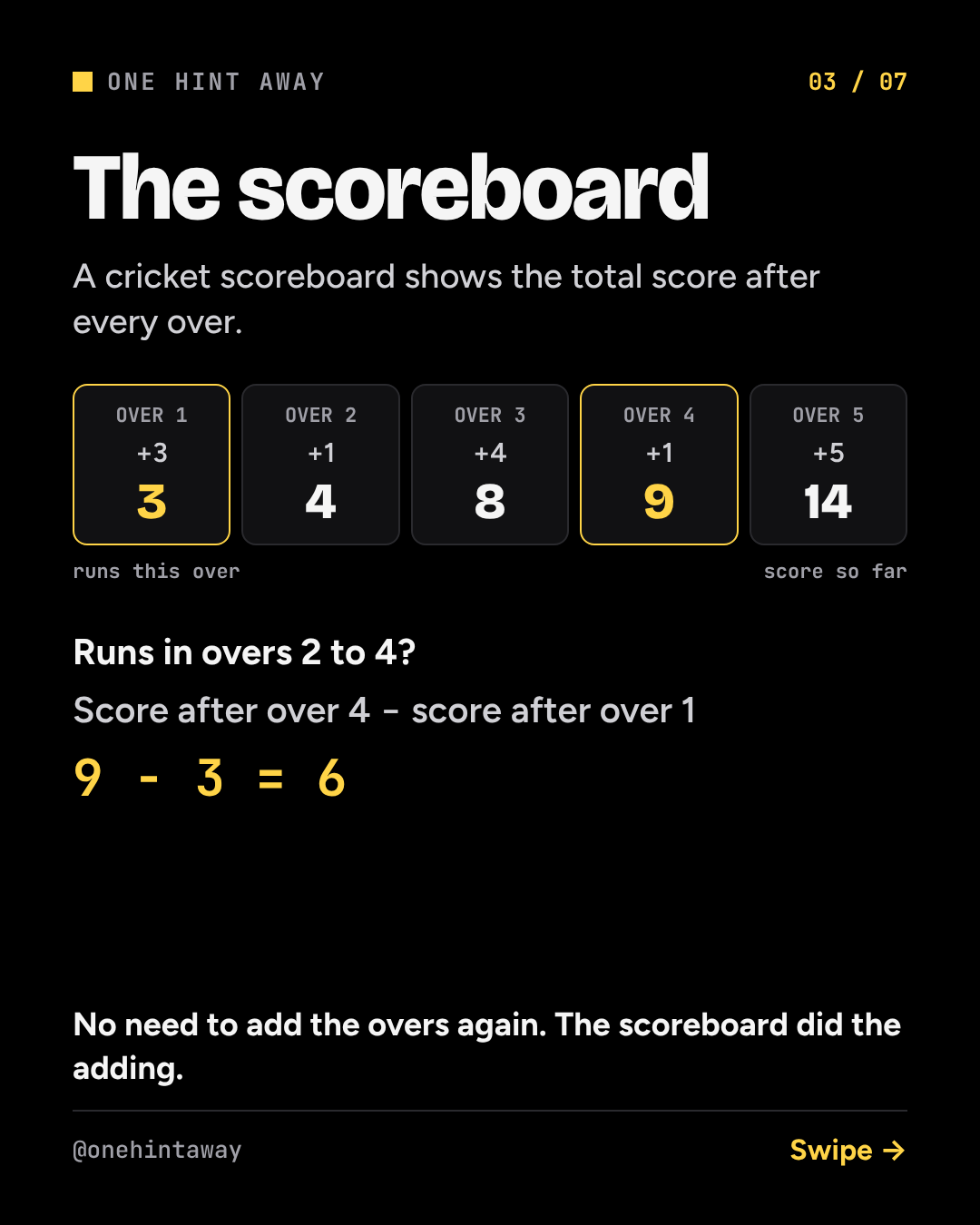
One Hint Away (@onehintaway). Clue: many questions that ask "what is the sum from index left to right?" on an array that never changes.
Worked example: range sum query. Build the prefix array once, then answer every query with one subtraction. This is exactly LeetCode 303, Range Sum Query - Immutable (Easy).
The idea
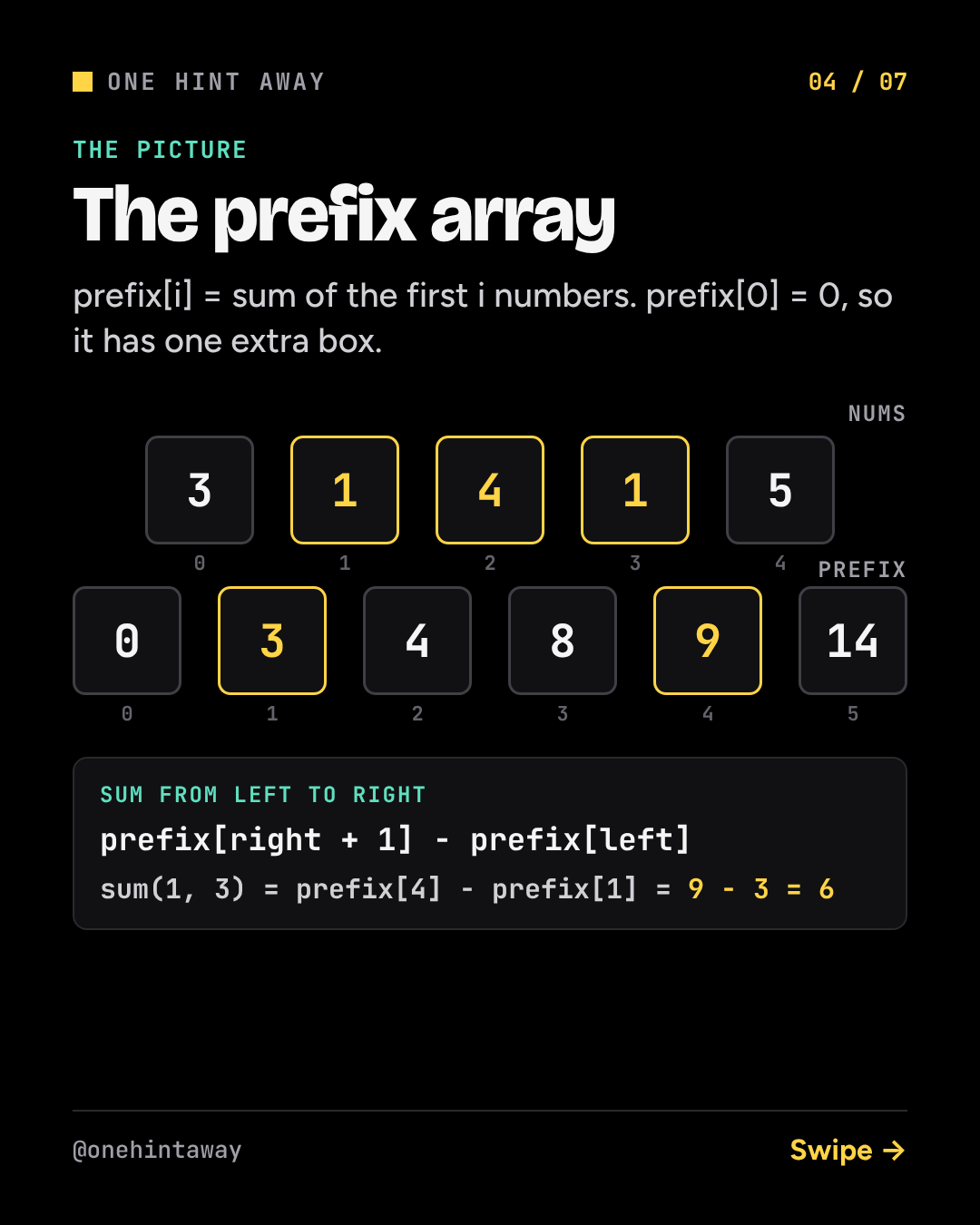
prefix[i] is the sum of the first i numbers, so prefix[0] = 0. The sum from left to right (both included) is everything up to right, minus everything before left:
sum(left, right) = prefix[right + 1] - prefix[left]
The walk
nums = [3, 1, 4, 1, 5]
| i | nums[i] | prefix[i + 1] = prefix[i] + nums[i] |
|---|---|---|
| 0 | 3 | 0 + 3 = 3 |
| 1 | 1 | 3 + 1 = 4 |
| 2 | 4 | 4 + 4 = 8 |
| 3 | 1 | 8 + 1 = 9 |
| 4 | 5 | 9 + 5 = 14 |
prefix = [0, 3, 4, 8, 9, 14]. Query sum(1, 3) = prefix[4] - prefix[1] = 9 - 3 = 6 (1 + 4 + 1).
Pseudocode
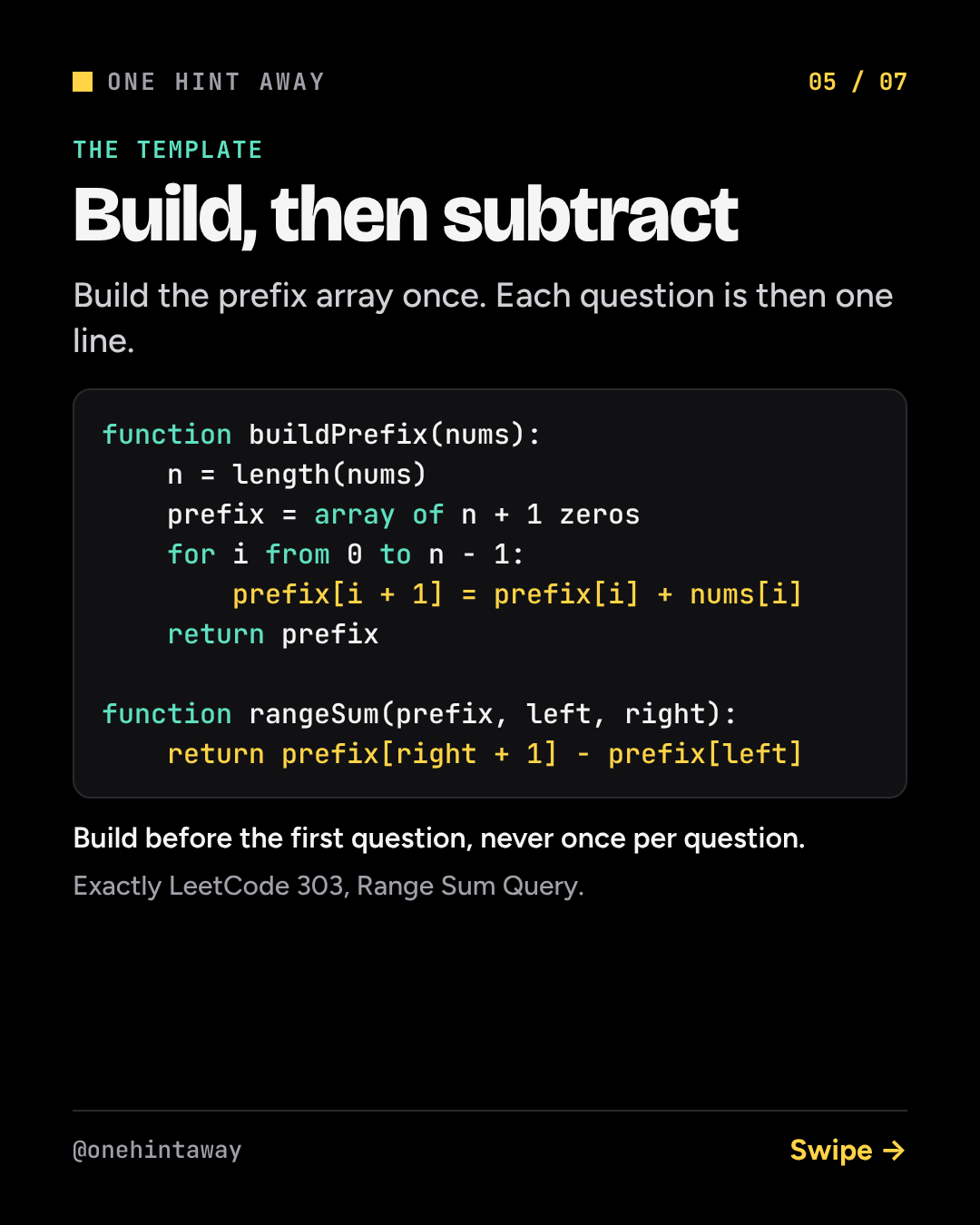
function buildPrefix(nums):
    n = length(nums)
    prefix = array of n + 1 zeros
    for i from 0 to n - 1:
        prefix[i + 1] = prefix[i] + nums[i]
    return prefix

function rangeSum(prefix, left, right):
    return prefix[right + 1] - prefix[left]
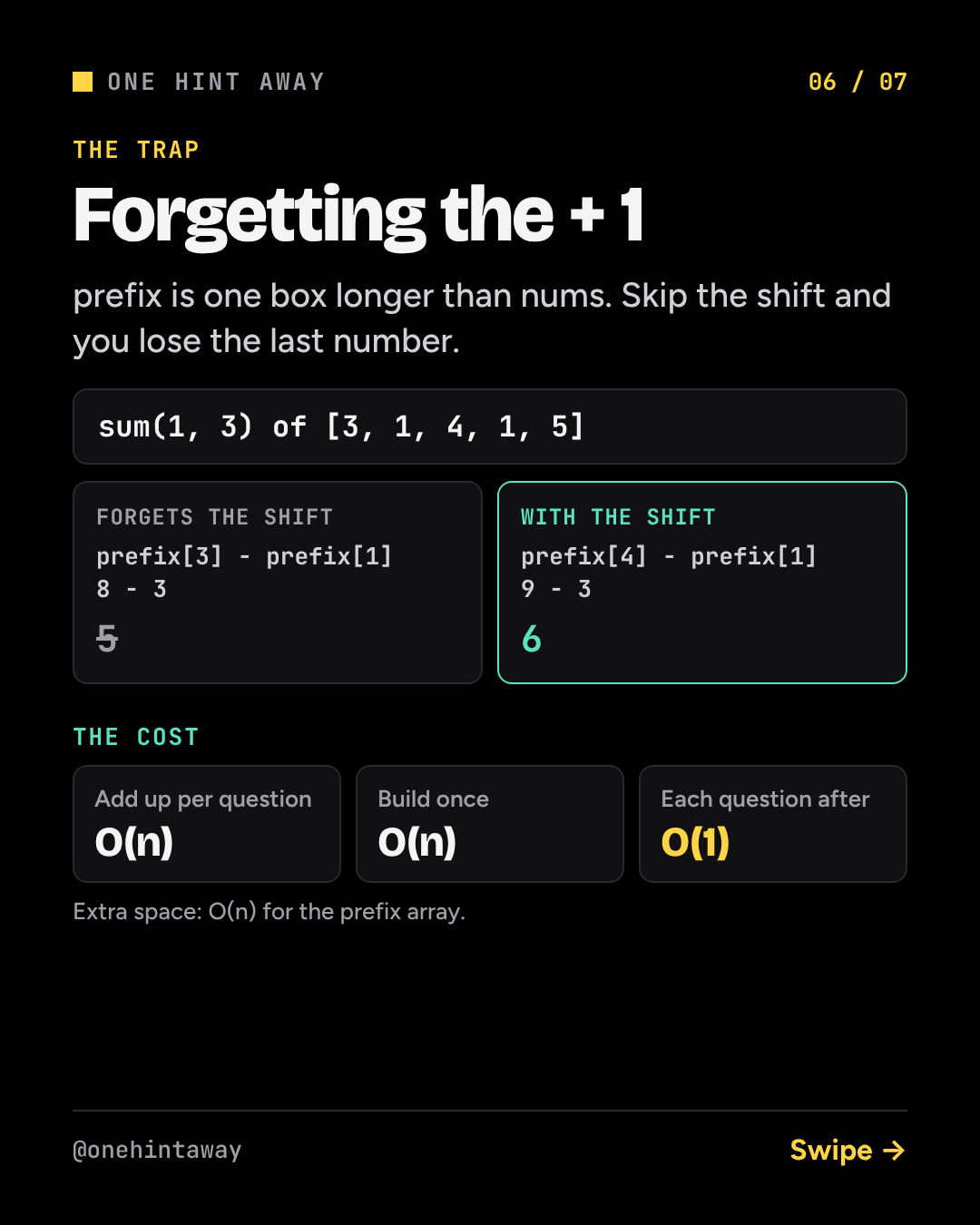
The trap: forgetting the shift. prefix[right] - prefix[left] on the example gives 8 - 3 = 5, which drops nums[3]. Use prefix[right + 1].
Code
class Prefix {
    // build: O(n) time, O(n) space
    static long[] buildPrefix(int[] nums) {
        int n = nums.length;
        long[] prefix = new long[n + 1];
        for (int i = 0; i < n; i++) {
            prefix[i + 1] = prefix[i] + nums[i];
        }
        return prefix;
    }

    // query: O(1)
    static long rangeSum(long[] prefix, int left, int right) {
        return prefix[right + 1] - prefix[left];
    }
}
# build: O(n) time, O(n) space
def build_prefix(nums):
n = len(nums)
prefix = [0] * (n + 1)
for i in range(n):
prefix[i + 1] = prefix[i] + nums[i]
return prefix
# query: O(1)
def range_sum(prefix, left, right):
return prefix[right + 1] - prefix[left]#include <vector>
using namespace std;
// build: O(n) time, O(n) space
vector<long long> buildPrefix(const vector<int>& nums) {
int n = nums.size();
vector<long long> prefix(n + 1, 0);
for (int i = 0; i < n; i++) {
prefix[i + 1] = prefix[i] + nums[i];
}
return prefix;
}
// query: O(1)
long long rangeSum(const vector<long long>& prefix, int left, int right) {
return prefix[right + 1] - prefix[left];
}// build: O(n) time, O(n) space
function buildPrefix(nums) {
const n = nums.length;
const prefix = new Array(n + 1).fill(0);
for (let i = 0; i < n; i++) {
prefix[i + 1] = prefix[i] + nums[i];
}
return prefix;
}
// query: O(1)
function rangeSum(prefix, left, right) {
return prefix[right + 1] - prefix[left];
}Complexity
| Version | Build | Each query | Extra space |
|---|---|---|---|
| Add the numbers up per query | none | O(n) | O(1) |
| Prefix array | O(n) | O(1) | O(n) |
With q queries that is O(n · q) against O(n + q). Build before the first question, never once per question.
How it was tested
All four languages answer sum(1, 3) = 6 on the example. They were run on 3,001 inputs (3,000 random arrays of length 1 to 12 with values up to ±100,000, each with 1 to 5 random queries, plus the example) and every answer matched adding the numbers up directly.
Practice
Try these in order. Open the worked example first if you got stuck on the slides.
- LeetCode 303 Range Sum Query - Immutableworked example
The same running idea with products, once from the left and once from the right.