11Prefix sumArrays and hashing
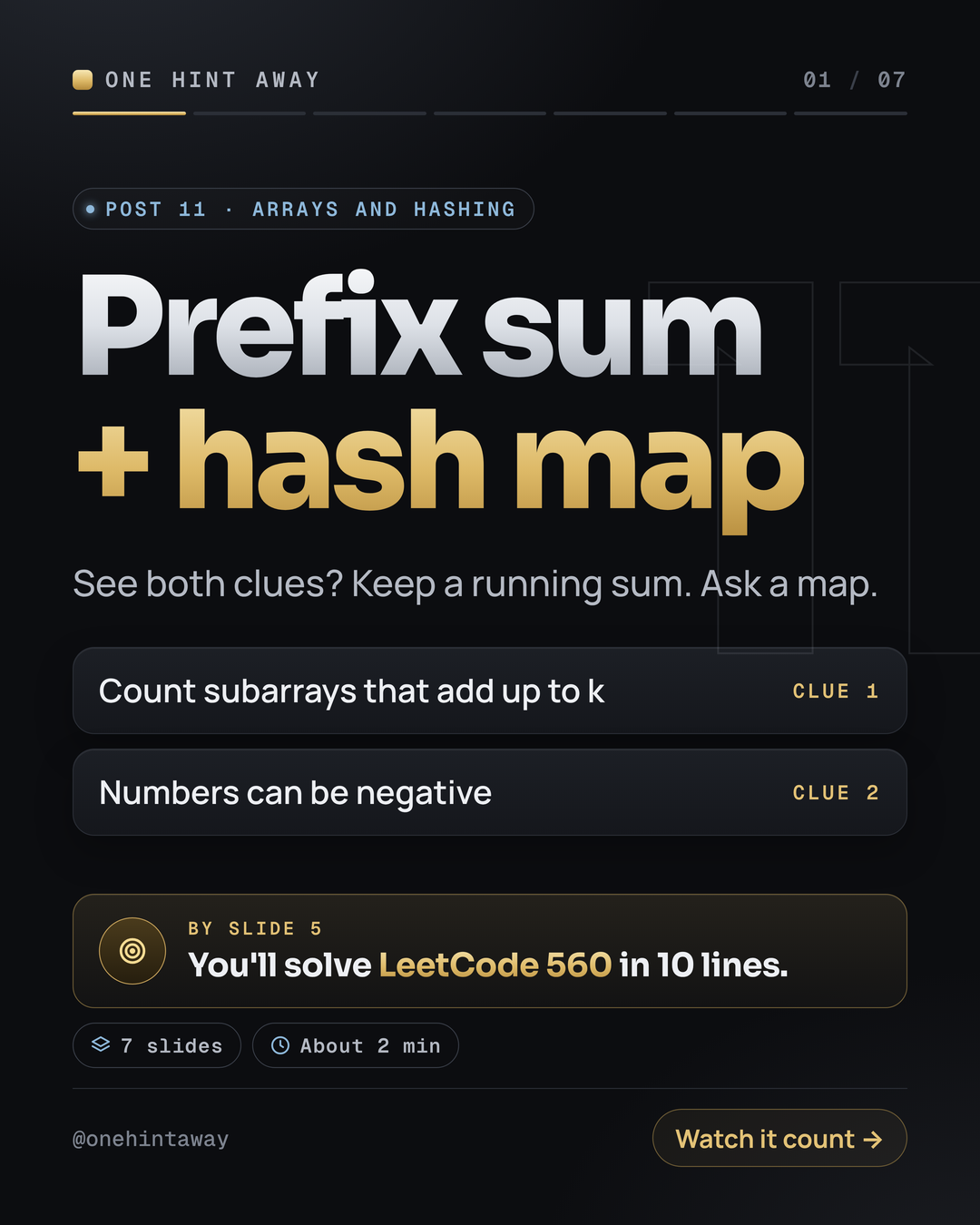
Prefix sum with a hash map
Count subarrays that add up to k, even with negative numbers: remember how often each running sum appeared.
Problem: LeetCode 560, Subarray Sum Equals K (Medium). Count the subarrays (contiguous, non-empty) whose numbers add up to k. Numbers can be negative, which is why a sliding window does not work here.
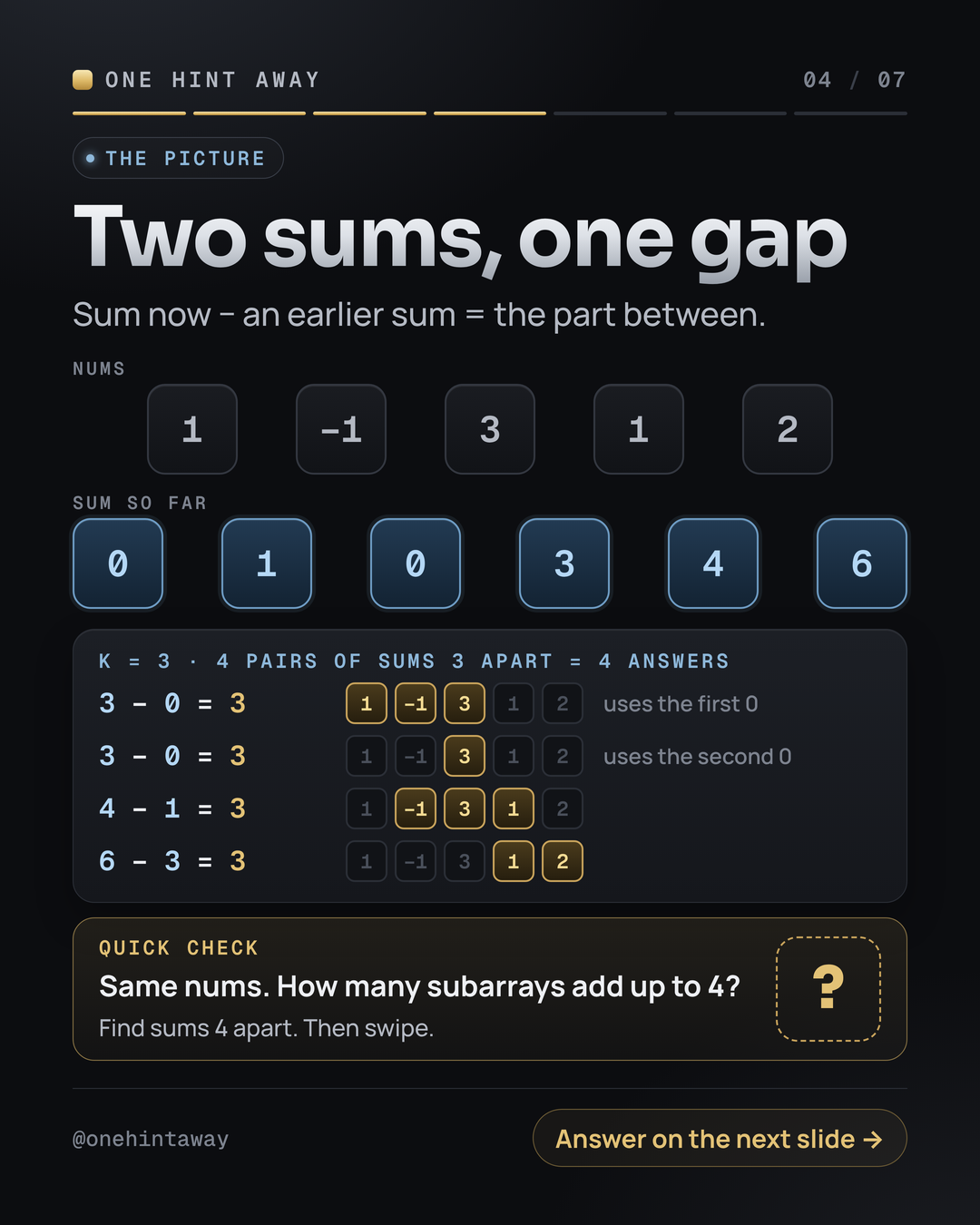
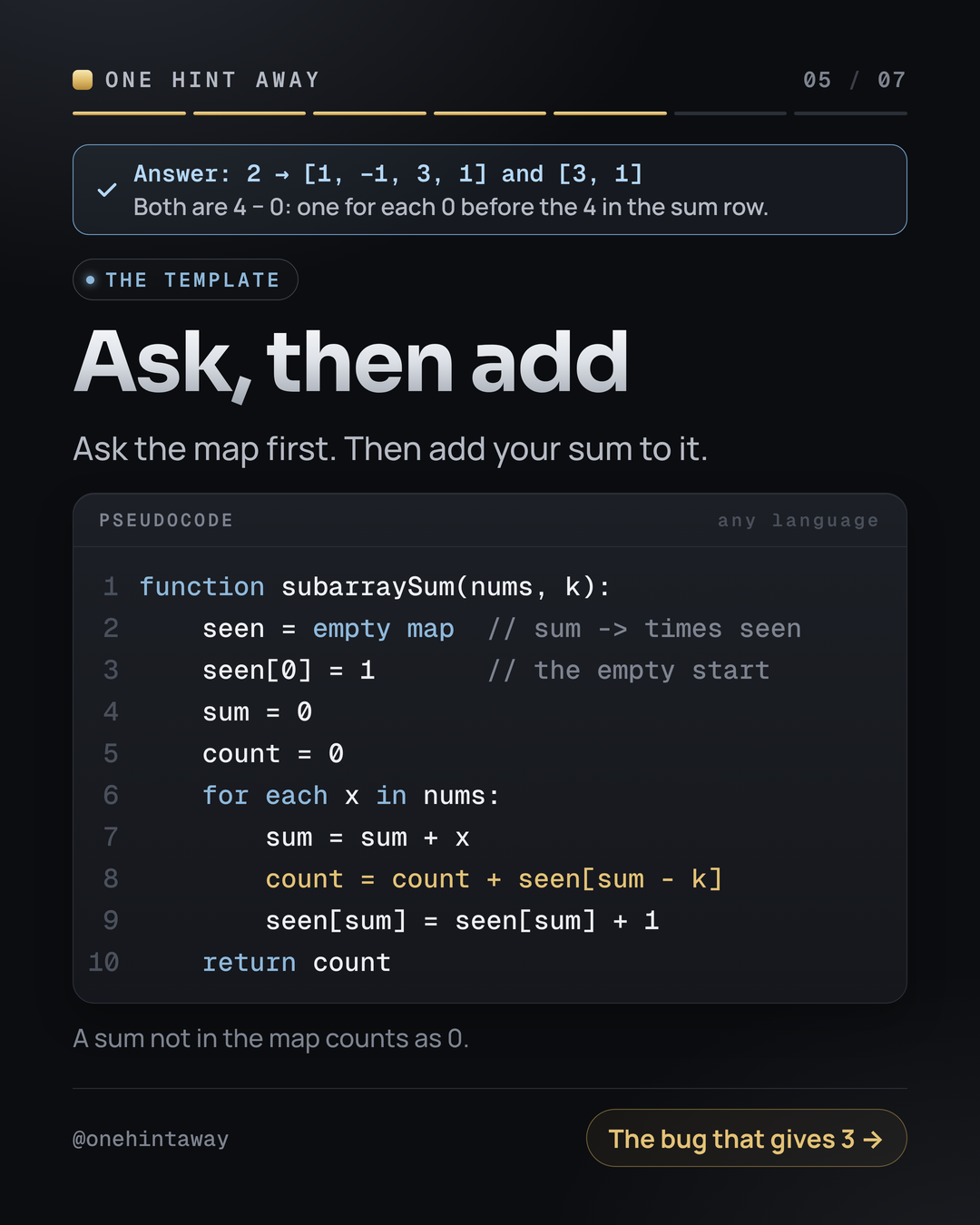
Example from the post: nums = [1, -1, 3, 1, 2], k = 3 → 4 (the subarrays [1, -1, 3], [3], [-1, 3, 1], [1, 2]). With k = 4 the answer is 2 ([1, -1, 3, 1] and [3, 1]).
The idea
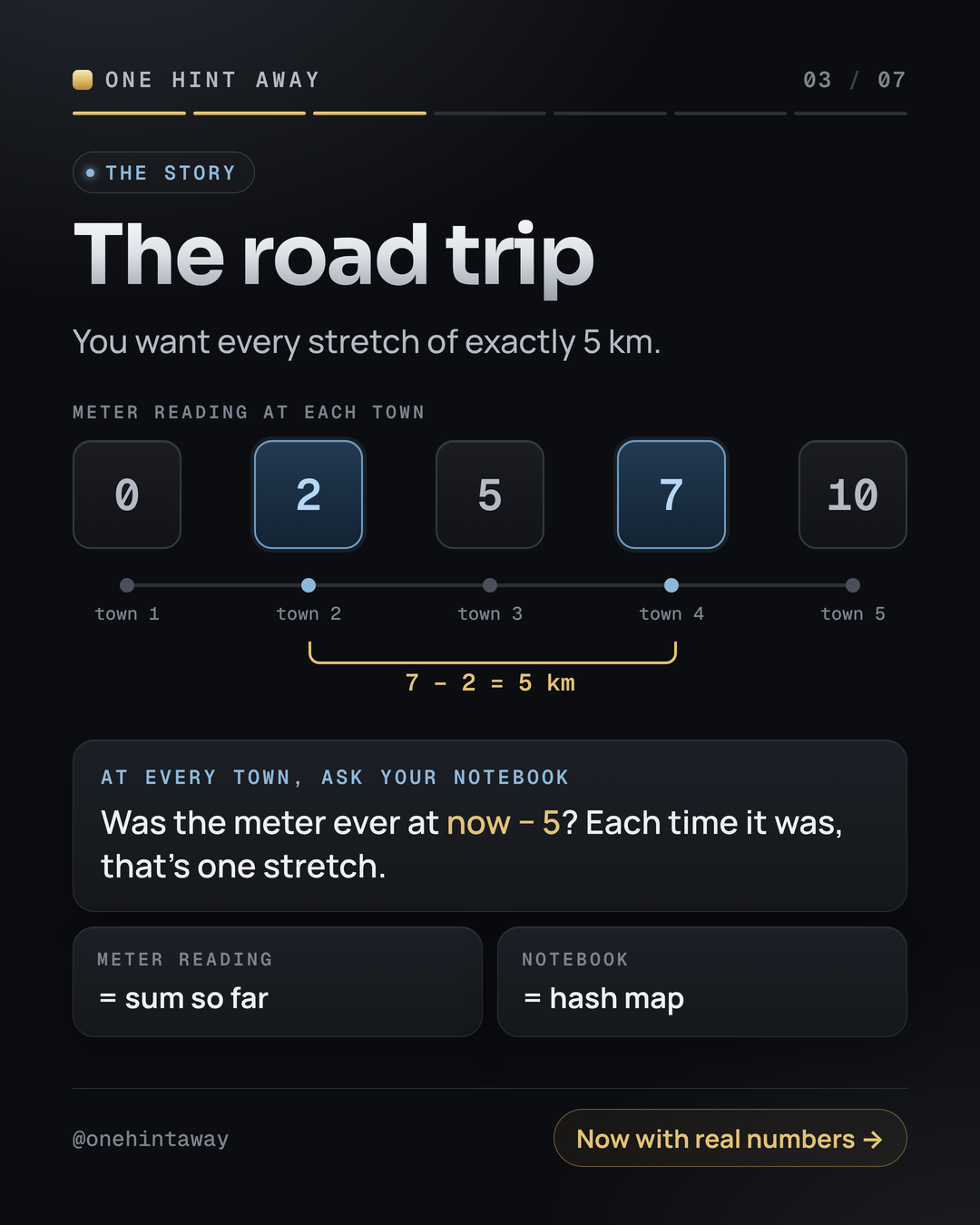
A road trip: you want every stretch of exactly 5 km. At every town, ask your notebook: was the meter ever at now − 5? Each time it was, that's one stretch. The meter reading is the running sum; the notebook is a hash map.
Sum now − an earlier sum = the part between. So a subarray ending here adds up to k exactly when some earlier running sum equals sum - k. The hash map remembers how many times each running sum has appeared.
The walk
nums = [1, -1, 3, 1, 2], k = 3. Running sums, starting from the empty start: 0, 1, 0, 3, 4, 6.
| sum now | earlier sum it needs | times seen | subarray |
|---|---|---|---|
| 3 | 0 | 2 (the empty start and after −1) | [1, -1, 3] and [3] |
| 4 | 1 | 1 | [-1, 3, 1] |
| 6 | 3 | 1 | [1, 2] |
Four pairs of sums 3 apart, four answers.
Pseudocode
function subarraySum(nums, k):
    seen = empty map  // sum -> times seen
    seen[0] = 1       // the empty start
    sum = 0
    count = 0
    for each x in nums:
        sum = sum + x
        count = count + seen[sum - k]
        seen[sum] = seen[sum] + 1
    return count
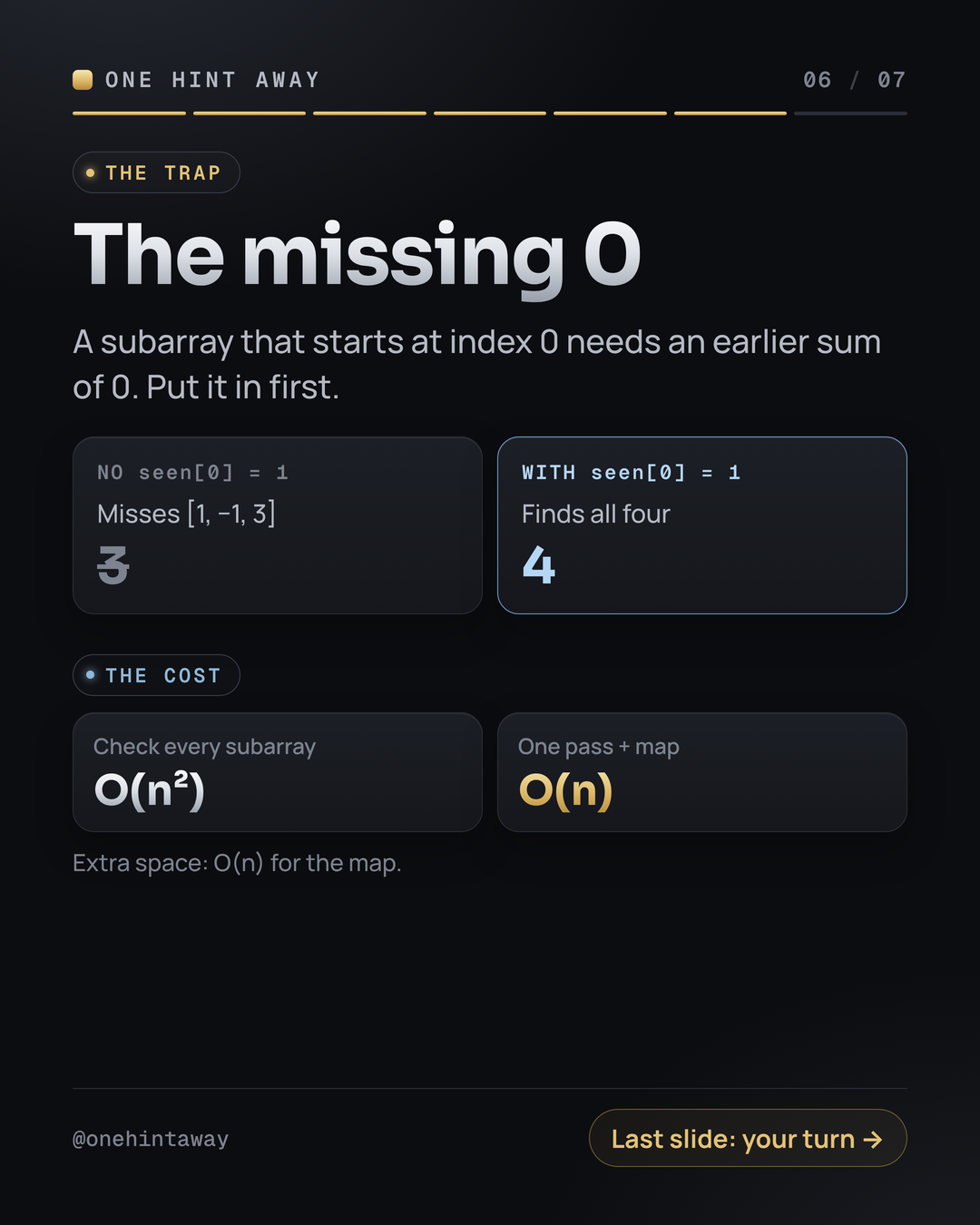
A sum not in the map counts as 0. Ask the map first, then add your sum to it.
The trap: the missing 0. A subarray that starts at index 0 needs an earlier sum of 0, so put it in first. Without seen[0] = 1 the example returns 3 and misses [1, -1, 3]; with it, all four are found.
Code
import java.util.*;

public class Solution {
    public static int subarraySum(int[] nums, int k) {
        Map<Integer, Integer> seen = new HashMap<>(); // sum -> times seen
        seen.put(0, 1);                               // the empty start
        int sum = 0;
        int count = 0;
        for (int x : nums) {
            sum = sum + x;
            count = count + seen.getOrDefault(sum - k, 0);
            seen.put(sum, seen.getOrDefault(sum, 0) + 1);
        }
        return count;
    }
}
def subarray_sum(nums, k):
seen = {0: 1} # sum -> times seen; 0 is the empty start
sum = 0
count = 0
for x in nums:
sum = sum + x
count = count + seen.get(sum - k, 0)
seen[sum] = seen.get(sum, 0) + 1
return count#include <bits/stdc++.h>
using namespace std;
int subarraySum(const vector<int>& nums, int k) {
unordered_map<long long, int> seen; // sum -> times seen
seen[0] = 1; // the empty start
long long sum = 0;
int count = 0;
for (int x : nums) {
sum = sum + x;
auto it = seen.find(sum - k);
if (it != seen.end()) count = count + it->second;
seen[sum] = seen[sum] + 1;
}
return count;
}function subarraySum(nums, k) {
const seen = new Map(); // sum -> times seen
seen.set(0, 1); // the empty start
let sum = 0;
let count = 0;
for (const x of nums) {
sum = sum + x;
count = count + (seen.get(sum - k) ?? 0);
seen.set(sum, (seen.get(sum) ?? 0) + 1);
}
return count;
}Complexity
- Time: O(n). One pass; each map lookup and update is O(1) on average.
- Space: O(n) for the map (up to n + 1 different running sums).
- Checking every subarray instead takes O(n²) time.
How it was tested
All four versions were checked against a brute-force count on 3,017 inputs: 3,000 random arrays (length 0 to 12, values from small ranges up to −1000..1000) plus edge cases (empty, single element, all zeros, all equal, sorted, reversed, length 200 at the value limits). All agreed. Re-run on 31 October 2026: all four print 4, 2, 2 and 2 on the four examples in their main.
Practice
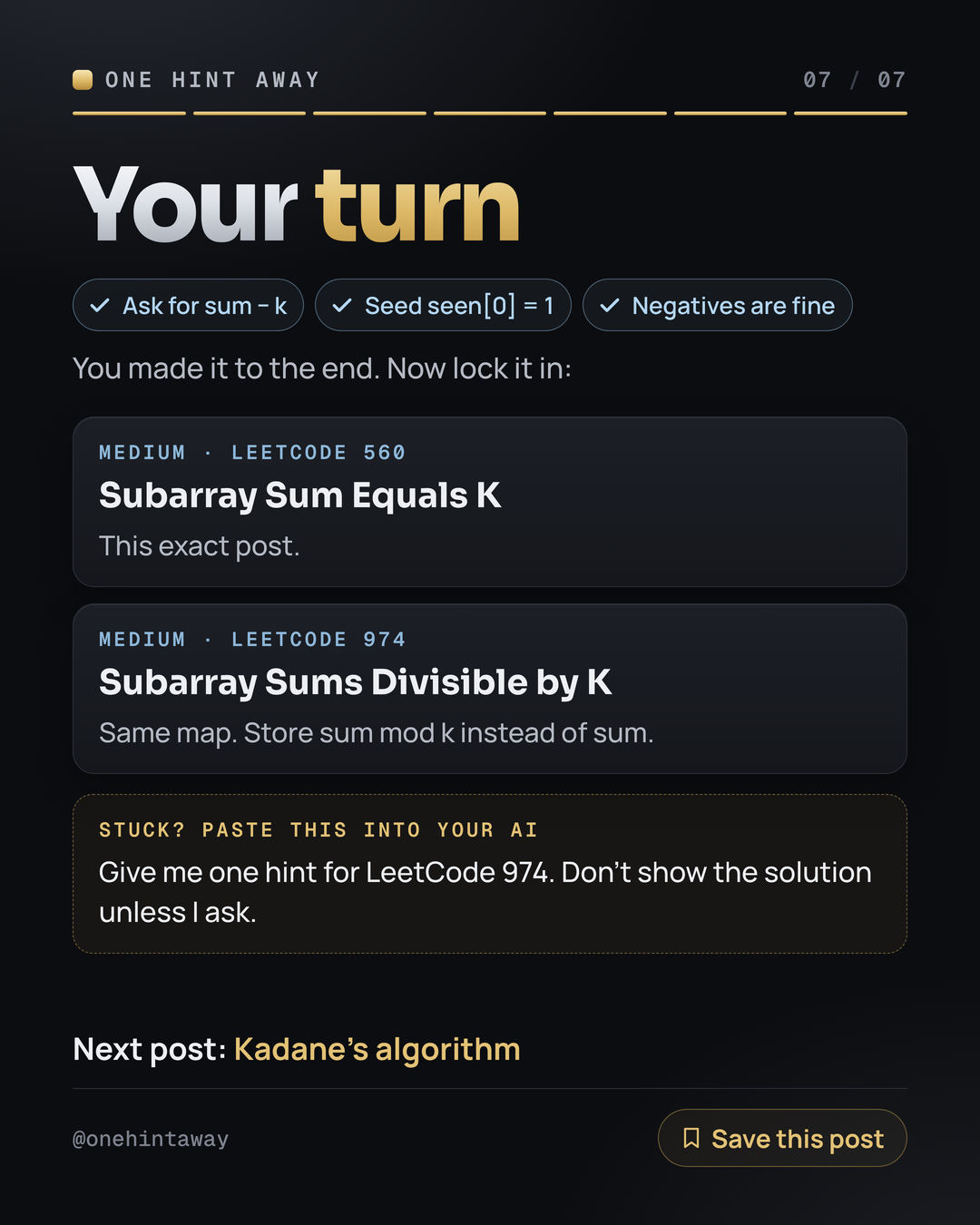
Try these in order. Open the worked example first if you got stuck on the slides.
- LeetCode 560 Subarray Sum Equals Kworked example
Same map. Store sum mod k instead of sum.