12Kadane's algorithmArrays and hashing
Kadane's algorithm
The largest sum of numbers in a row: drop the running sum as soon as it goes below zero.
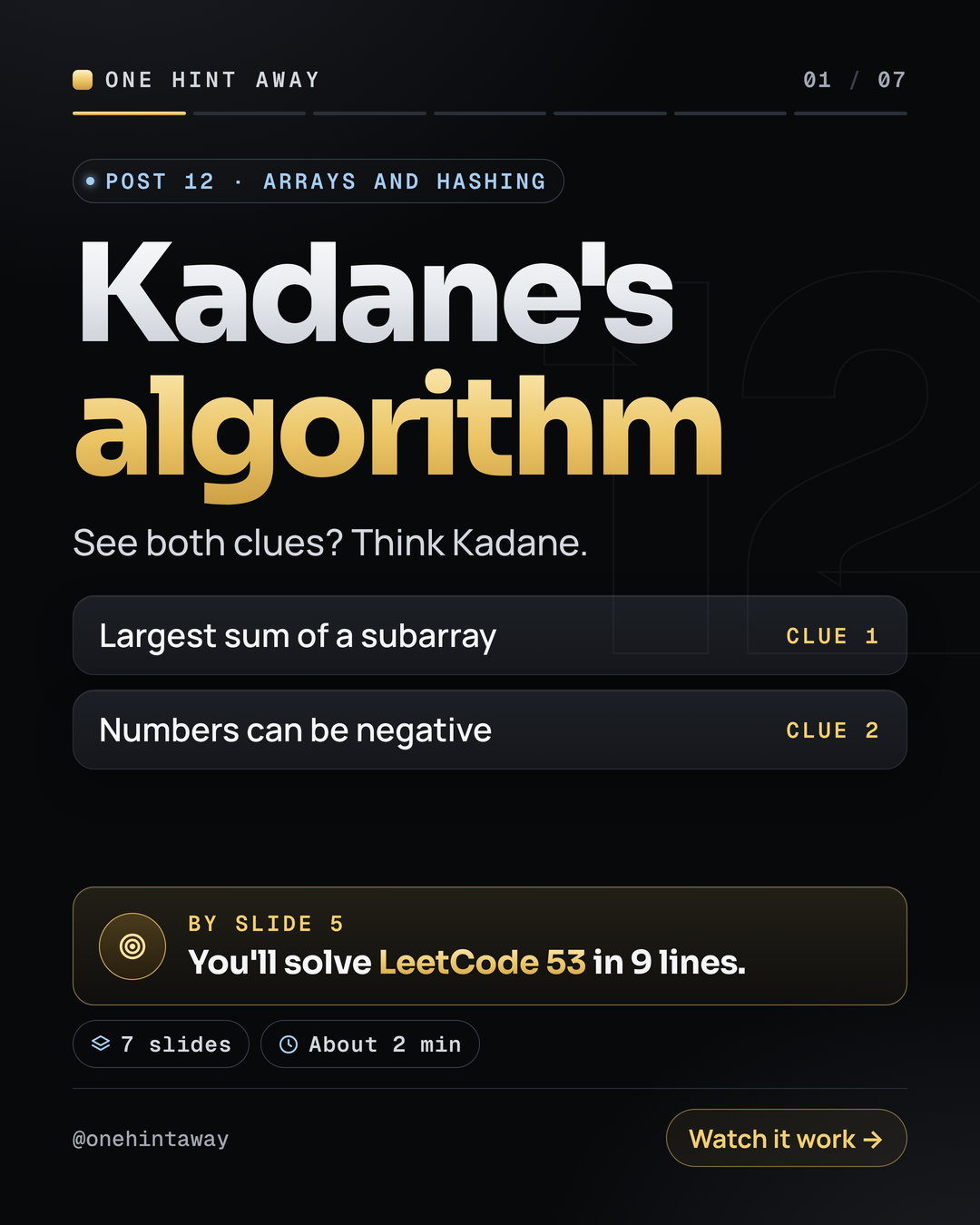
Problem: LeetCode 53 · Maximum Subarray (Medium). Given an integer array nums, return the largest sum of a non-empty subarray (numbers in a row).
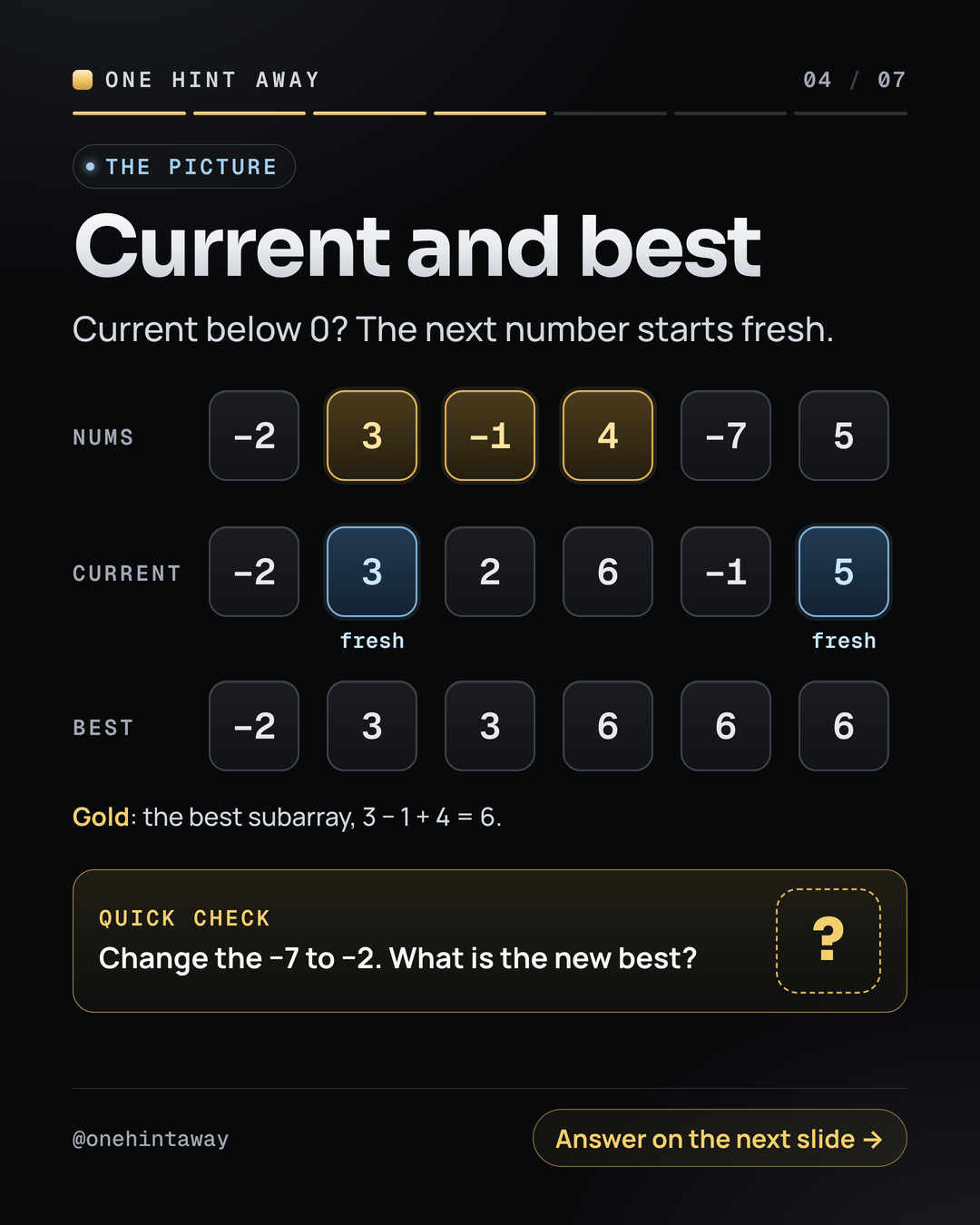
Worked example: nums = [-2, 3, -1, 4, -7, 5] → 6 (the subarray 3 - 1 + 4).
| index | 0 | 1 | 2 | 3 | 4 | 5 |
|---|---|---|---|---|---|---|
| nums | -2 | 3 | -1 | 4 | -7 | 5 |
| current (after adding the number) | -2 | 3 (fresh) | 2 | 6 | -1 | 5 (fresh) |
| best (largest so far) | -2 | 3 | 3 | 6 | 6 | 6 |
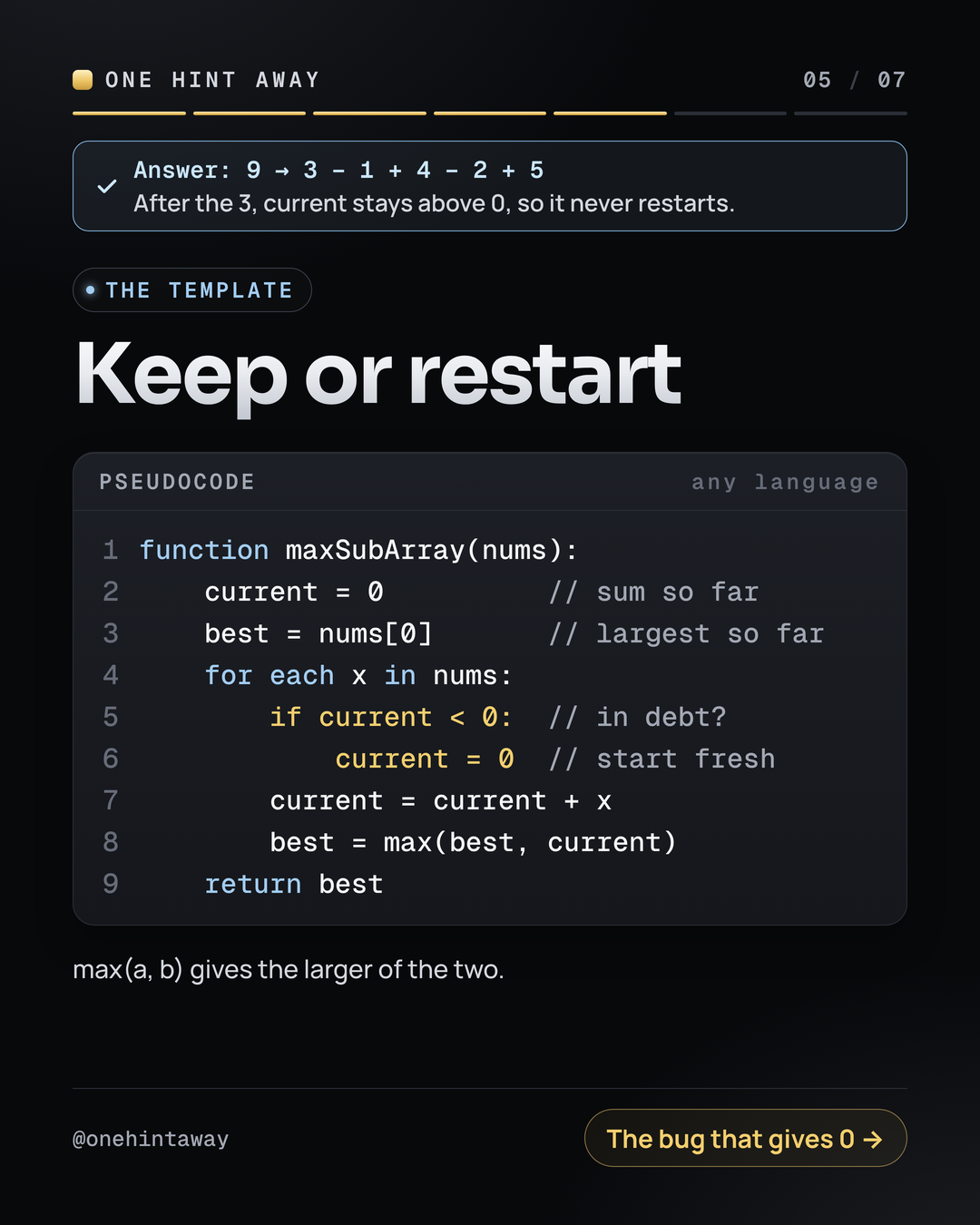
Quick check from the post: change -7 to -2 and the best becomes 9 (3 - 1 + 4 - 2 + 5).
The idea
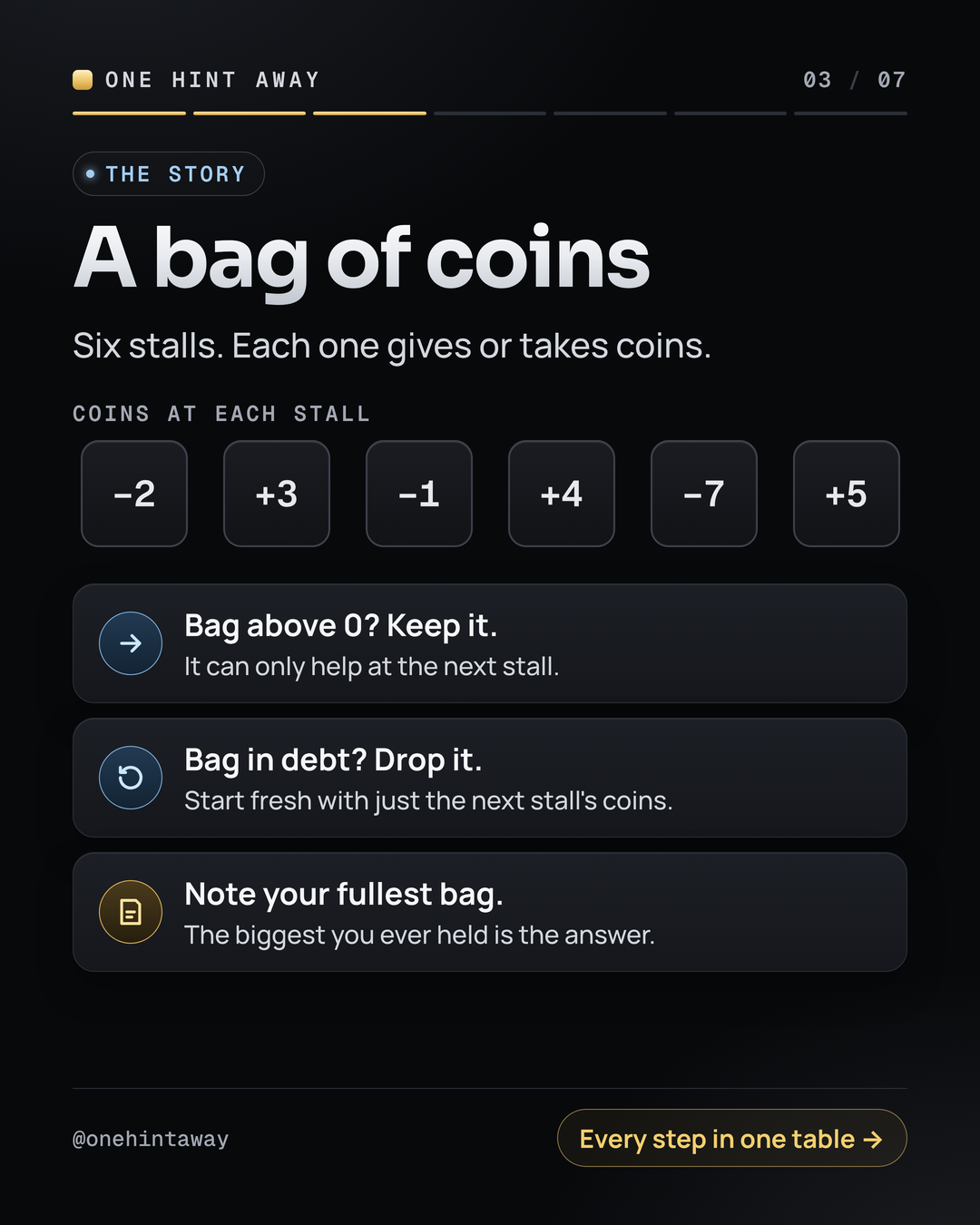
Walk through the numbers keeping a sum, current. Before adding the next number, check it: if current is below 0 it can only drag the next number down, so drop it and start fresh from 0. Keep the largest value current reaches in best. best starts at nums[0] (see the trap below). current can start at 0, because the first number is always added to it.
This is the same as the common one-line form current = max(x, current + x): adding to a negative current always gives less than x alone.
Pseudocode
function maxSubArray(nums):
    current = 0          // sum so far
    best = nums[0]       // largest so far
    for each x in nums:
        if current < 0:  // in debt?
            current = 0  // start fresh
        current = current + x
        best = max(best, current)
    return best
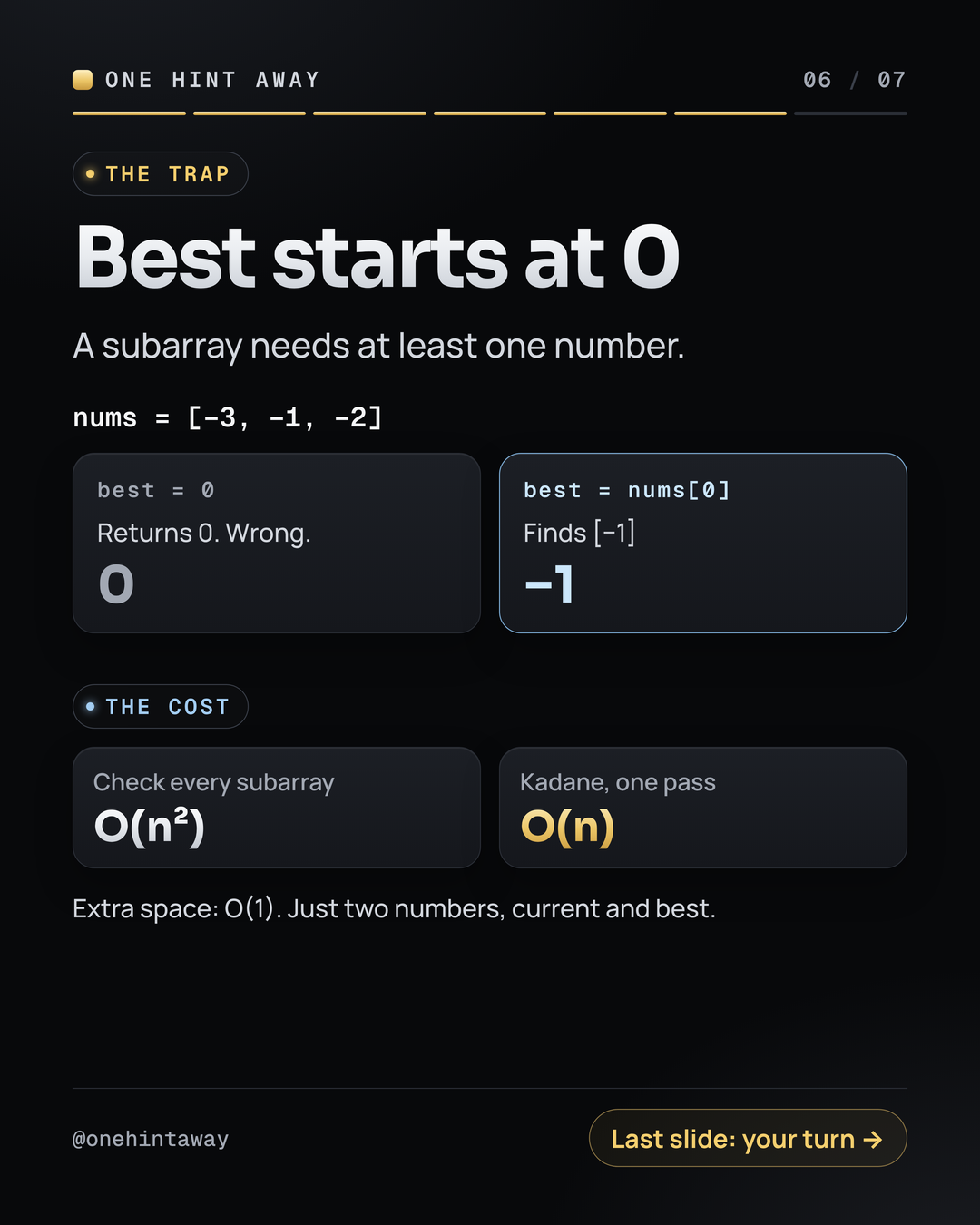
The trap: best starts at 0. A subarray needs at least one number. With nums = [-3, -1, -2], starting best at 0 returns 0, which is wrong; starting it at nums[0] finds [-1], so the answer is -1.
Code
public class Kadane {
    static int maxSubArray(int[] nums) {
        int current = 0;          // sum so far
        int best = nums[0];       // largest so far
        for (int x : nums) {
            if (current < 0) {    // in debt?
                current = 0;      // start fresh
            }
            current = current + x;
            best = Math.max(best, current);
        }
        return best;
    }
}
def max_sub_array(nums):
current = 0 # sum so far
best = nums[0] # largest so far
for x in nums:
if current < 0: # in debt?
current = 0 # start fresh
current = current + x
best = max(best, current)
return best#include <algorithm>
#include <vector>
using namespace std;
int maxSubArray(const vector<int>& nums) {
int current = 0; // sum so far
int best = nums[0]; // largest so far
for (int x : nums) {
if (current < 0) { // in debt?
current = 0; // start fresh
}
current = current + x;
best = max(best, current);
}
return best;
}function maxSubArray(nums) {
let current = 0; // sum so far
let best = nums[0]; // largest so far
for (const x of nums) {
if (current < 0) { // in debt?
current = 0; // start fresh
}
current = current + x;
best = Math.max(best, current);
}
return best;
}Complexity
- Time: O(n), one pass over the array.
- Extra space: O(1), just
currentandbest. - Brute force (every subarray with a running sum) is O(n²) time.
How it was tested
All four programs were compiled and tested on 3,016 inputs: 3,000 random arrays (length 1 to 12, values in ±3, ±10 or ±10,000) plus edge cases (single element, all negative, all equal, sorted, reversed, the LeetCode examples, and 1,000-element arrays at the ±10,000 value limit). Every output matched an O(n²) brute force. With LeetCode's limits (n ≤ 10⁵, |nums[i]| ≤ 10⁴) the sum stays within ±10⁹, so a 32-bit int is safe in Java and C++, and JavaScript numbers are exact. Re-run on 31 October 2026 on 3,005 inputs (3,000 random arrays, the example, the quick check, the trap input, a single element and a 1,000-element array at the value limit): all four matched the brute force on every one.
Practice
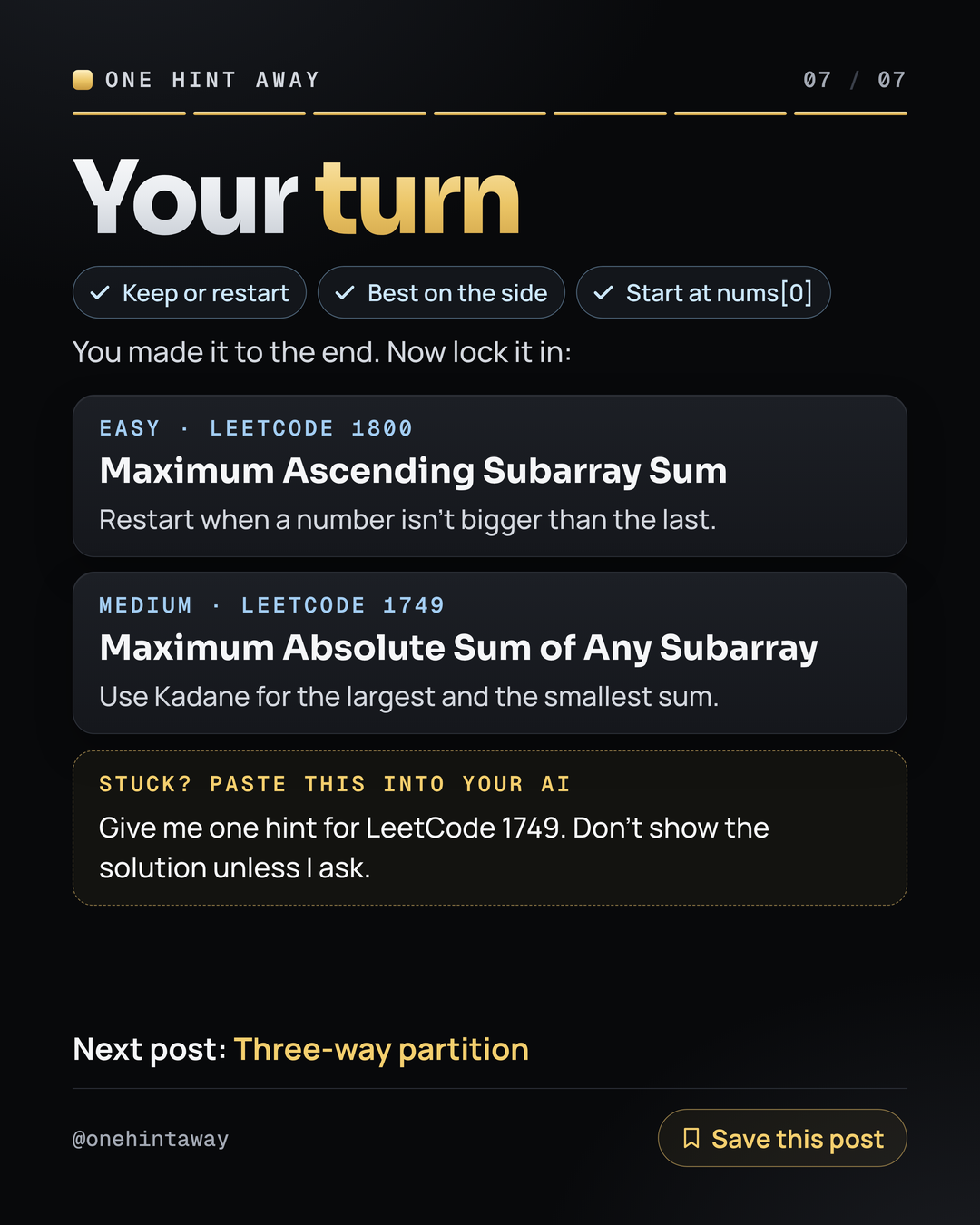
Try these in order. Open the worked example first if you got stuck on the slides.
- LeetCode 53 Maximum Subarrayworked example
Restart when a number isn't bigger than the last.
Use Kadane for the largest and the smallest sum.