00RoadmapStart here
Start here
DSA from zero, in about 90 posts. Patterns one slide at a time, hard problems one hint at a time.

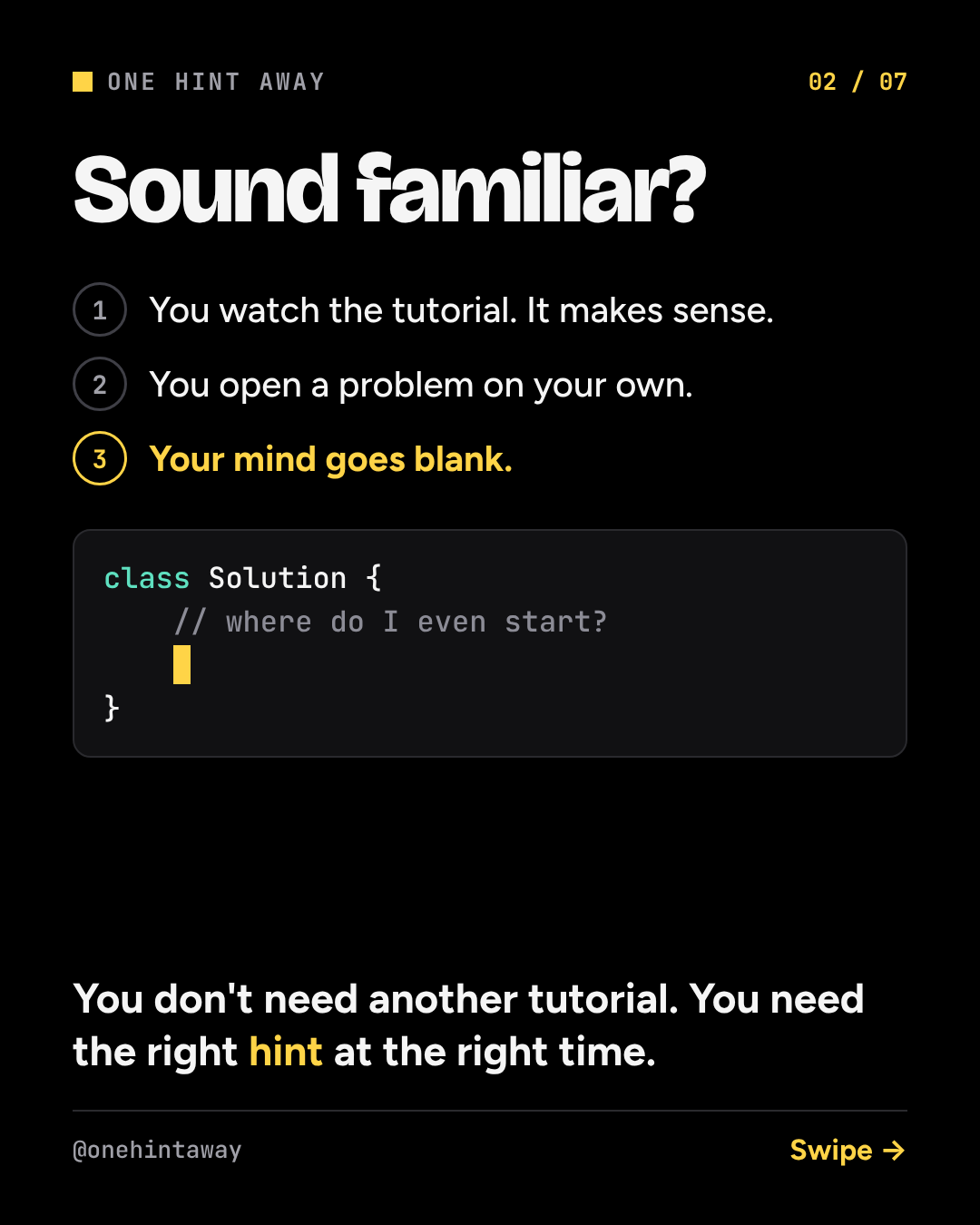
Sound familiar?
- You watch the tutorial. It makes sense.
- You open a problem on your own.
- Your mind goes blank.
You don't need another tutorial. You need the right hint at the right time.
Two kinds of post
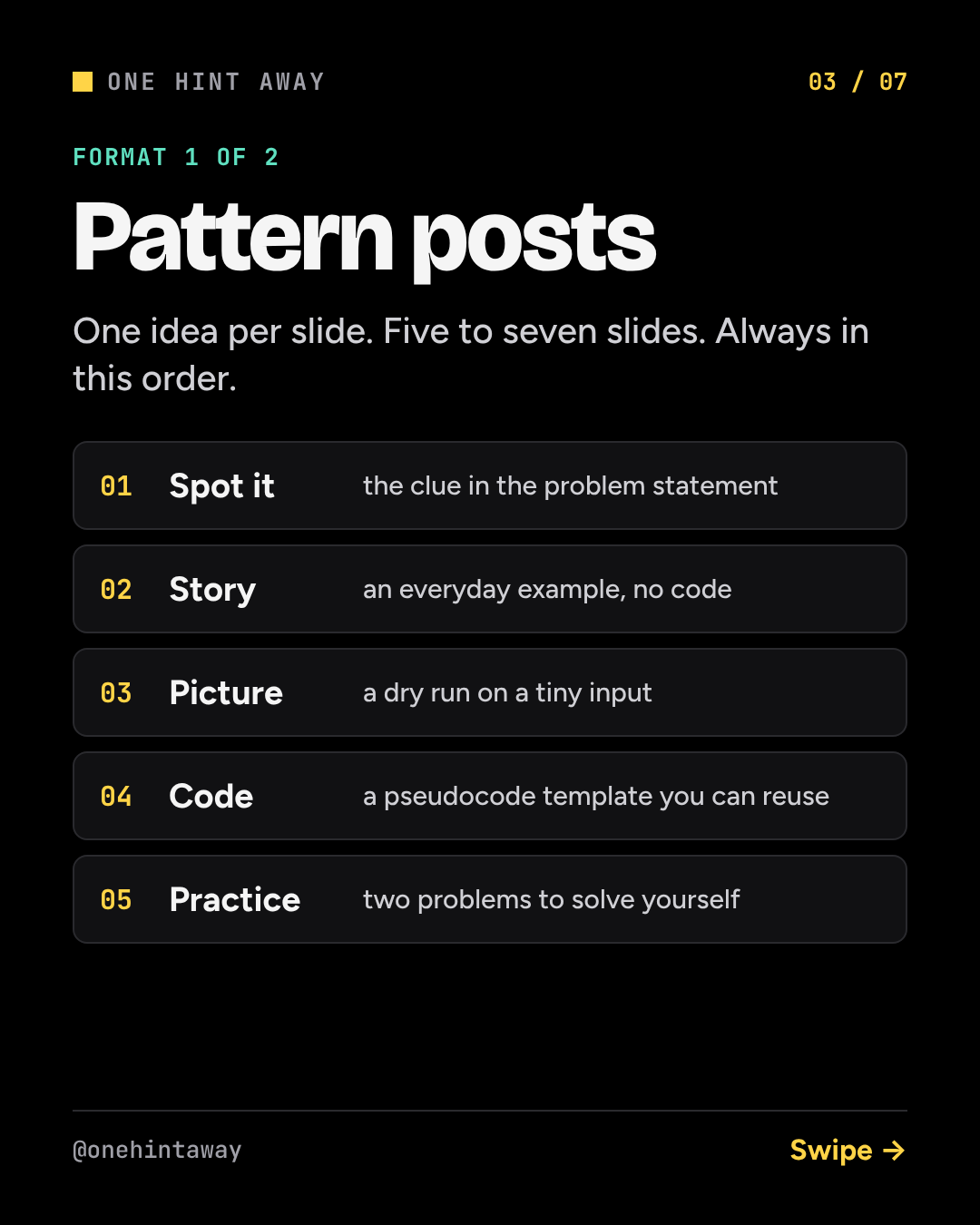
Pattern posts
One idea per slide, always in this order:
| Step | What it gives you |
|---|---|
| Spot it | the clue in the problem statement |
| Story | an everyday example, no code |
| Picture | a dry run on a tiny input |
| Code | a pseudocode template you can reuse |
| Practice | two problems to solve yourself |
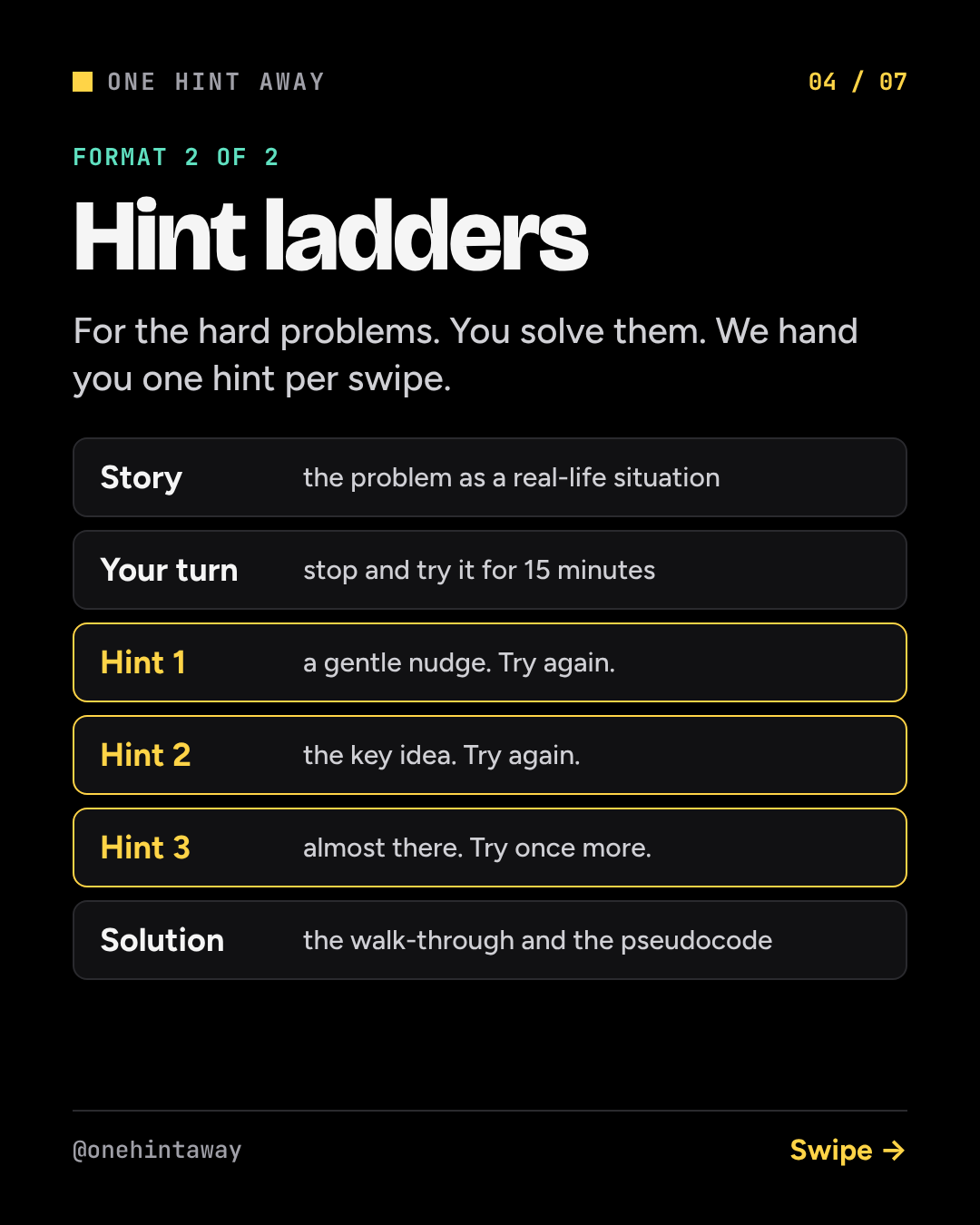
Hint ladders
For the hard problems. You solve them; each swipe hands you one more hint.
| Step | What it gives you |
|---|---|
| Story | the problem as a real-life situation |
| Your turn | stop and try it for 15 minutes |
| Hint 1 | a gentle nudge. Try again. |
| Hint 2 | the key idea. Try again. |
| Hint 3 | almost there. Try once more. |
| Solution | the walk-through and the code |
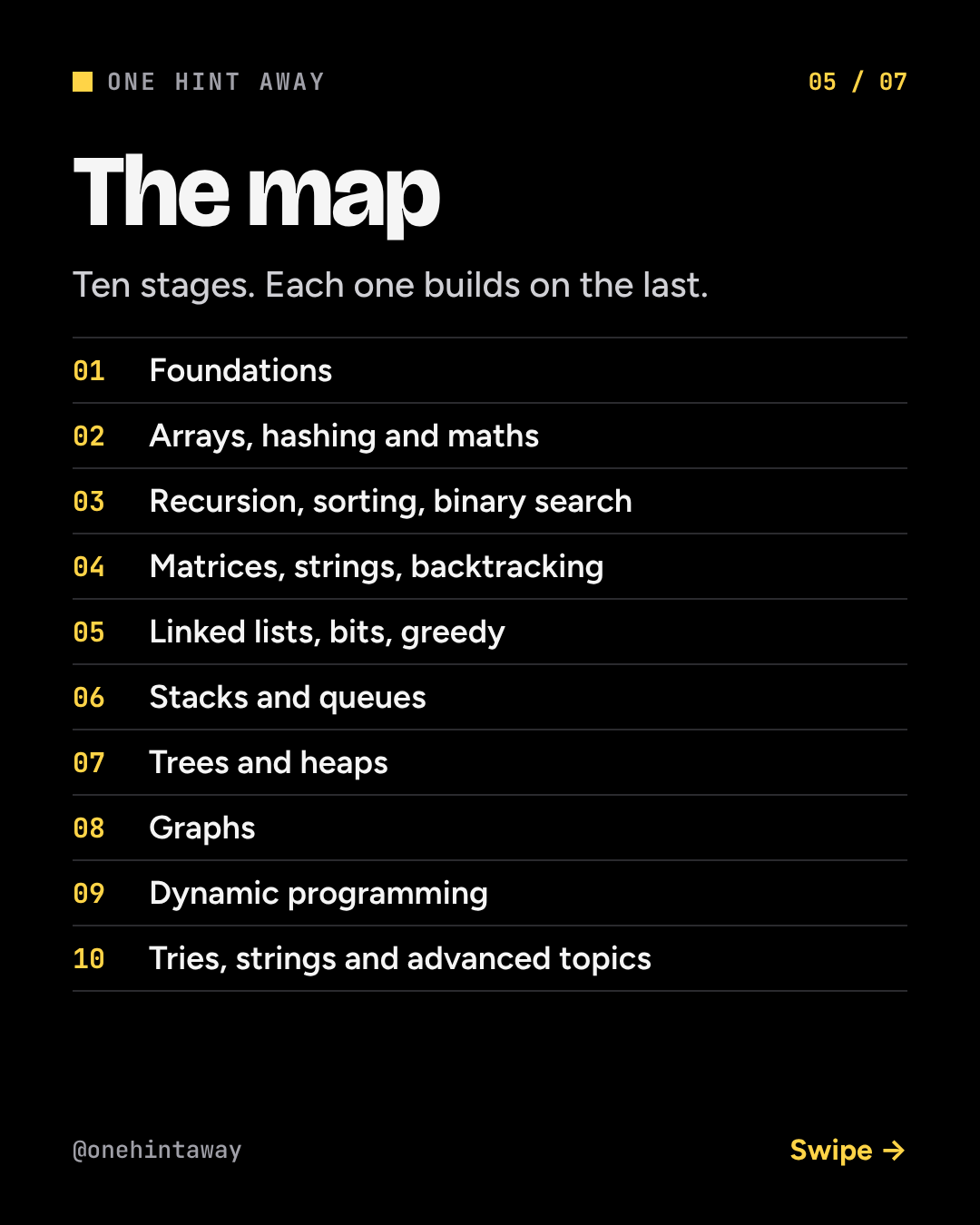
The map
Ten stages. Each one builds on the last.
- Foundations
- Arrays, hashing and maths
- Recursion, sorting, binary search
- Matrices, strings, backtracking
- Linked lists, bits, greedy
- Stacks and queues
- Trees and heaps
- Graphs
- Dynamic programming
- Tries, strings and advanced topics
The home page lists every post so far, grouped by stage, and Patterns lists them by pattern.
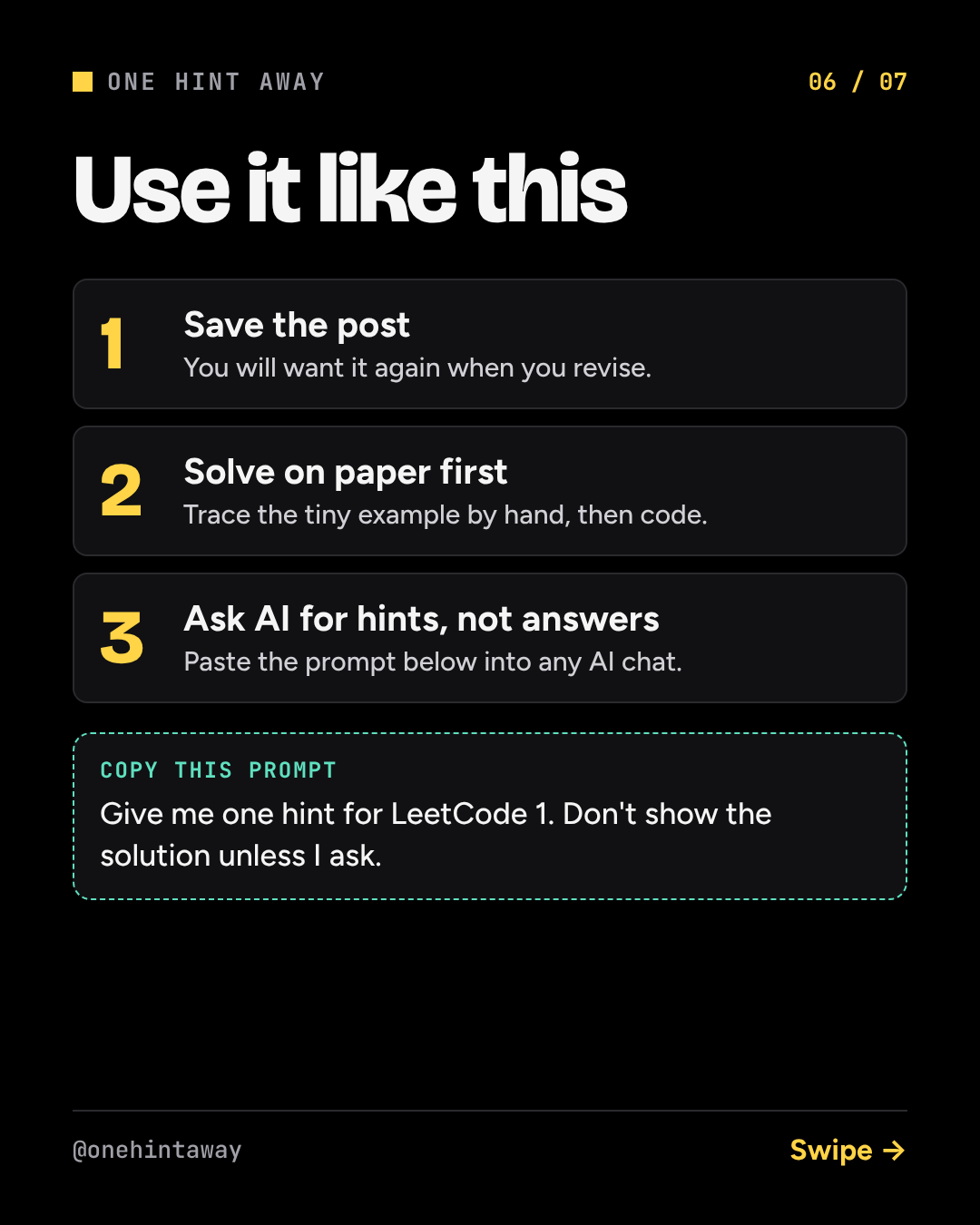
Use it like this
- Save the post. You will want it again when you revise.
- Solve on paper first. Trace the tiny example by hand, then code.
- Ask AI for hints, not answers. Paste this into any AI chat:
Give me one hint for LeetCode 1. Don't show the solution unless I ask.
What the blog adds
The slides use pseudocode, so they work whatever language you write. Every post page here also has the explanation, the pseudocode, tested code in Java, Python, C++ and JavaScript with a copy button, and the practice problems as links.
Next: 01 · Eight data structures, the structures every pattern is built on.