01Foundations
Eight data structures
The eight structures every pattern is built on, and what each operation costs.
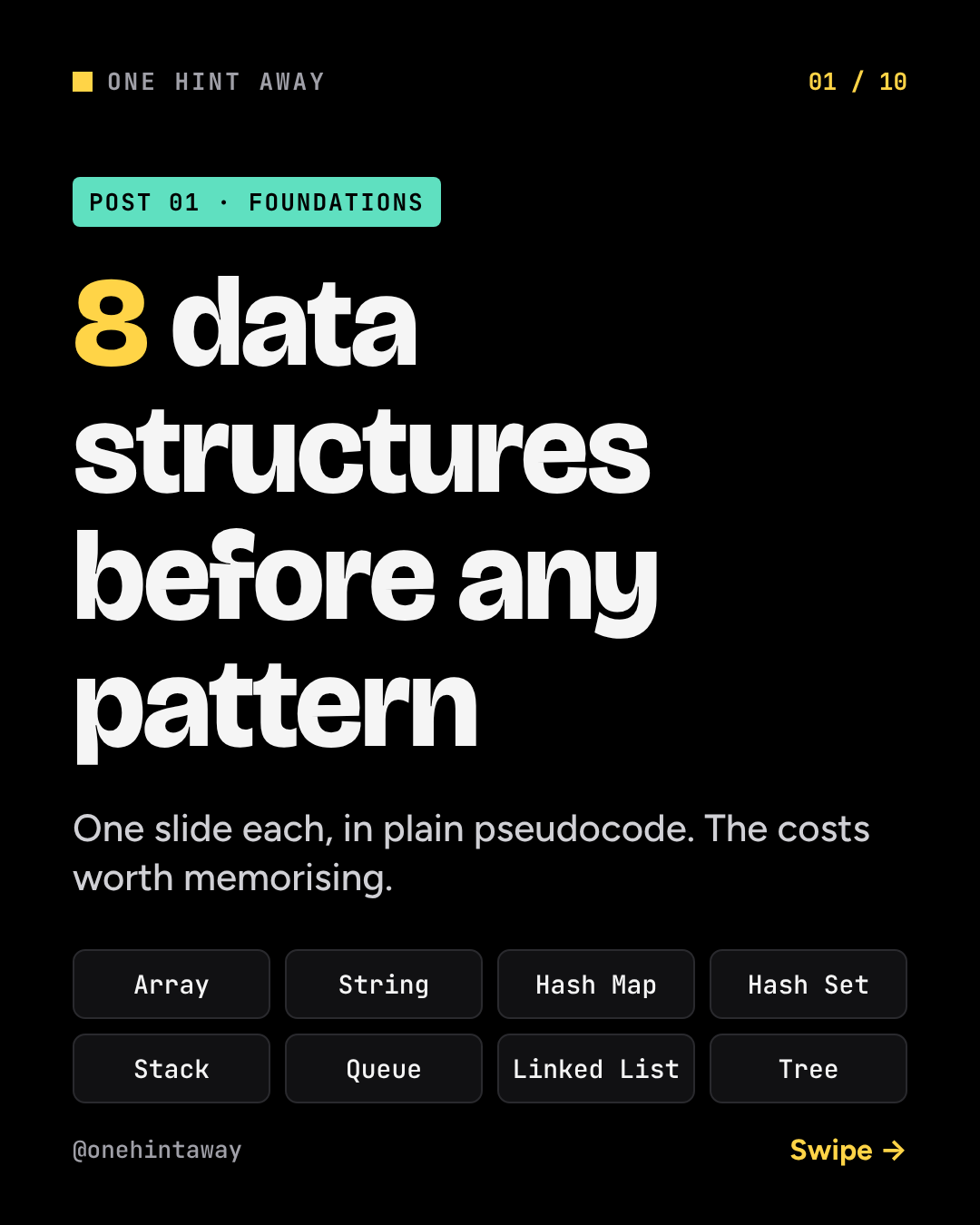
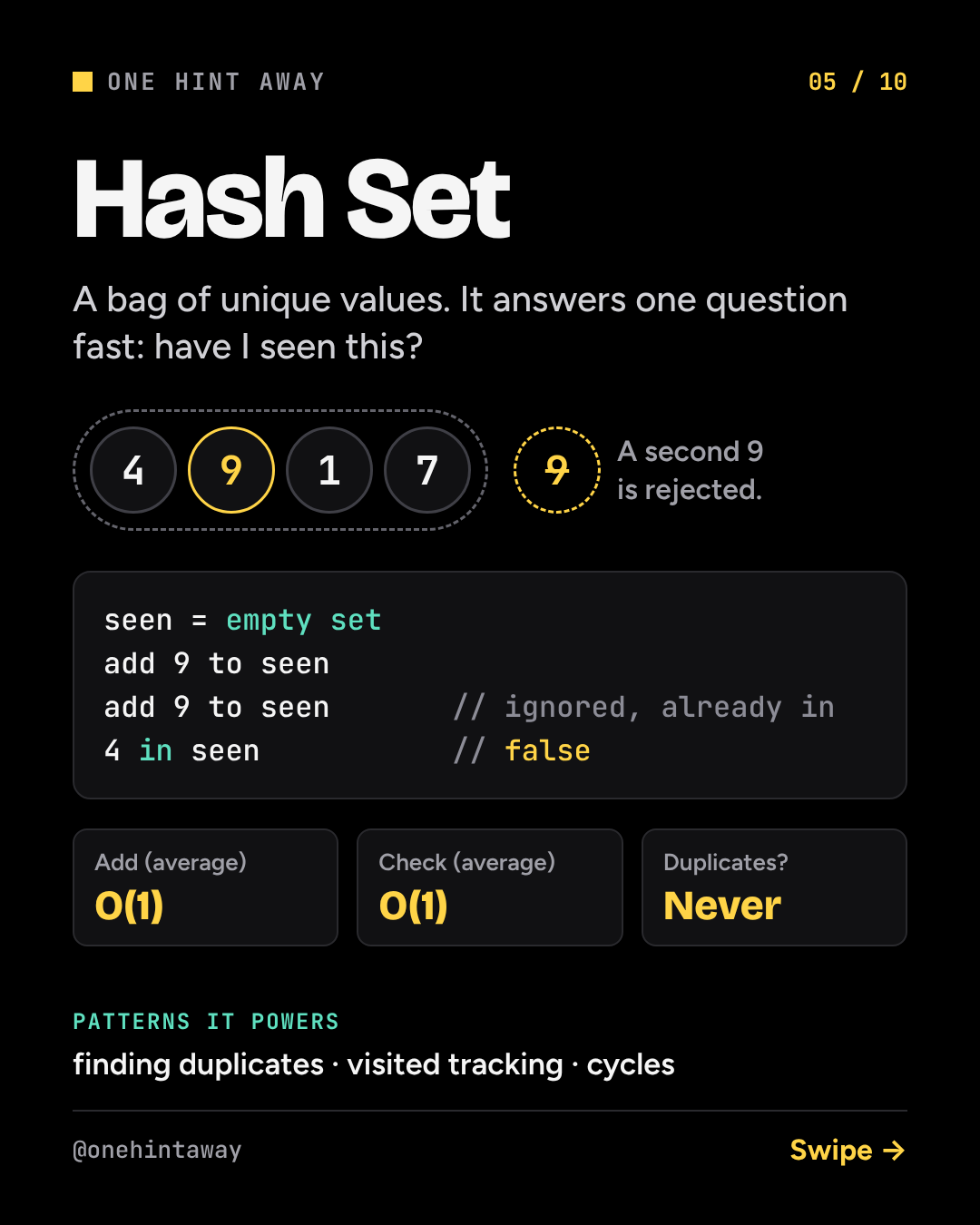
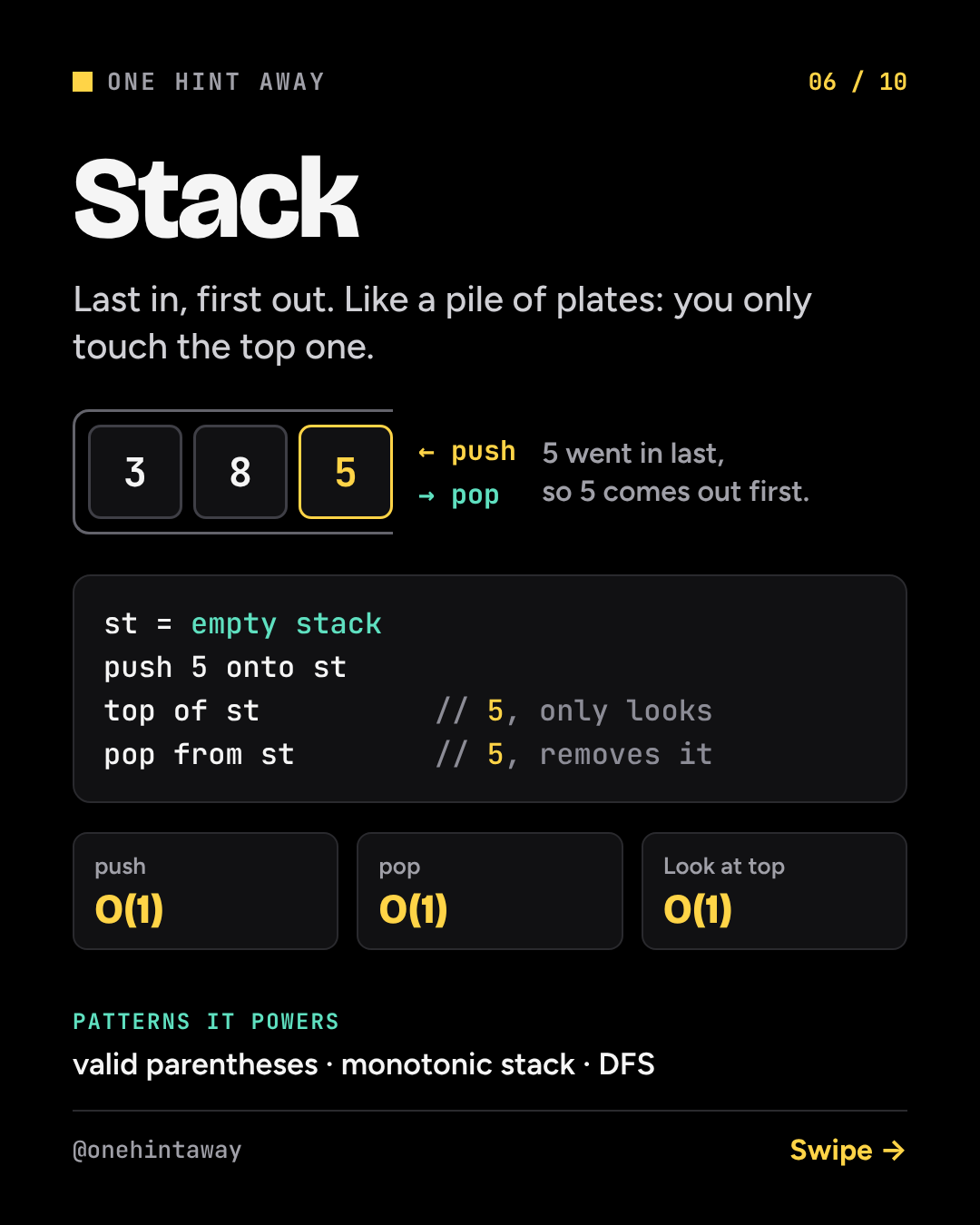
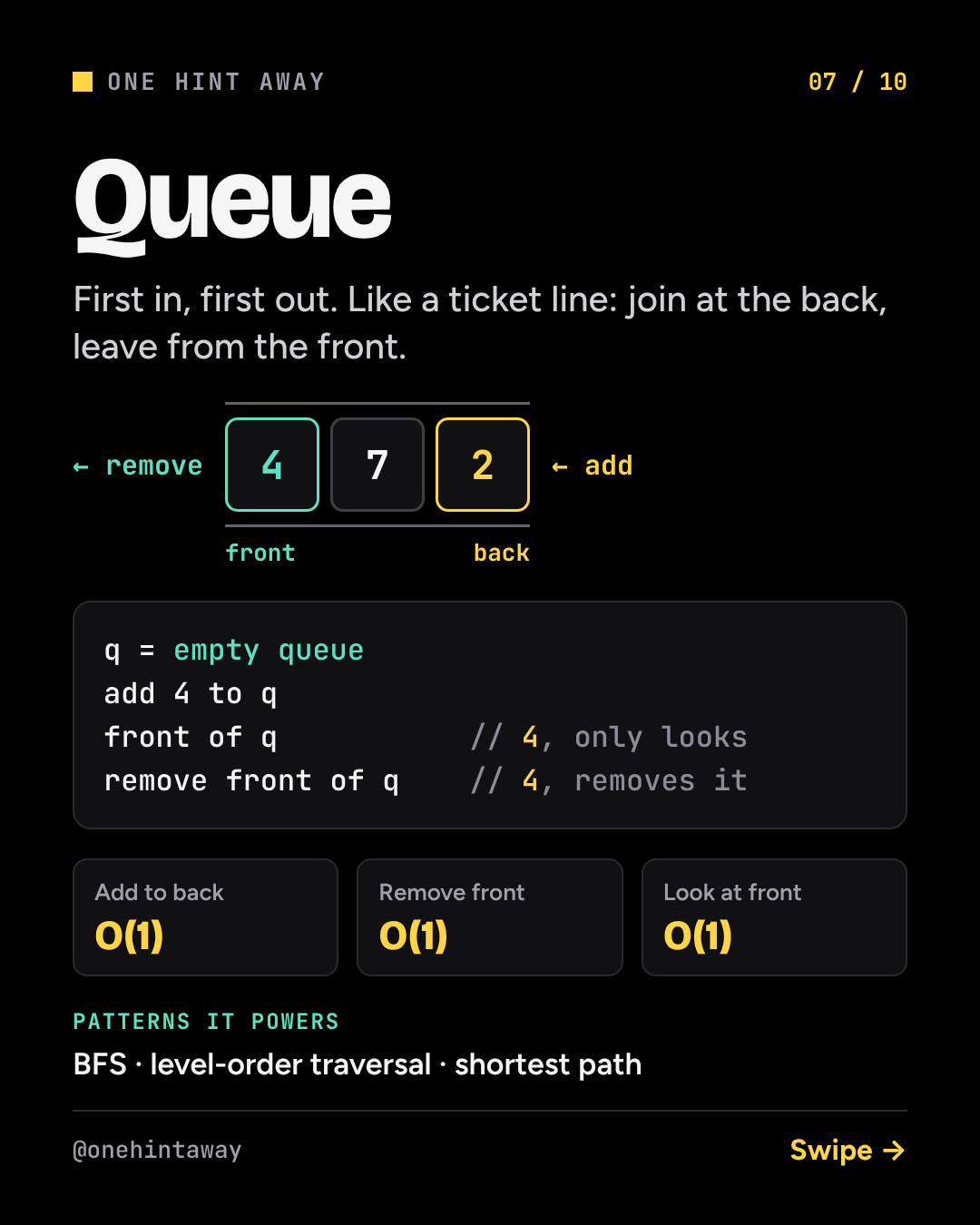
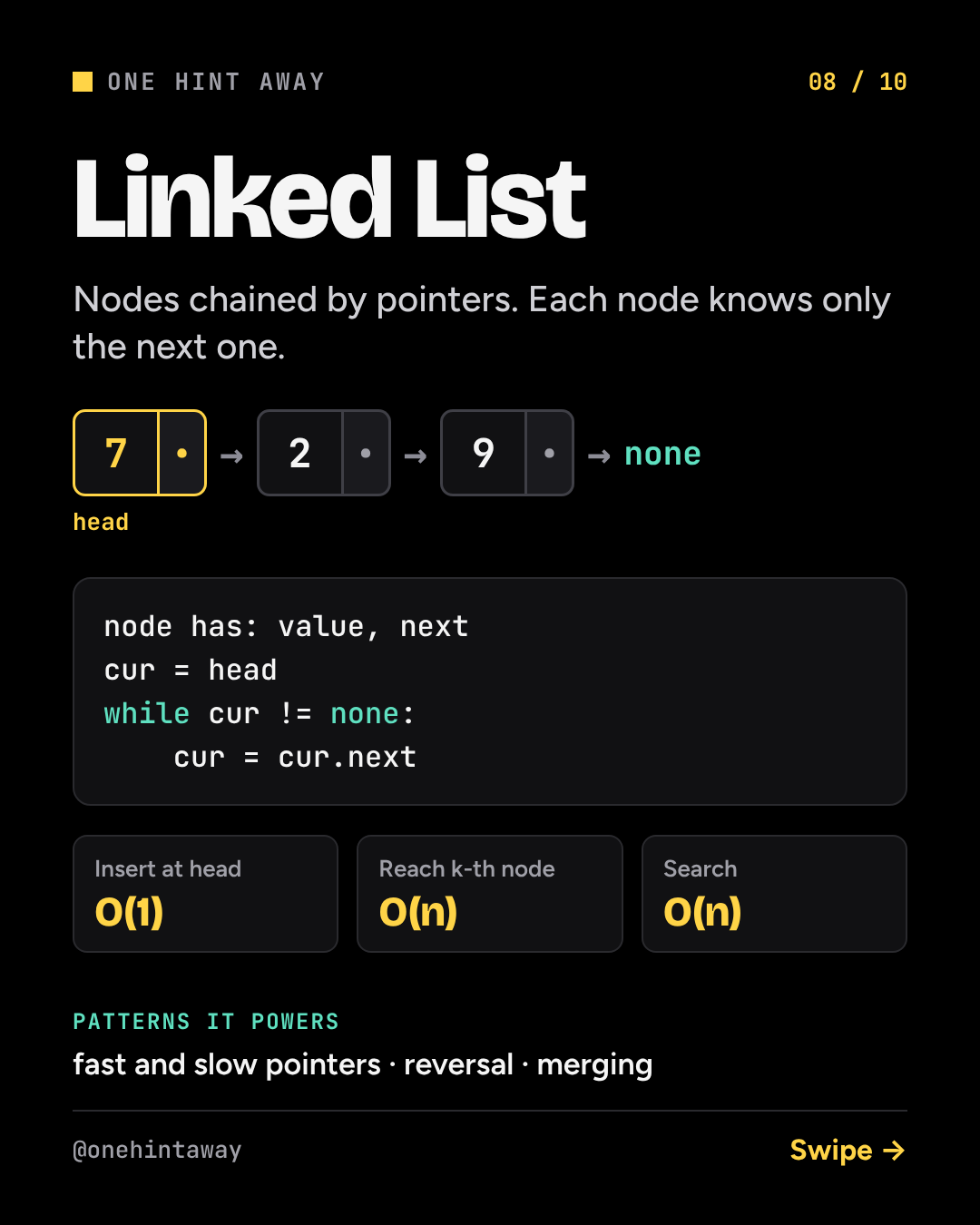
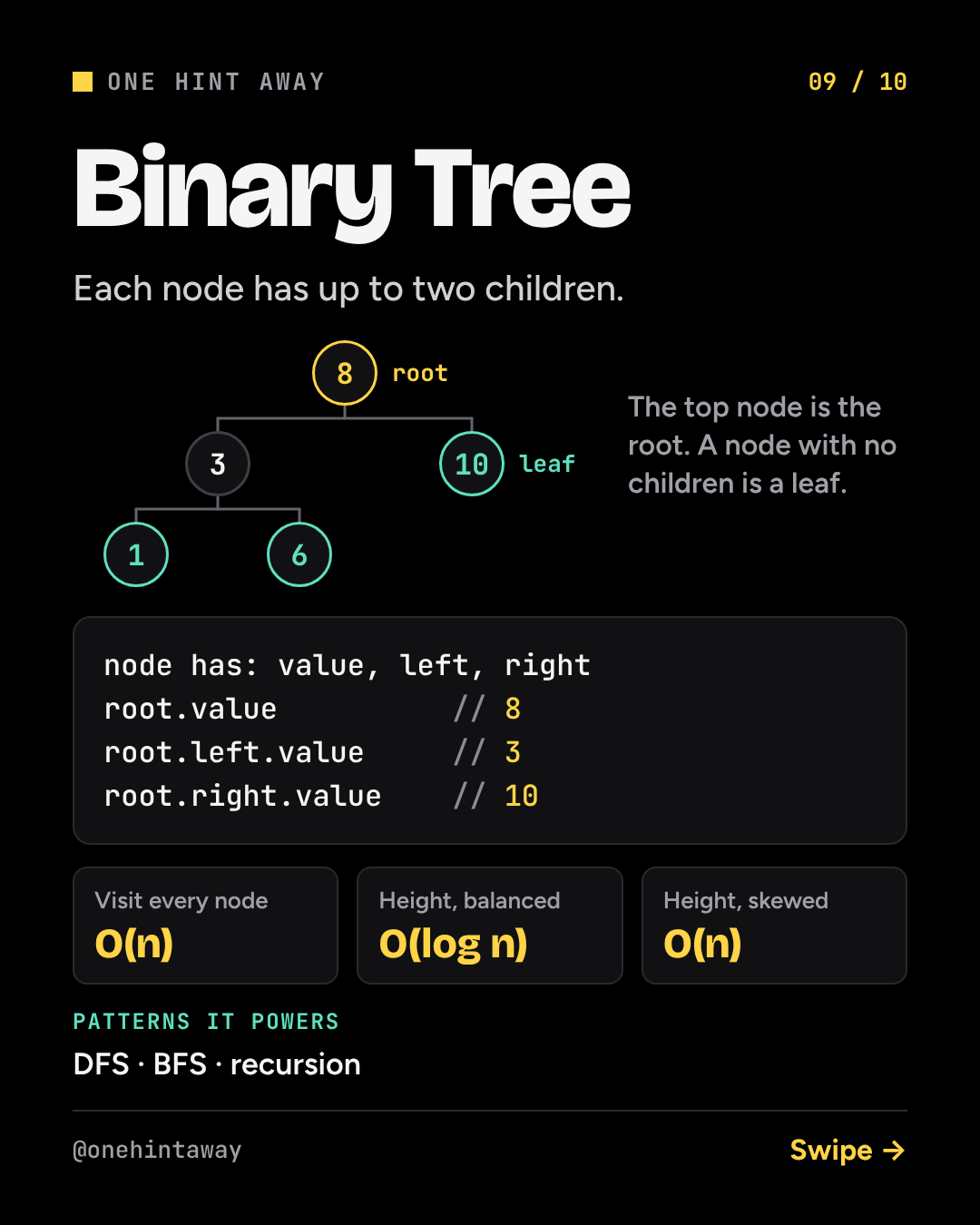
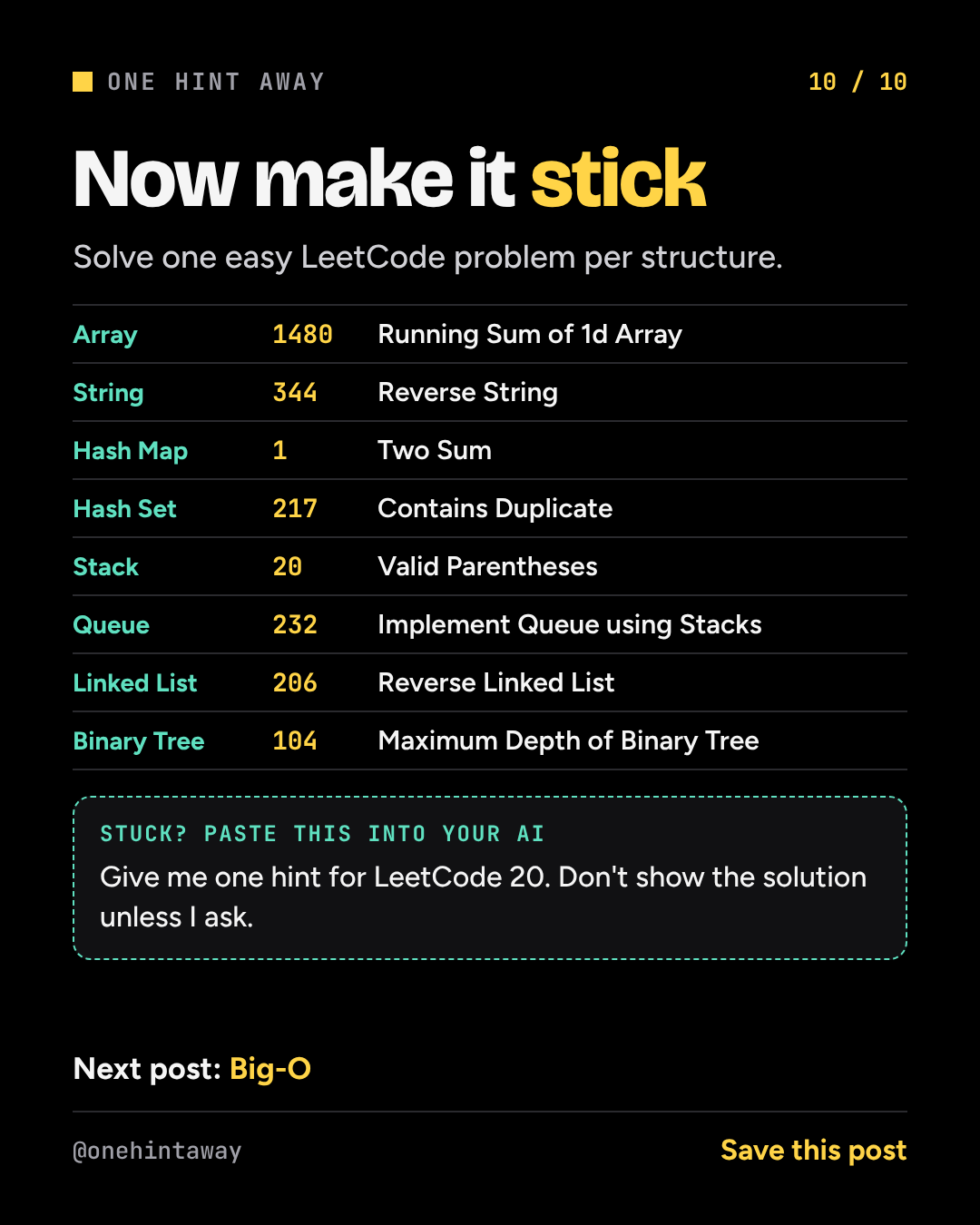
The eight structures every pattern is built on, one slide each. Learn what each one is for and what its operations cost, and every later post reads faster.
The idea
| Structure | What it is | Patterns it powers |
|---|---|---|
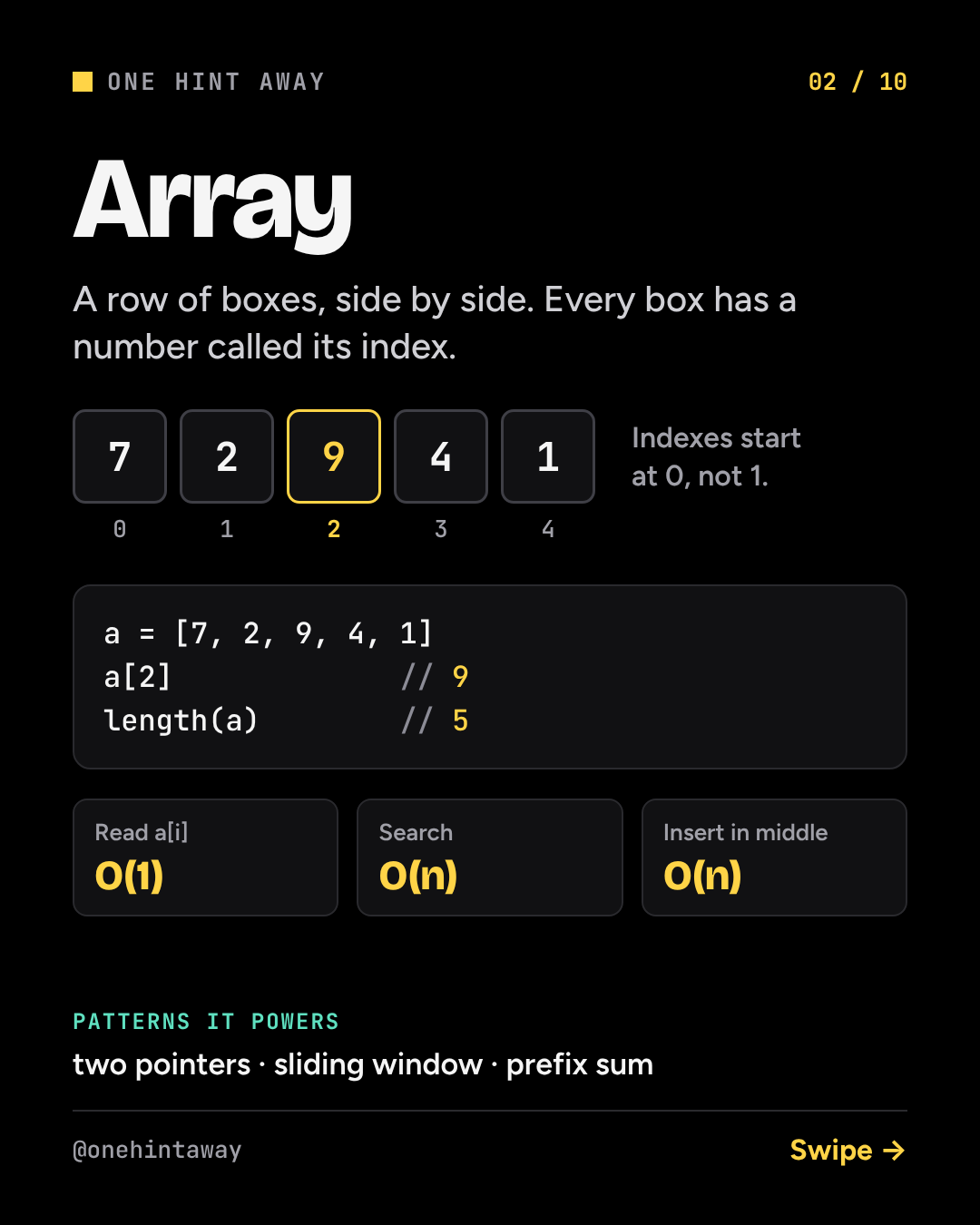
| Array | A row of boxes, side by side. Every box has a number called its index. | two pointers, sliding window, prefix sum |
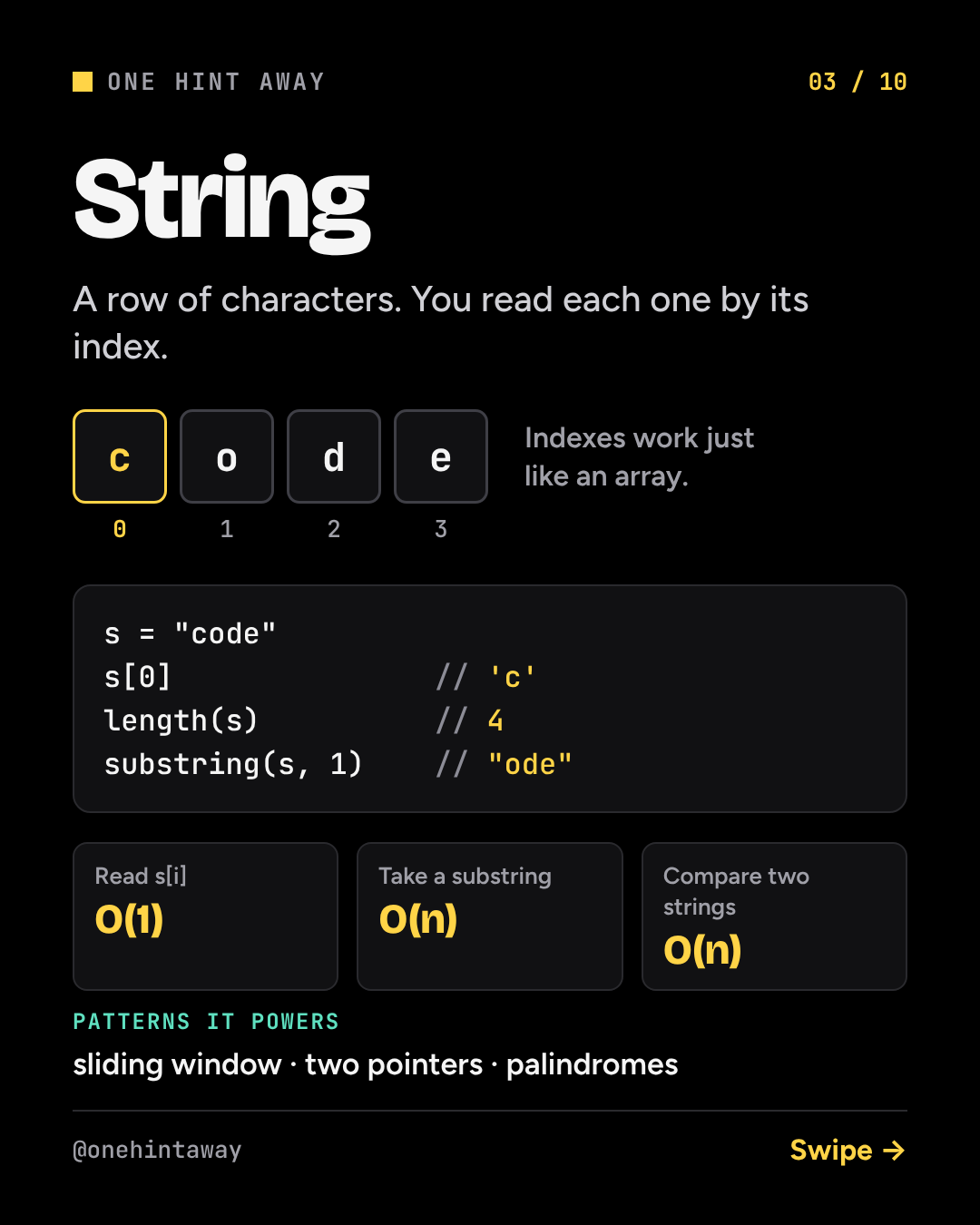
| String | A row of characters. You read each one by its index. | sliding window, two pointers, palindromes |
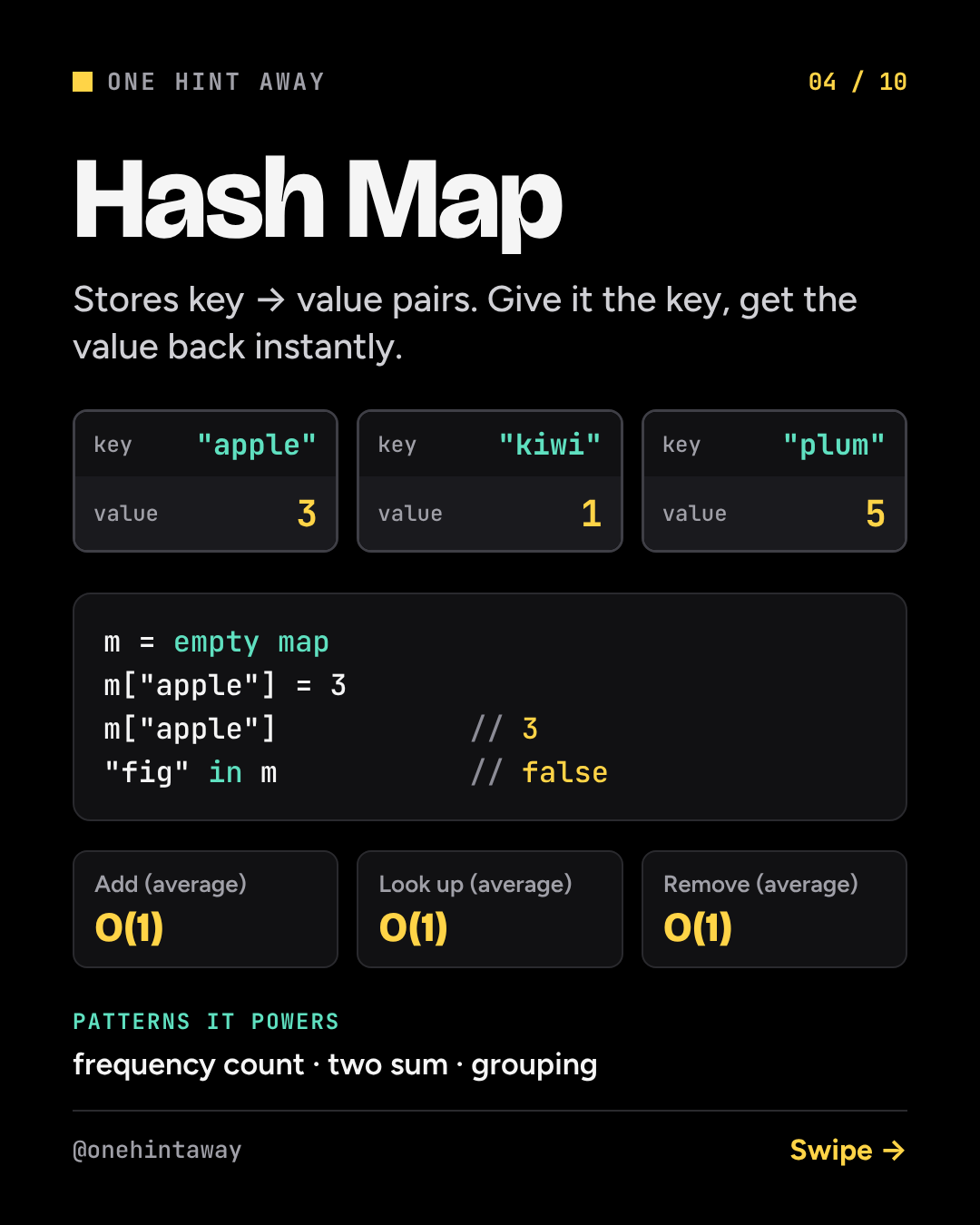
| Hash map | Stores key → value pairs. Give it the key, get the value back instantly. | frequency count, two sum, grouping |
| Hash set | A bag of unique values. It answers one question fast: have I seen this? | finding duplicates, visited tracking, cycles |
| Stack | Last in, first out. Like a pile of plates: you only touch the top one. | valid parentheses, monotonic stack, DFS |
| Queue | First in, first out. Like a ticket line: join at the back, leave from the front. | BFS, level-order traversal, shortest path |
| Linked list | Nodes chained by pointers. Each node knows only the next one. | fast and slow pointers, reversal, merging |
| Binary tree | Each node has up to two children. The top node is the root; a node with no children is a leaf. | DFS, BFS, recursion |
Pseudocode
// array
a = [7, 2, 9, 4, 1]
a[2]                    // 9
length(a)               // 5

// string
s = "code"
s[0]                    // 'c'
length(s)               // 4
substring(s, 1)         // "ode"

// hash map
m = empty map
m["apple"] = 3
m["apple"]              // 3
"fig" in m              // false

// hash set
seen = empty set
add 9 to seen
add 9 to seen           // ignored, already in
4 in seen               // false

// stack
st = empty stack
push 5 onto st
top of st               // 5, only looks
pop from st             // 5, removes it

// queue
q = empty queue
add 4 to q
front of q              // 4, only looks
remove front of q       // 4, removes it

// linked list
node has: value, next
cur = head
while cur != none:
    cur = cur.next

// binary tree
node has: value, left, right
root.value              // 8
root.left.value         // 3
root.right.value        // 10
The trap: indexes start at 0, not 1. In a = [7, 2, 9, 4, 1], a[2] is the third box, 9, not the second box, 2. The last box is a[length(a) - 1], and a[length(a)] is past the end.
Code
import java.util.ArrayDeque;
import java.util.Deque;
import java.util.HashMap;
import java.util.HashSet;
import java.util.Map;
import java.util.Queue;
import java.util.Set;

public class EightStructures {
    static class ListNode {
        int value;
        ListNode next;
        ListNode(int value, ListNode next) { this.value = value; this.next = next; }
    }

    static class TreeNode {
        int value;
        TreeNode left, right;
        TreeNode(int value, TreeNode left, TreeNode right) {
            this.value = value; this.left = left; this.right = right;
        }
    }

    public static void main(String[] args) {
        // array
        int[] a = {7, 2, 9, 4, 1};
        System.out.println(a[2]);            // 9
        System.out.println(a.length);        // 5

        // string
        String s = "code";
        System.out.println(s.charAt(0));     // c
        System.out.println(s.length());      // 4
        System.out.println(s.substring(1));  // ode

        // hash map
        Map<String, Integer> m = new HashMap<>();
        m.put("apple", 3);
        System.out.println(m.get("apple"));          // 3
        System.out.println(m.containsKey("fig"));    // false

        // hash set
        Set<Integer> seen = new HashSet<>();
        seen.add(9);
        seen.add(9);                                  // ignored, already in
        System.out.println(seen.contains(4));         // false

        // stack
        Deque<Integer> st = new ArrayDeque<>();
        st.push(5);
        System.out.println(st.peek());       // 5, only looks
        System.out.println(st.pop());        // 5, removes it

        // queue
        Queue<Integer> q = new ArrayDeque<>();
        q.offer(4);
        System.out.println(q.peek());        // 4, only looks
        System.out.println(q.poll());        // 4, removes it

        // linked list: 7 -> 2 -> 9
        ListNode head = new ListNode(7, new ListNode(2, new ListNode(9, null)));
        ListNode cur = head;
        while (cur != null) {
            cur = cur.next;
        }

        // binary tree
        TreeNode root = new TreeNode(8,
            new TreeNode(3, new TreeNode(1, null, null), new TreeNode(6, null, null)),
            new TreeNode(10, null, null));
        System.out.println(root.value);        // 8
        System.out.println(root.left.value);   // 3
        System.out.println(root.right.value);  // 10
    }
}
from collections import deque
class ListNode:
def __init__(self, value, next=None):
self.value = value
self.next = next
class TreeNode:
def __init__(self, value, left=None, right=None):
self.value = value
self.left = left
self.right = right
# array (a Python list)
a = [7, 2, 9, 4, 1]
print(a[2]) # 9
print(len(a)) # 5
# string
s = "code"
print(s[0]) # c
print(len(s)) # 4
print(s[1:]) # ode
# hash map (a dict)
m = {}
m["apple"] = 3
print(m["apple"]) # 3
print("fig" in m) # False
# hash set
seen = set()
seen.add(9)
seen.add(9) # ignored, already in
print(4 in seen) # False
# stack (a list used from the end)
st = []
st.append(5)
print(st[-1]) # 5, only looks
print(st.pop()) # 5, removes it
# queue
q = deque()
q.append(4)
print(q[0]) # 4, only looks
print(q.popleft()) # 4, removes it
# linked list: 7 -> 2 -> 9
head = ListNode(7, ListNode(2, ListNode(9)))
cur = head
while cur is not None:
cur = cur.next
# binary tree
root = TreeNode(8, TreeNode(3, TreeNode(1), TreeNode(6)), TreeNode(10))
print(root.value) # 8
print(root.left.value) # 3
print(root.right.value) # 10#include <iostream>
#include <queue>
#include <stack>
#include <string>
#include <unordered_map>
#include <unordered_set>
#include <vector>
using namespace std;
struct ListNode {
int value;
ListNode* next;
};
struct TreeNode {
int value;
TreeNode* left;
TreeNode* right;
};
int main() {
cout << boolalpha;
// array (a vector)
vector<int> a = {7, 2, 9, 4, 1};
cout << a[2] << "\n"; // 9
cout << a.size() << "\n"; // 5
// string
string s = "code";
cout << s[0] << "\n"; // c
cout << s.size() << "\n"; // 4
cout << s.substr(1) << "\n"; // ode
// hash map
unordered_map<string, int> m;
m["apple"] = 3;
cout << m["apple"] << "\n"; // 3
cout << (m.count("fig") > 0) << "\n"; // false
// hash set
unordered_set<int> seen;
seen.insert(9);
seen.insert(9); // ignored, already in
cout << (seen.count(4) > 0) << "\n"; // false
// stack
stack<int> st;
st.push(5);
cout << st.top() << "\n"; // 5, only looks
st.pop(); // removes it
// queue
queue<int> q;
q.push(4);
cout << q.front() << "\n"; // 4, only looks
q.pop(); // removes it
// linked list: 7 -> 2 -> 9
ListNode third{9, nullptr}, second{2, &third}, first{7, &second};
ListNode* cur = &first;
while (cur != nullptr) {
cur = cur->next;
}
// binary tree
TreeNode one{1, nullptr, nullptr}, six{6, nullptr, nullptr};
TreeNode three{3, &one, &six}, ten{10, nullptr, nullptr};
TreeNode root{8, &three, &ten};
cout << root.value << "\n"; // 8
cout << root.left->value << "\n"; // 3
cout << root.right->value << "\n"; // 10
}class ListNode {
constructor(value, next = null) {
this.value = value;
this.next = next;
}
}
class TreeNode {
constructor(value, left = null, right = null) {
this.value = value;
this.left = left;
this.right = right;
}
}
// array
const a = [7, 2, 9, 4, 1];
console.log(a[2]); // 9
console.log(a.length); // 5
// string
const s = "code";
console.log(s[0]); // c
console.log(s.length); // 4
console.log(s.slice(1)); // ode
// hash map (a Map)
const m = new Map();
m.set("apple", 3);
console.log(m.get("apple")); // 3
console.log(m.has("fig")); // false
// hash set
const seen = new Set();
seen.add(9);
seen.add(9); // ignored, already in
console.log(seen.has(4)); // false
// stack (an array used from the end)
const st = [];
st.push(5);
console.log(st[st.length - 1]); // 5, only looks
console.log(st.pop()); // 5, removes it
// queue (an array plus a head index, so removing is O(1))
const q = [];
let head = 0;
q.push(4);
console.log(q[head]); // 4, only looks
console.log(q[head++]); // 4, removes it
// linked list: 7 -> 2 -> 9
const list = new ListNode(7, new ListNode(2, new ListNode(9)));
let cur = list;
while (cur !== null) {
cur = cur.next;
}
// binary tree
const root = new TreeNode(8, new TreeNode(3, new TreeNode(1), new TreeNode(6)), new TreeNode(10));
console.log(root.value); // 8
console.log(root.left.value); // 3
console.log(root.right.value); // 10Complexity
| Structure | Operation | Cost |
|---|---|---|
| Array | read by index | O(1) |
| Array | search, insert in the middle | O(n) |
| String | read by index | O(1) |
| String | take a substring, compare two strings | O(n) |
| Hash map | add, look up, remove | O(1) on average |
| Hash set | add, check | O(1) on average |
| Stack | push, pop, look at top | O(1) |
| Queue | add to back, remove front, look at front | O(1) |
| Linked list | insert at head | O(1) |
| Linked list | reach the k-th node, search | O(n) |
| Binary tree | visit every node | O(n) |
| Binary tree | height when balanced | O(log n) |
| Binary tree | height when skewed | O(n) |
How it was tested
All four programs were compiled and run, and each printed the values in the pseudocode comments: 9, 5, 'c', 4, "ode", and so on down to the tree's 8, 3 and 10. The C++ version prints the stack and queue values once each, because pop() there removes without giving the value back (see post 03).
Practice
Try these in order. Open the worked example first if you got stuck on the slides.
Array.
String.
Hash map.
Hash set.
Stack.
Queue.
Linked list.
Binary tree.