09Sliding windowArrays and hashing
Minimum Window Substring
The shortest stretch that holds every letter of t: grow until nothing is missing, then shrink.

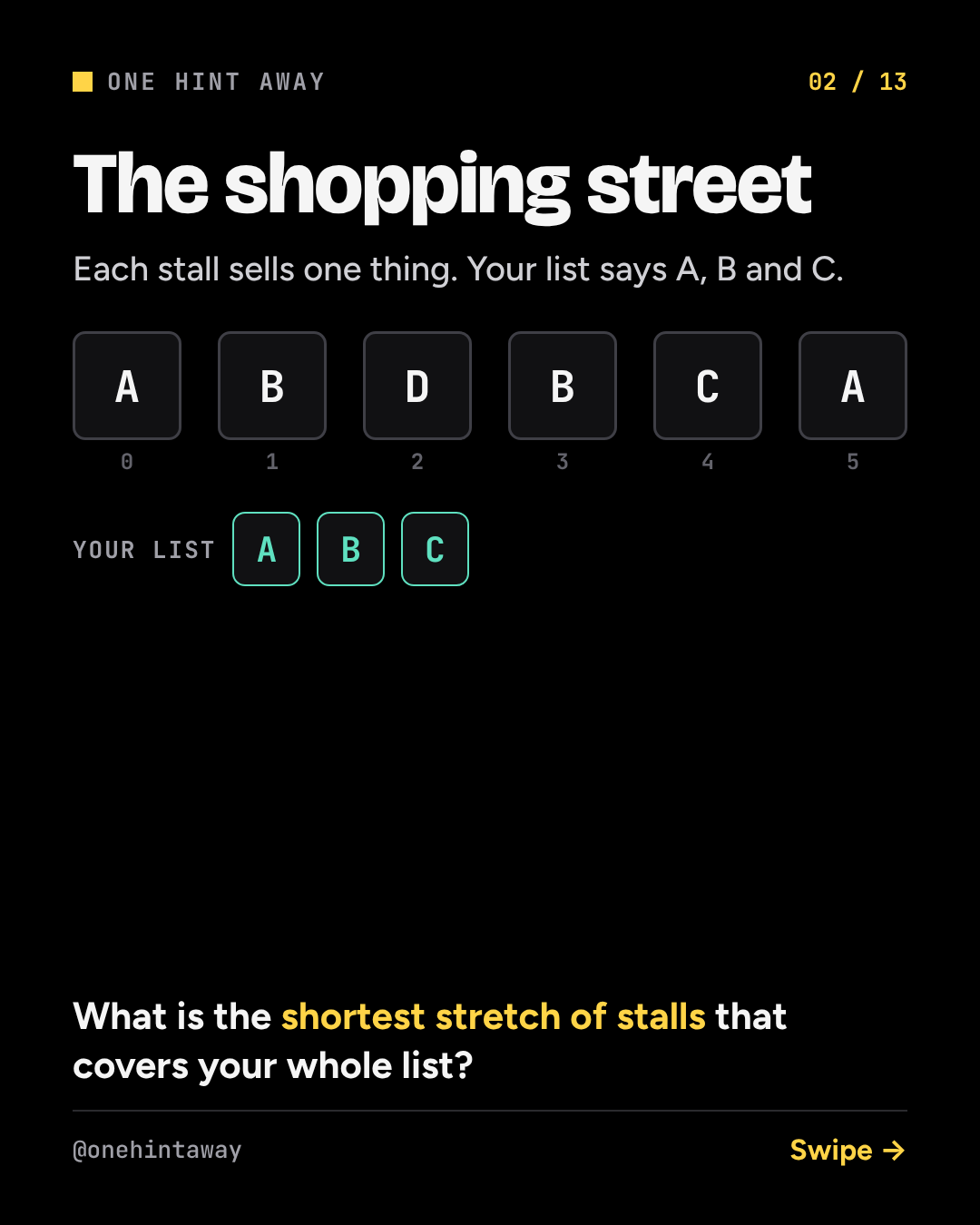
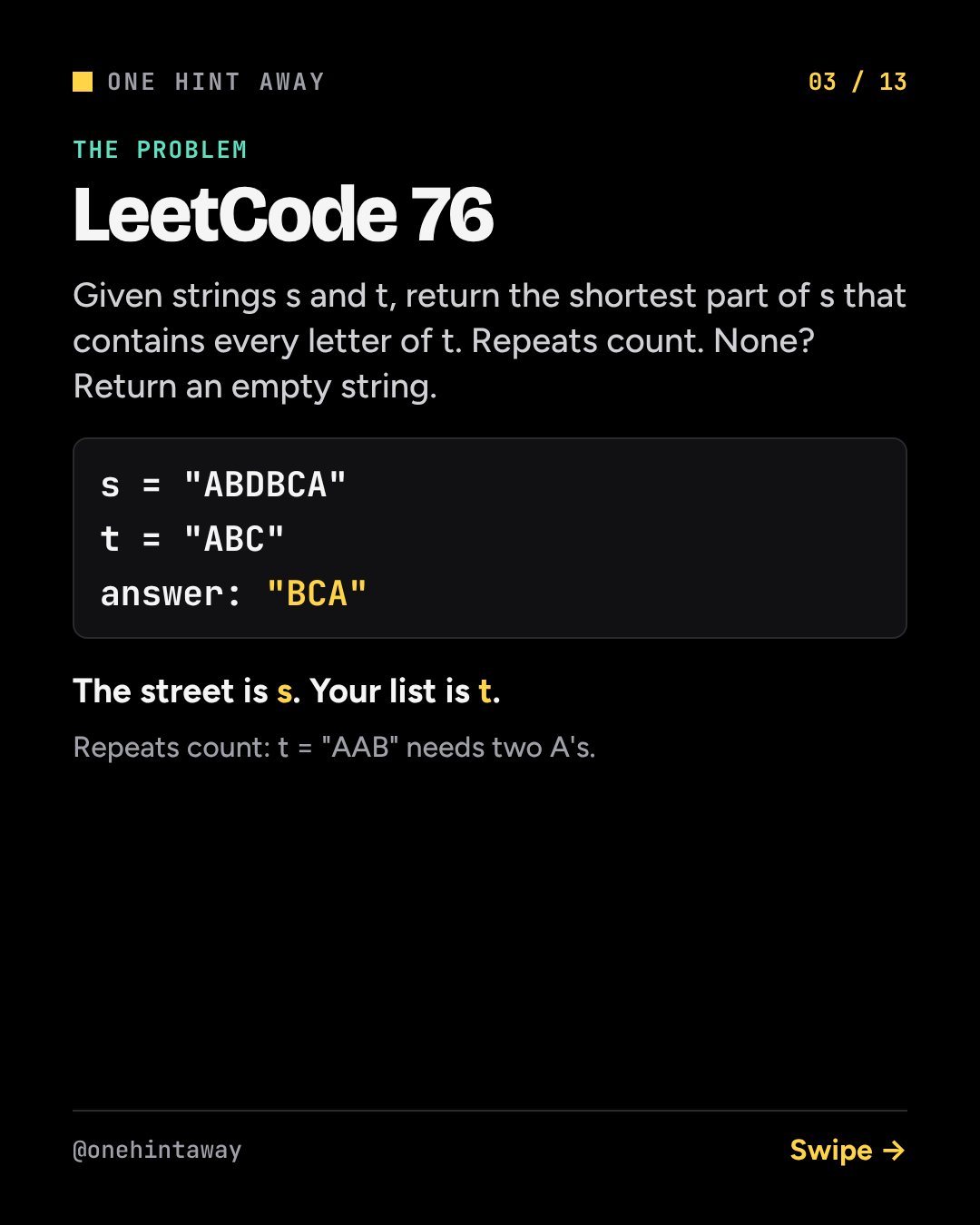

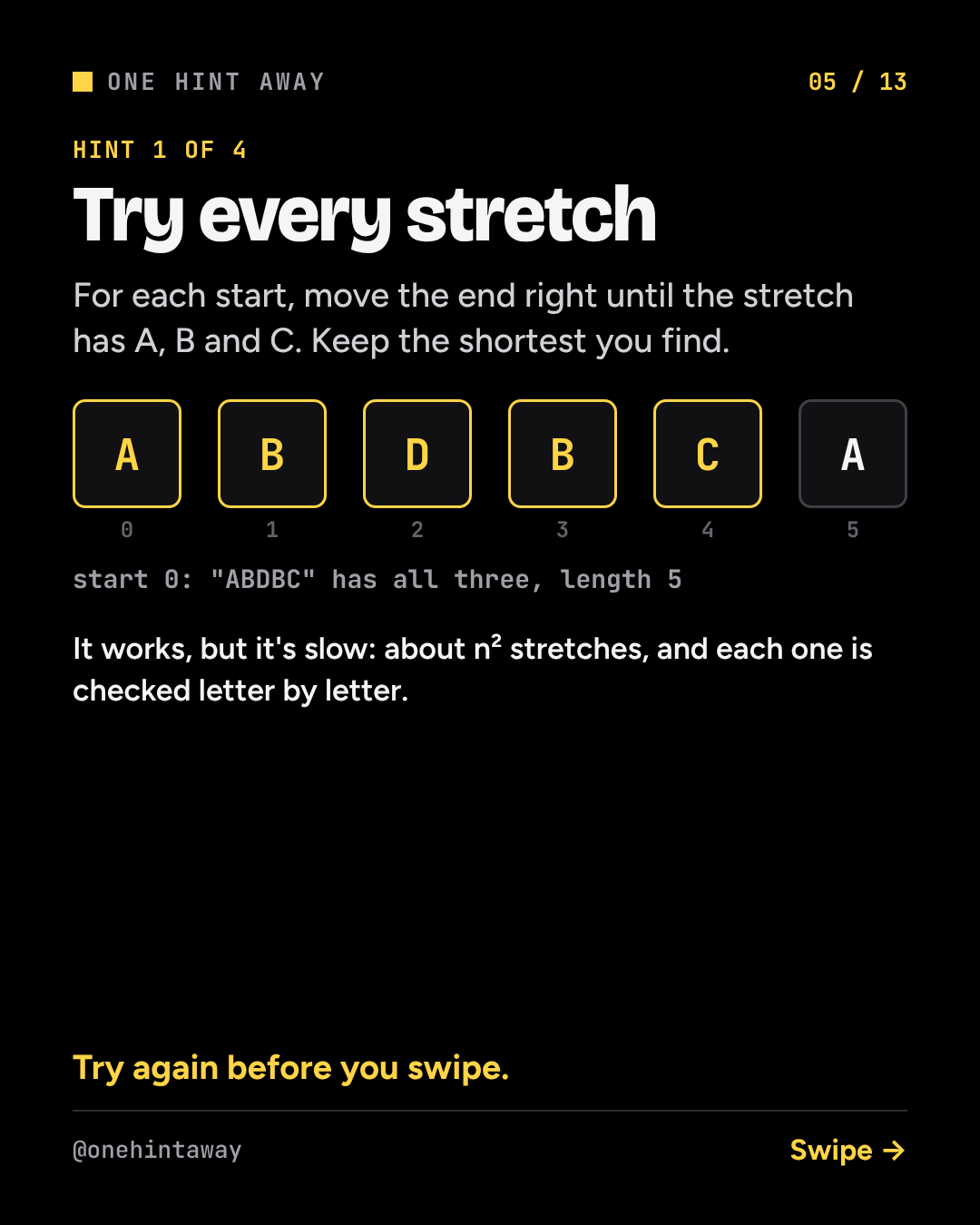
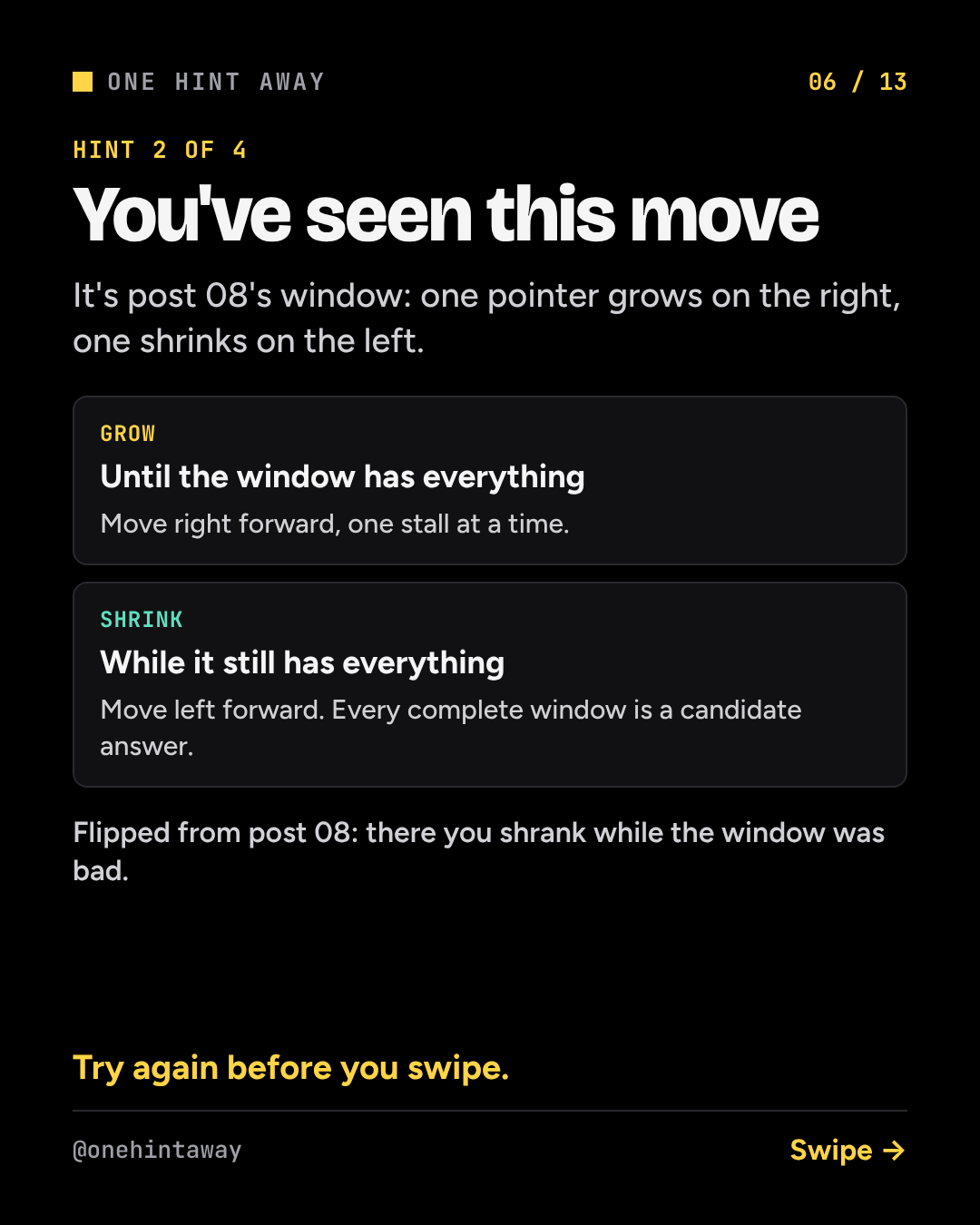
One Hint Away (@onehintaway). LeetCode 76, Minimum Window Substring (Hard). Pattern: sliding window (post 08) + a counting map (post 05).
Given strings s and t, return the shortest part of s that contains every letter of t, repeats included. If there is none, return "".
Worked example: s = "ABDBCA", t = "ABC" returns "BCA". LeetCode's own example s = "ADOBECODEBANC" returns "BANC".
The idea
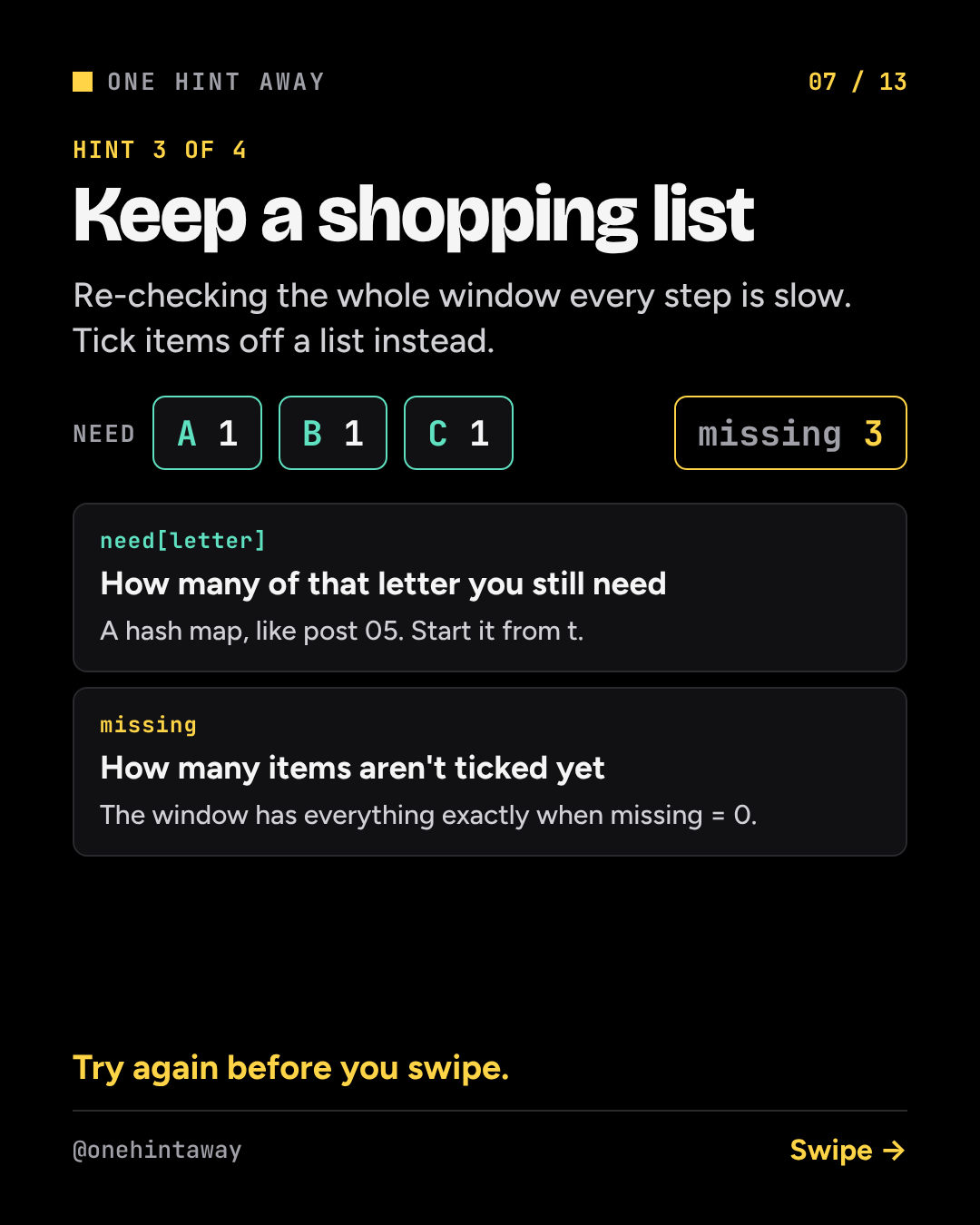
need[letter]: how many of that letter the window still needs. It starts fromt. It can go below 0, which means the window holds extra copies.missing: how many letters oftthe window still lacks. The window has everything exactly whenmissing == 0.- Grow on the right until
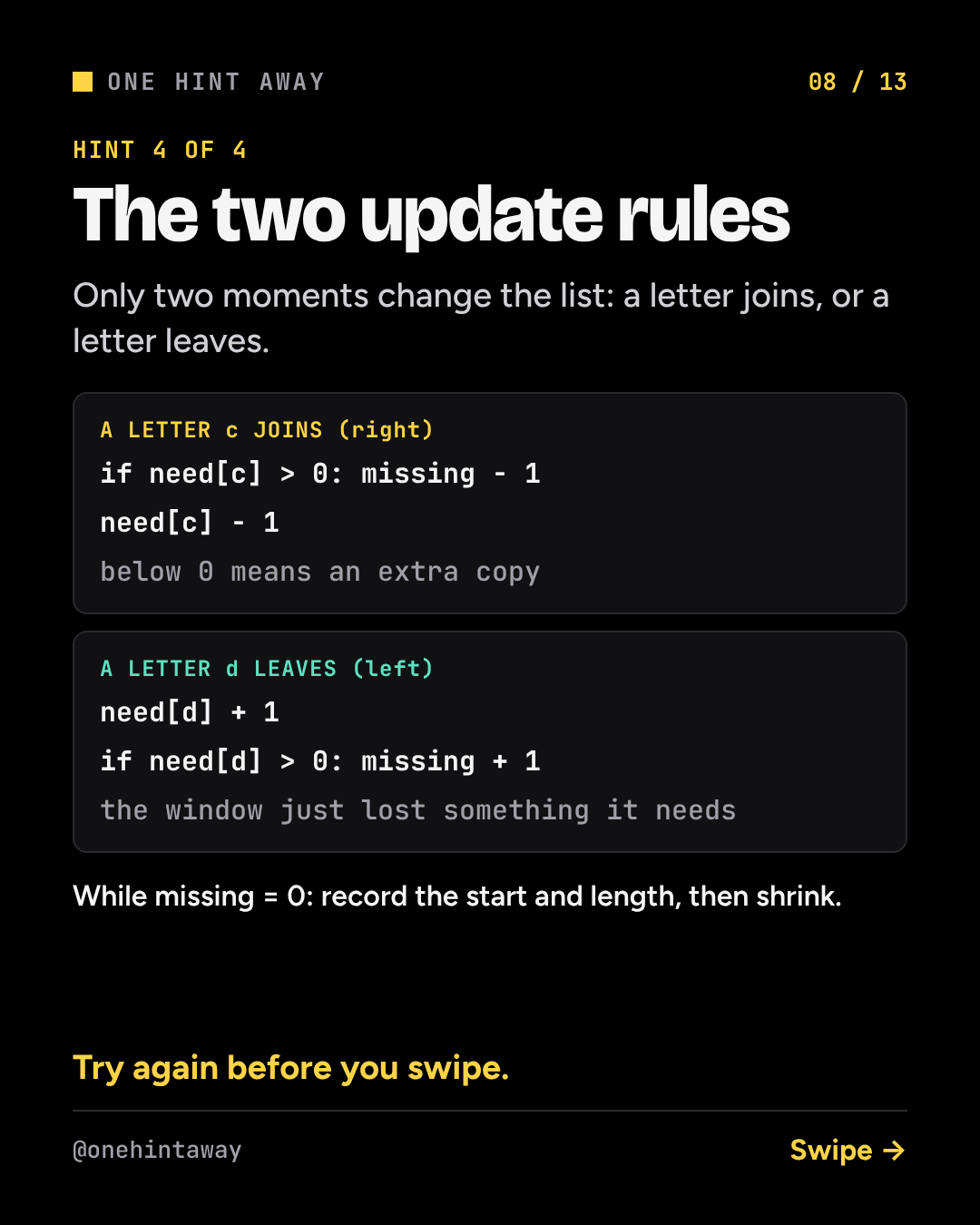
missing == 0. Then shrink from the left whilemissingstays 0, recording every window along the way.
The walk
| step | move | letter | missing | need A, B, C | window | recorded |
|---|---|---|---|---|---|---|
| 0 | start | 3 | 1, 1, 1 | (empty) | ||
| 1 | grow | A | 3 − 1 = 2 | 0, 1, 1 | A | |
| 2 | grow | B | 2 − 1 = 1 | 0, 0, 1 | AB | |
| 3 | grow | D | 1 − 0 = 1 | 0, 0, 1 | ABD | |
| 4 | grow | B | 1 − 0 = 1 | 0, −1, 1 | ABDB | |
| 5 | grow | C | 1 − 1 = 0 | 0, −1, 0 | ABDBC | ABDBC · 5 |
| 6 | shrink | A out | 0 + 1 = 1 | 1, −1, 0 | BDBC | |
| 7 | grow | A | 1 − 1 = 0 | 0, −1, 0 | BDBCA | 5, not shorter |
| 8 | shrink | B out | 0 + 0 = 0 | 0, 0, 0 | DBCA | DBCA · 4 |
| 9 | shrink | D out | 0 + 0 = 0 | 0, 0, 0 | BCA | BCA · 3 |
| 10 | shrink | B out | 0 + 1 = 1 | 0, 1, 0 | CA |
Answer: "BCA".
Pseudocode
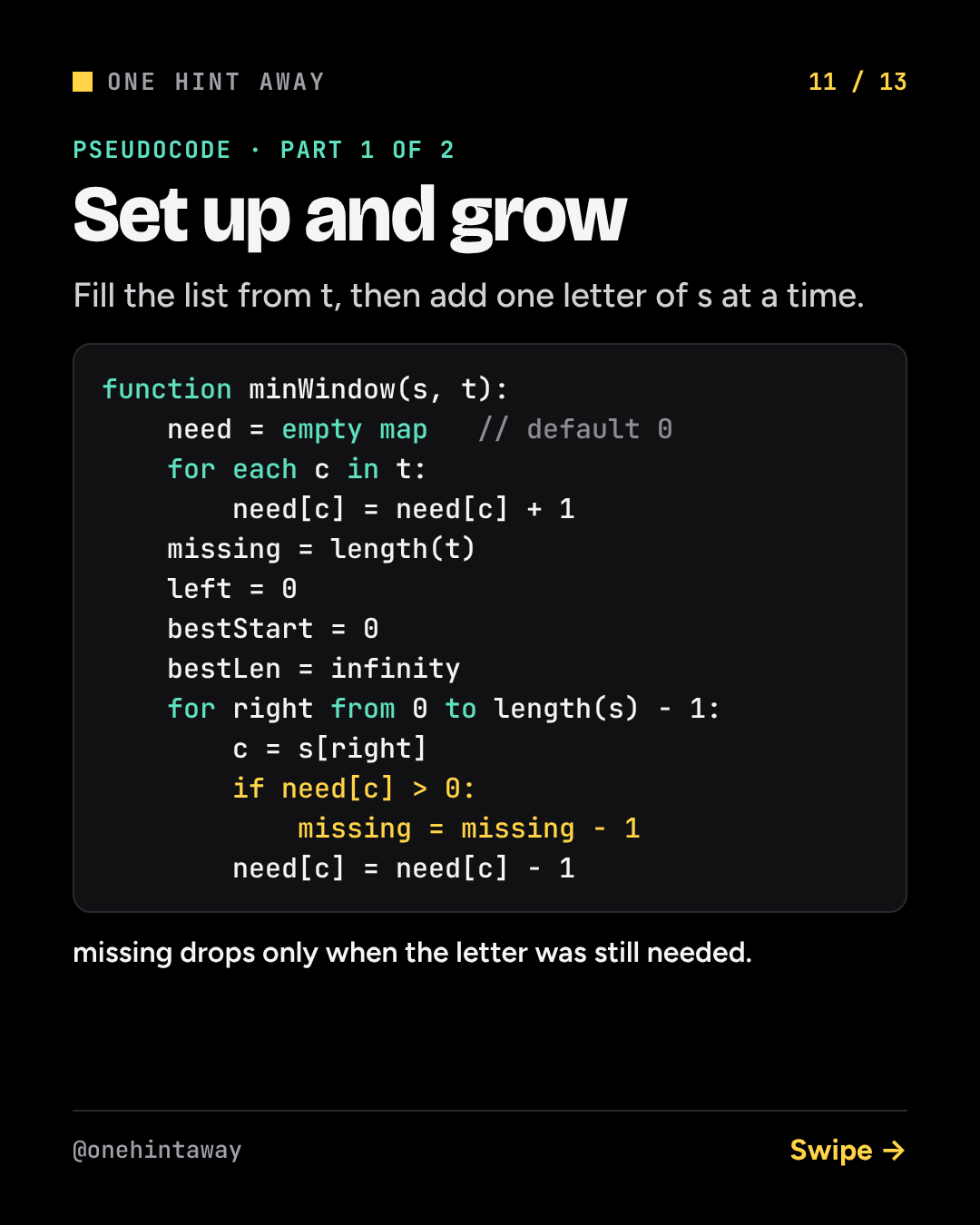
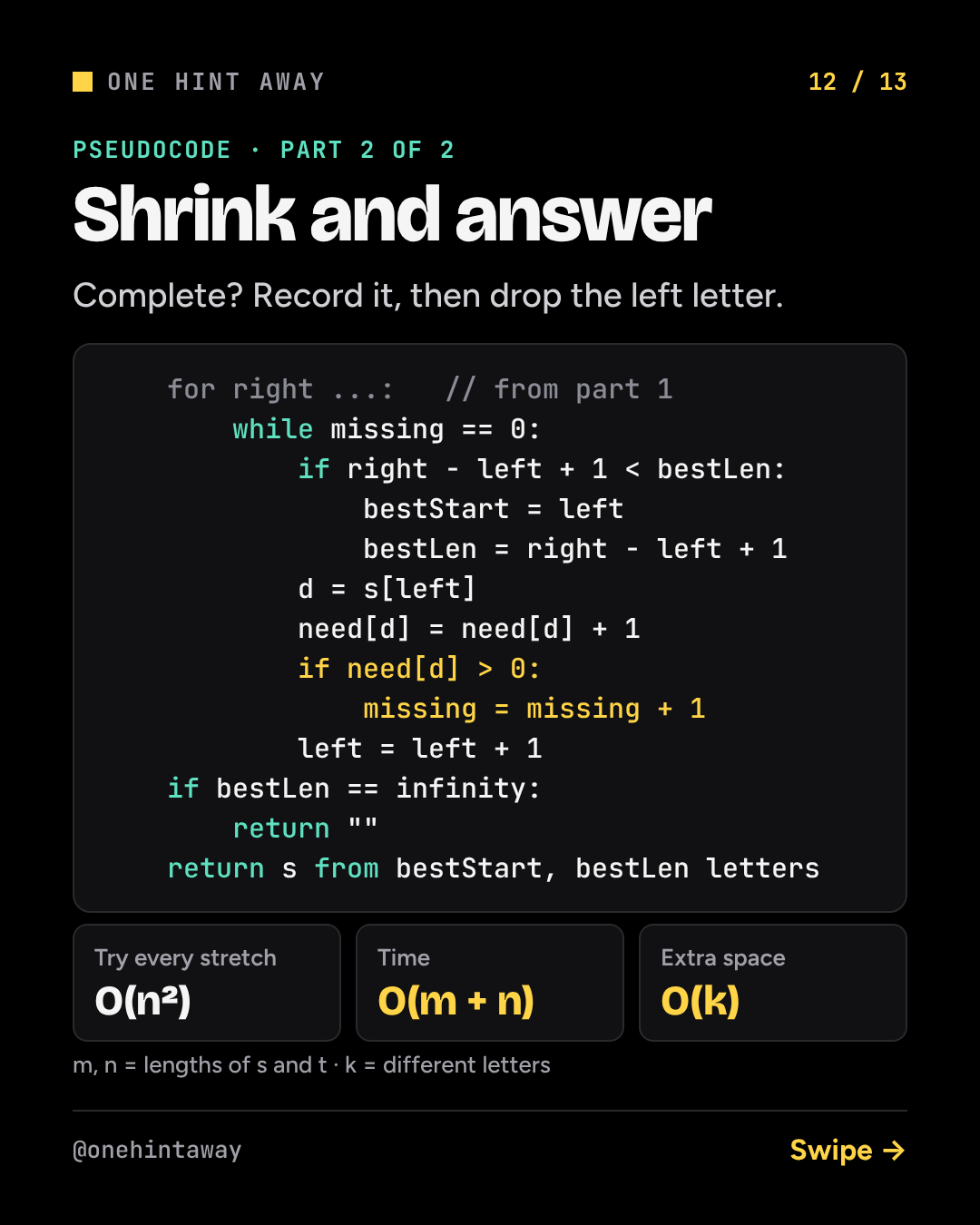
function minWindow(s, t):
    need = empty map   // default 0
    for each c in t:
        need[c] = need[c] + 1
    missing = length(t)
    left = 0
    bestStart = 0
    bestLen = infinity
    for right from 0 to length(s) - 1:
        c = s[right]
        if need[c] > 0:
            missing = missing - 1
        need[c] = need[c] - 1
        while missing == 0:
            if right - left + 1 < bestLen:
                bestStart = left
                bestLen = right - left + 1
            d = s[left]
            need[d] = need[d] + 1
            if need[d] > 0:
                missing = missing + 1
            left = left + 1
    if bestLen == infinity:
        return ""
    return s from bestStart, bestLen letters
The trap: lowering missing for every letter that joins. It should only drop when that letter was still needed (need[c] > 0 before the decrement); otherwise extra copies, like the second B, look like progress. On the example, lowering it for every letter returns "B", which doesn't even hold an A, instead of "BCA".
Two more mistakes to watch for:
- Raising
missingevery time a letter leaves. It should only rise whenneed[d]becomes positive, which means the window just lost a copy it needed. - Recording the window after the shrink instead of before it. You then miss the complete window you just had.
Why record start and length, not the string: copying a substring every time costs extra work. Cut the answer once at the end.
Code
import java.util.*;

class Solution {
    // O(m + n) time, O(k) space
    public String minWindow(String s, String t) {
        Map<Character, Integer> need = new HashMap<>();
        for (char c : t.toCharArray()) {
            need.put(c, need.getOrDefault(c, 0) + 1);
        }
        int missing = t.length();
        int left = 0;
        int bestStart = 0;
        int bestLen = Integer.MAX_VALUE;
        for (int right = 0; right < s.length(); right++) {
            char c = s.charAt(right);
            if (need.getOrDefault(c, 0) > 0) {
                missing = missing - 1;
            }
            need.put(c, need.getOrDefault(c, 0) - 1);
            while (missing == 0) {
                if (right - left + 1 < bestLen) {
                    bestStart = left;
                    bestLen = right - left + 1;
                }
                char d = s.charAt(left);
                need.put(d, need.get(d) + 1);
                if (need.get(d) > 0) {
                    missing = missing + 1;
                }
                left = left + 1;
            }
        }
        if (bestLen == Integer.MAX_VALUE) {
            return "";
        }
        return s.substring(bestStart, bestStart + bestLen);
    }
}
class Solution:
# O(m + n) time, O(k) space
def minWindow(self, s: str, t: str) -> str:
need = {}
for c in t:
need[c] = need.get(c, 0) + 1
missing = len(t)
left = 0
best_start = 0
best_len = float("inf")
for right in range(len(s)):
c = s[right]
if need.get(c, 0) > 0:
missing = missing - 1
need[c] = need.get(c, 0) - 1
while missing == 0:
if right - left + 1 < best_len:
best_start = left
best_len = right - left + 1
d = s[left]
need[d] = need[d] + 1
if need[d] > 0:
missing = missing + 1
left = left + 1
if best_len == float("inf"):
return ""
return s[best_start:best_start + best_len]#include <string>
#include <unordered_map>
#include <climits>
using namespace std;
class Solution {
public:
// O(m + n) time, O(k) space
string minWindow(string s, string t) {
unordered_map<char, int> need;
for (char c : t) {
need[c] = need[c] + 1;
}
int missing = t.size();
int left = 0;
int bestStart = 0;
int bestLen = INT_MAX;
for (int right = 0; right < (int)s.size(); right++) {
char c = s[right];
if (need[c] > 0) {
missing = missing - 1;
}
need[c] = need[c] - 1;
while (missing == 0) {
if (right - left + 1 < bestLen) {
bestStart = left;
bestLen = right - left + 1;
}
char d = s[left];
need[d] = need[d] + 1;
if (need[d] > 0) {
missing = missing + 1;
}
left = left + 1;
}
}
if (bestLen == INT_MAX) {
return "";
}
return s.substr(bestStart, bestLen);
}
};// O(m + n) time, O(k) space
var minWindow = function (s, t) {
const need = new Map();
for (const c of t) {
need.set(c, (need.get(c) ?? 0) + 1);
}
let missing = t.length;
let left = 0;
let bestStart = 0;
let bestLen = Infinity;
for (let right = 0; right < s.length; right++) {
const c = s[right];
if ((need.get(c) ?? 0) > 0) {
missing = missing - 1;
}
need.set(c, (need.get(c) ?? 0) - 1);
while (missing === 0) {
if (right - left + 1 < bestLen) {
bestStart = left;
bestLen = right - left + 1;
}
const d = s[left];
need.set(d, need.get(d) + 1);
if (need.get(d) > 0) {
missing = missing + 1;
}
left = left + 1;
}
}
if (bestLen === Infinity) {
return "";
}
return s.substring(bestStart, bestStart + bestLen);
};Complexity
| Version | Time | Extra space |
|---|---|---|
| Try every stretch | O(m²) stretches, each checked letter by letter | O(k) |
| Grow and shrink | O(m + n) | O(k) |
m and n are the lengths of s and t, and k is the number of different letters. Each letter of s joins the window once and leaves at most once.
How it was tested
All four languages return "BCA" on the worked example and "BANC" on LeetCode's example. They were run on 3,005 inputs (3,000 random strings s of length 1 to 12 and t of length 1 to 4 over the letters A to D, plus the two examples and the edge cases "a"/"a", "a"/"aa" and "a"/"b") and matched a brute force that checks every stretch on every one.
Practice
Try these in order. Open the worked example first if you got stuck on the slides.
- LeetCode 76 Minimum Window Substringworked example
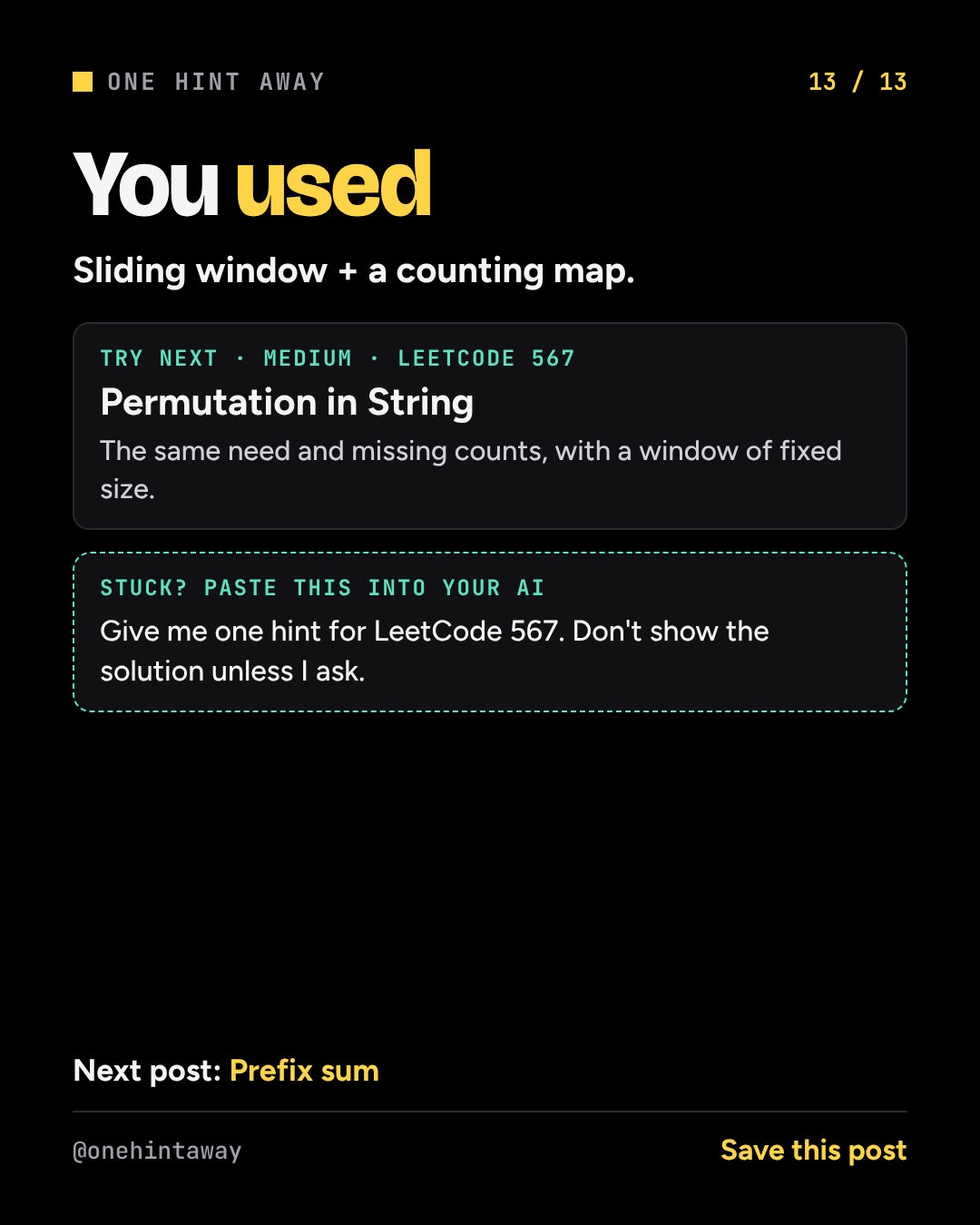
The same need and missing counts, with a window of fixed size.