08Sliding windowArrays and hashing
Sliding window, any size
The longest stretch in a row that follows a rule, like sum ≤ 5: grow on the right, shrink on the left.
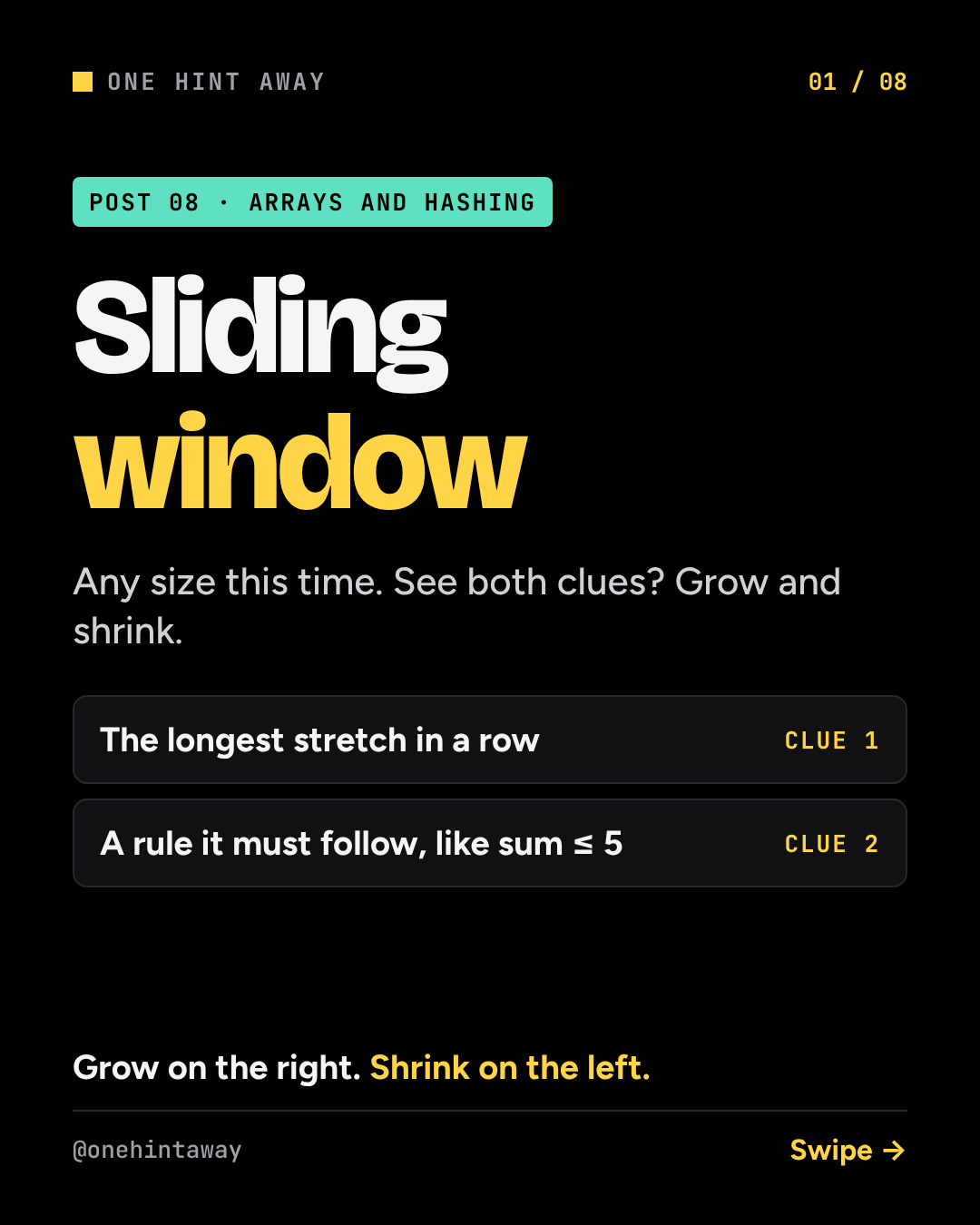
One Hint Away (@onehintaway). Clues: the longest stretch in a row (a subarray or substring) and a rule it must follow, like "the sum is at most 5".
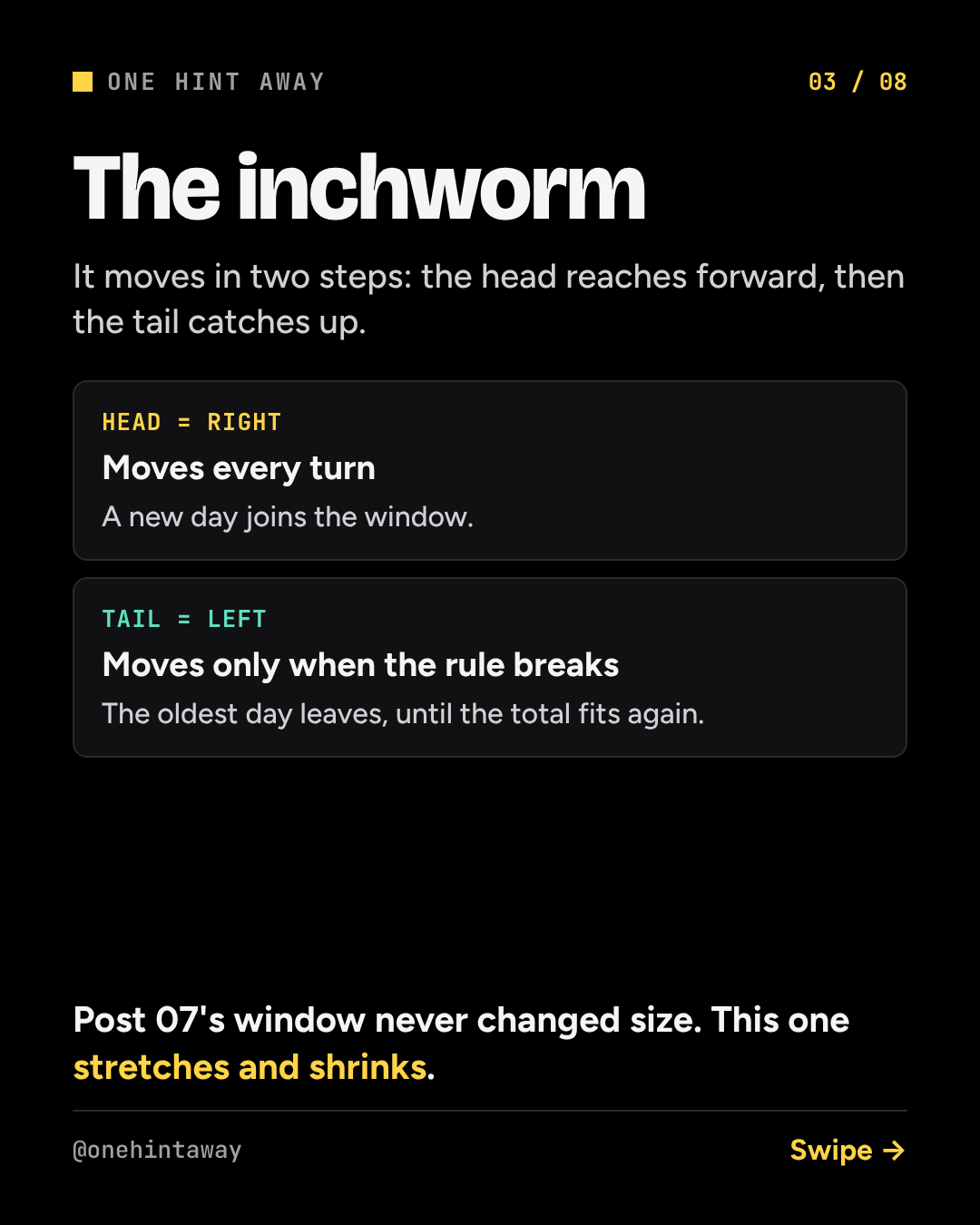
Post 07's window never changed size. This one stretches and shrinks, like an inchworm:
- Head =
right. Moves every turn: a new day joins the window. - Tail =
left. Moves only when the rule breaks: the oldest day leaves, until the total fits again.
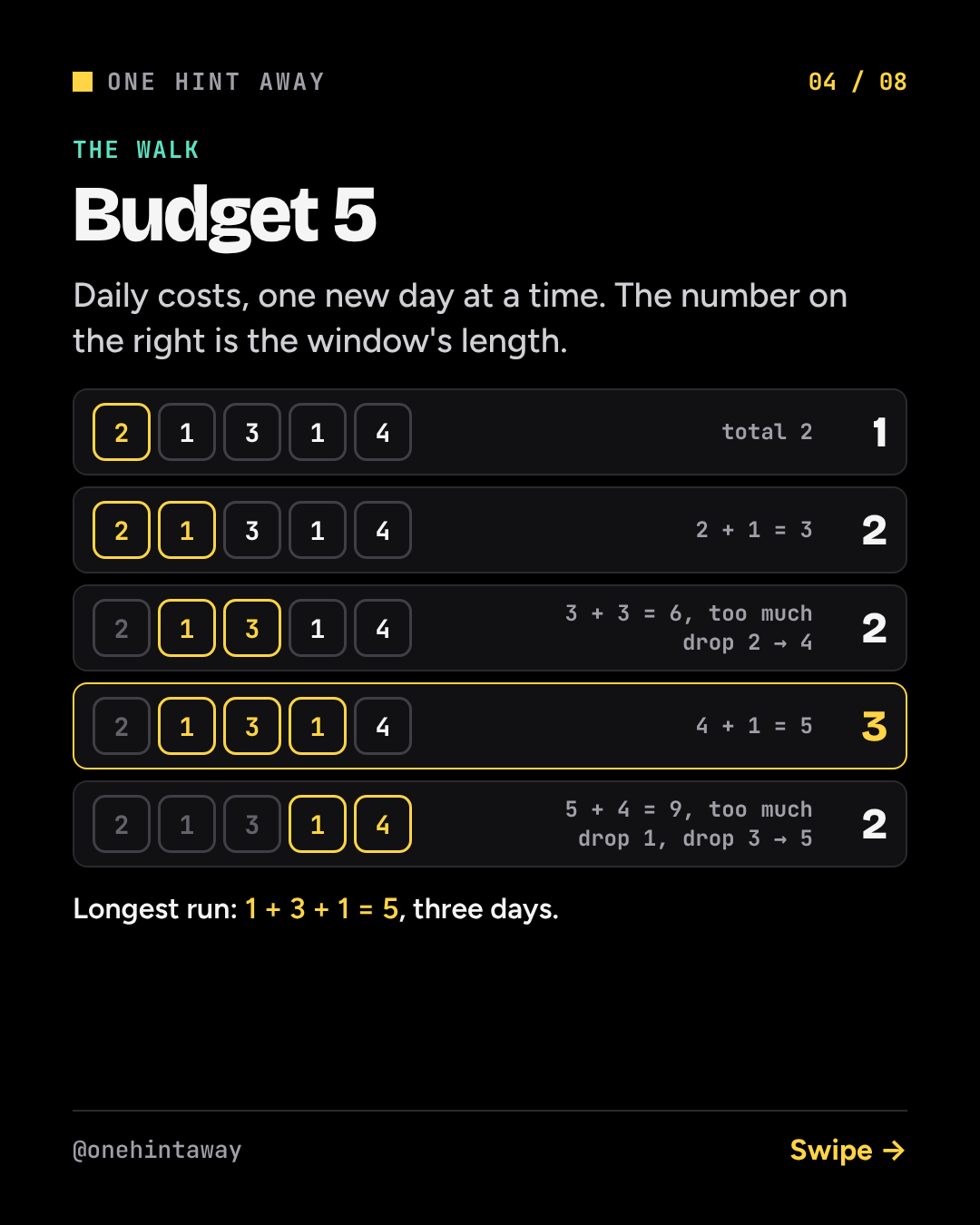
Worked example: daily costs nums = [2, 1, 3, 1, 4] with budget = 5. What is the longest run of days in a row that costs at most 5? Answer: 3 (1 + 3 + 1).
The walk
| right | joins | total | shrink | window | length |
|---|---|---|---|---|---|
| 0 | 2 | 2 | [2] | 1 | |
| 1 | 1 | 2 + 1 = 3 | [2, 1] | 2 | |
| 2 | 3 | 3 + 3 = 6, too much | drop 2 → 4 | [1, 3] | 2 |
| 3 | 1 | 4 + 1 = 5 | [1, 3, 1] | 3 | |
| 4 | 4 | 5 + 4 = 9, too much | drop 1, drop 3 → 5 | [1, 4] | 2 |
Longest run: 1 + 3 + 1 = 5, three days.
Pseudocode
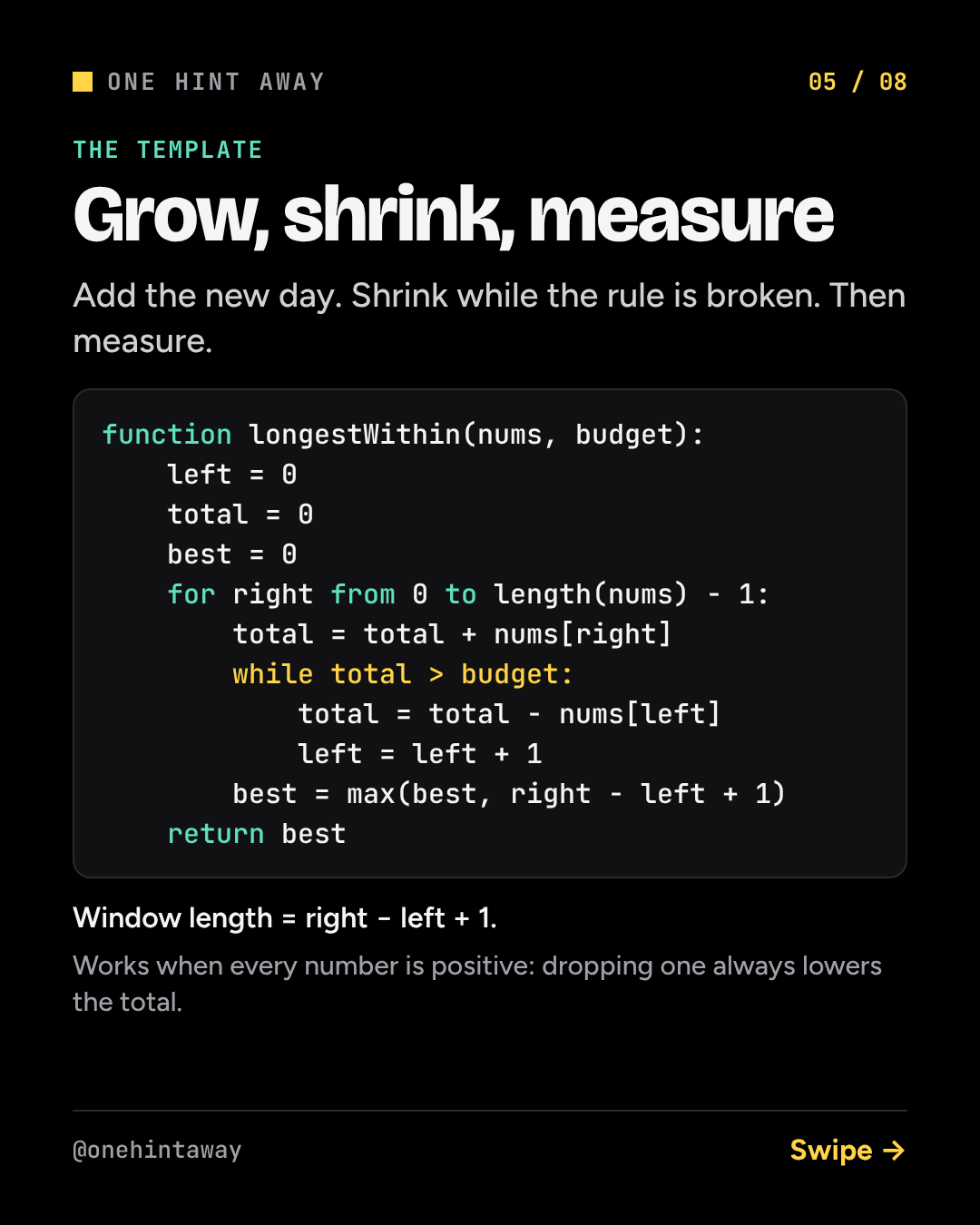
Grow, shrink, measure: add the new day, shrink while the rule is broken, then measure.
function longestWithin(nums, budget):
    left = 0
    total = 0
    best = 0
    for right from 0 to length(nums) - 1:
        total = total + nums[right]
        while total > budget:
            total = total - nums[left]
            left = left + 1
        best = max(best, right - left + 1)
    return best
Window length = right - left + 1. This works when every number is positive: dropping one always lowers the total.
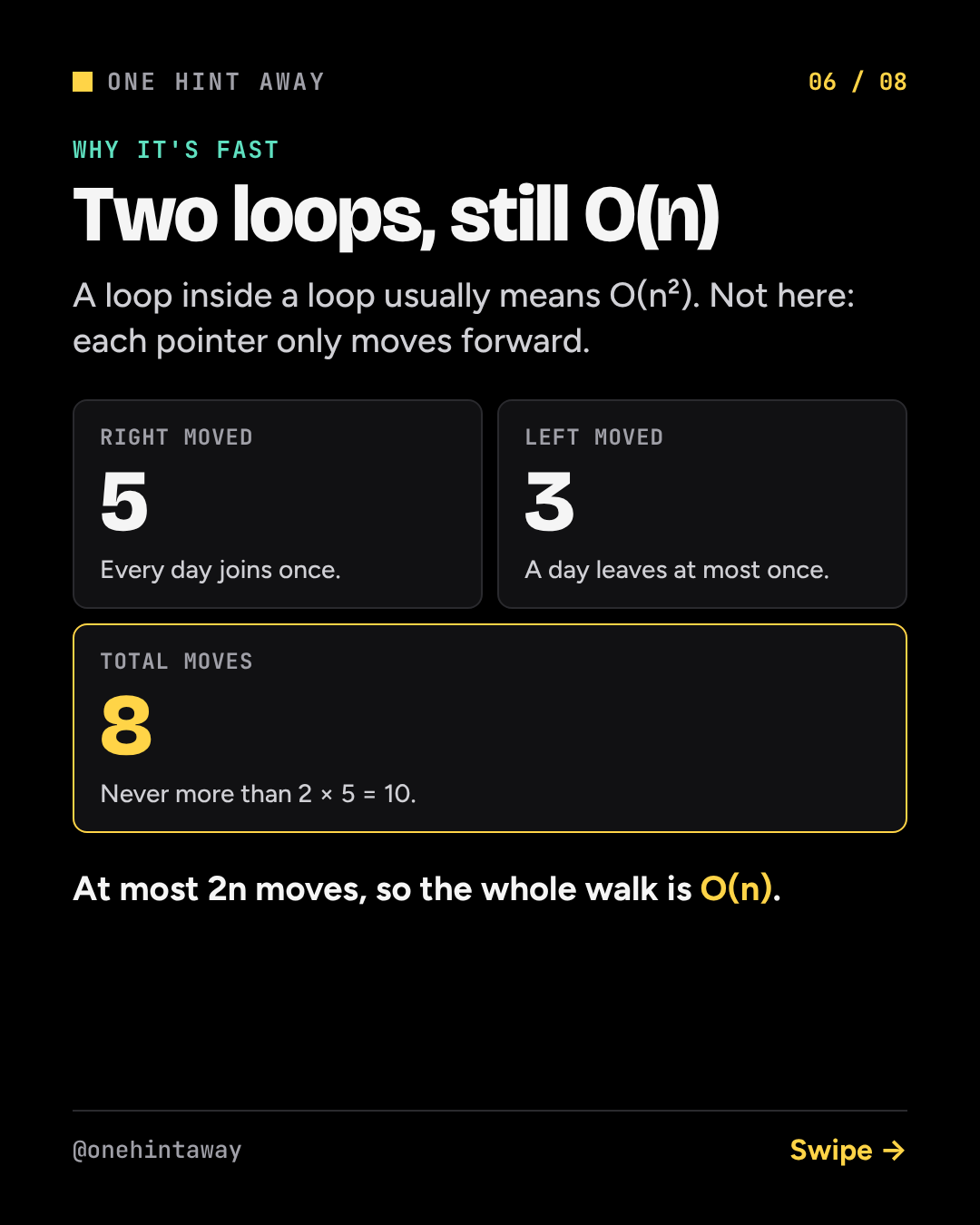
Why two loops are still O(n): a loop inside a loop usually means O(n²), but here each pointer only moves forward. On the example right moves 5 times and left 3 times: 8 moves, never more than 2 × 5 = 10. Every day joins once and leaves at most once.
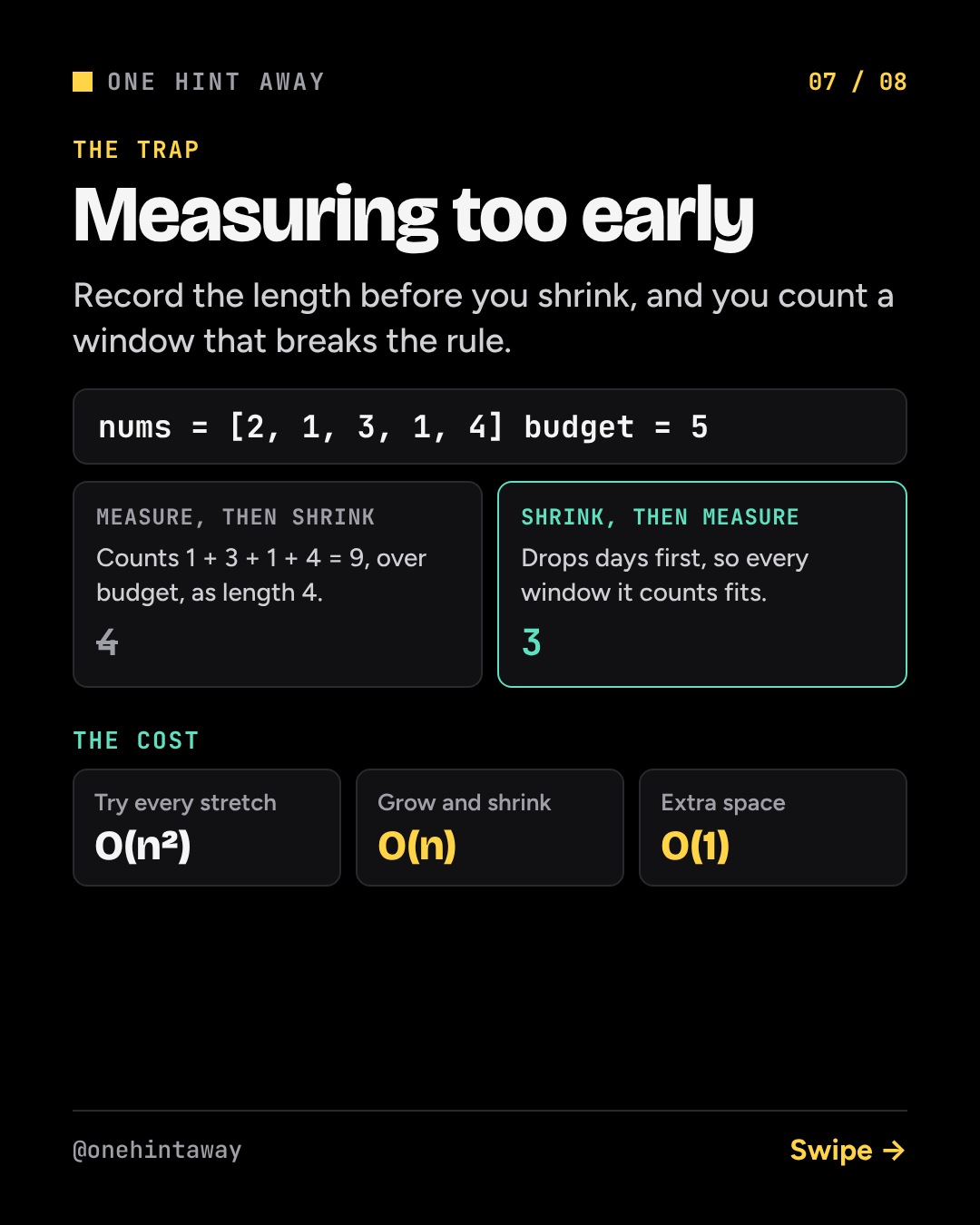
The trap: measuring too early. Record the length before you shrink and you count a window that breaks the rule. On the example, "measure, then shrink" counts 1 + 3 + 1 + 4 = 9, over budget, as length 4. "Shrink, then measure" drops days first, so every window it counts fits, and it returns 3.
Code
class Solution {
    // O(n) time, O(1) space. Every number must be positive.
    public int longestWithin(int[] nums, int budget) {
        int left = 0;
        int total = 0;
        int best = 0;
        for (int right = 0; right < nums.length; right++) {
            total = total + nums[right];
            while (total > budget) {
                total = total - nums[left];
                left = left + 1;
            }
            best = Math.max(best, right - left + 1);
        }
        return best;
    }
}
class Solution:
# O(n) time, O(1) space. Every number must be positive.
def longestWithin(self, nums: list[int], budget: int) -> int:
left = 0
total = 0
best = 0
for right in range(len(nums)):
total = total + nums[right]
while total > budget:
total = total - nums[left]
left = left + 1
best = max(best, right - left + 1)
return bestclass Solution {
public:
// O(n) time, O(1) space. Every number must be positive.
int longestWithin(vector<int>& nums, int budget) {
int left = 0;
int total = 0;
int best = 0;
for (int right = 0; right < (int)nums.size(); right++) {
total = total + nums[right];
while (total > budget) {
total = total - nums[left];
left = left + 1;
}
best = max(best, right - left + 1);
}
return best;
}
};// O(n) time, O(1) space. Every number must be positive.
function longestWithin(nums, budget) {
let left = 0;
let total = 0;
let best = 0;
for (let right = 0; right < nums.length; right++) {
total = total + nums[right];
while (total > budget) {
total = total - nums[left];
left = left + 1;
}
best = Math.max(best, right - left + 1);
}
return best;
}If a number can be 0 or negative, dropping the oldest day might not lower the total, so the shrink step stops being safe. Those problems need a different tool, like the prefix sum with a hash map in post 11.
Complexity
| Version | Time | Extra space |
|---|---|---|
| Try every stretch | O(n²) | O(1) |
| Grow and shrink | O(n) | O(1) |
How it was tested
The Java, Python and JavaScript versions return 3 on the example and match a try-every-stretch brute force on 3,007 inputs (3,000 random arrays of length 0 to 12 with values 1 to 10, plus edge cases: empty, one number over or exactly at the budget, budget 0, every number over budget). The measure-too-early version returns 4 on the example. On 31 October 2026 all four versions, C++ included, were compiled and run on 3,001 more inputs (3,000 random arrays of length 0 to 12 with values 1 to 10 and budgets 0 to 30, plus the example) and matched the brute force on every one.
Practice
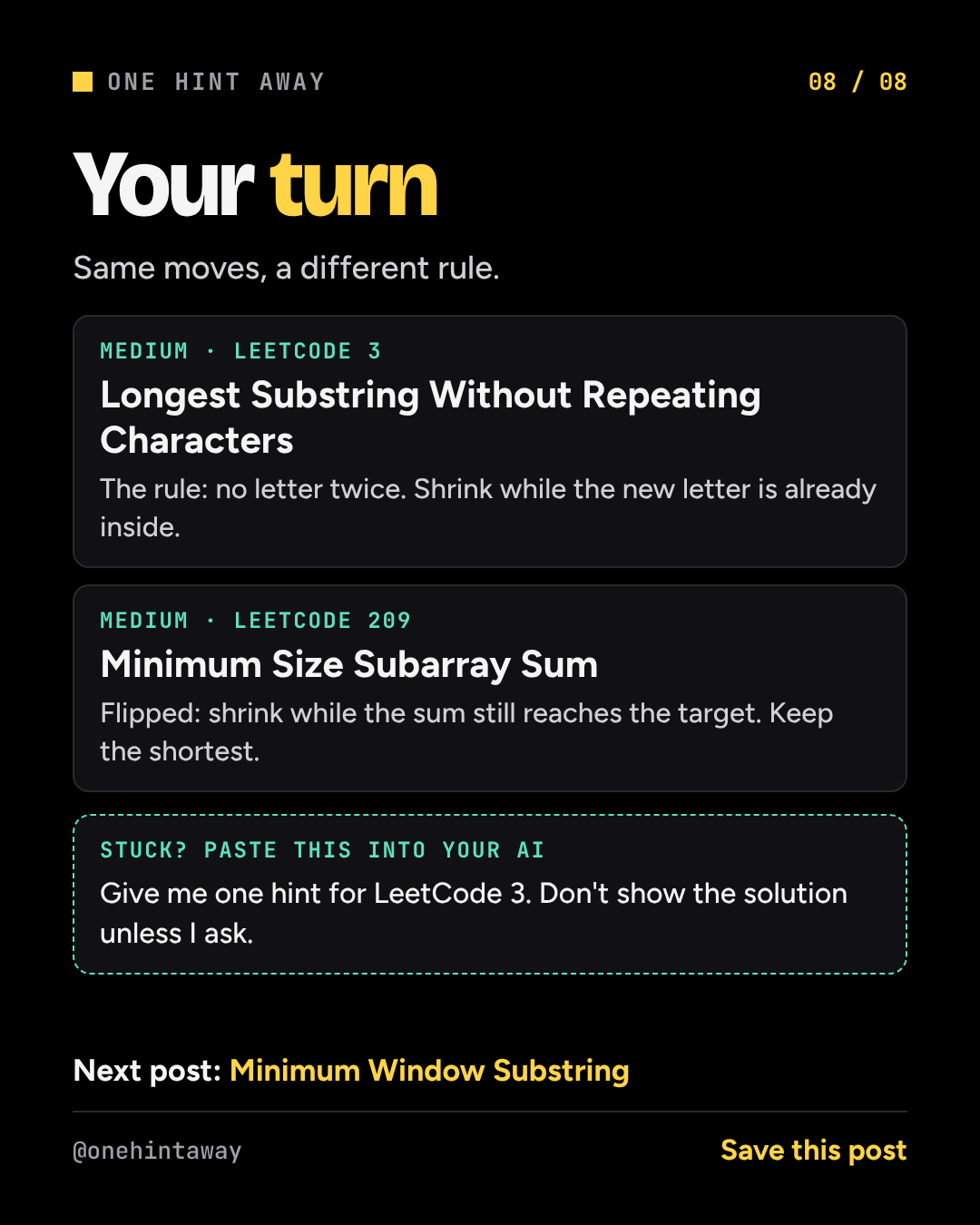
Try these in order. Open the worked example first if you got stuck on the slides.
The rule: no letter twice. Shrink while the new letter is already inside.
Flipped: shrink while the sum still reaches the target. Keep the shortest.