06Two pointersArrays and hashing
Two pointers
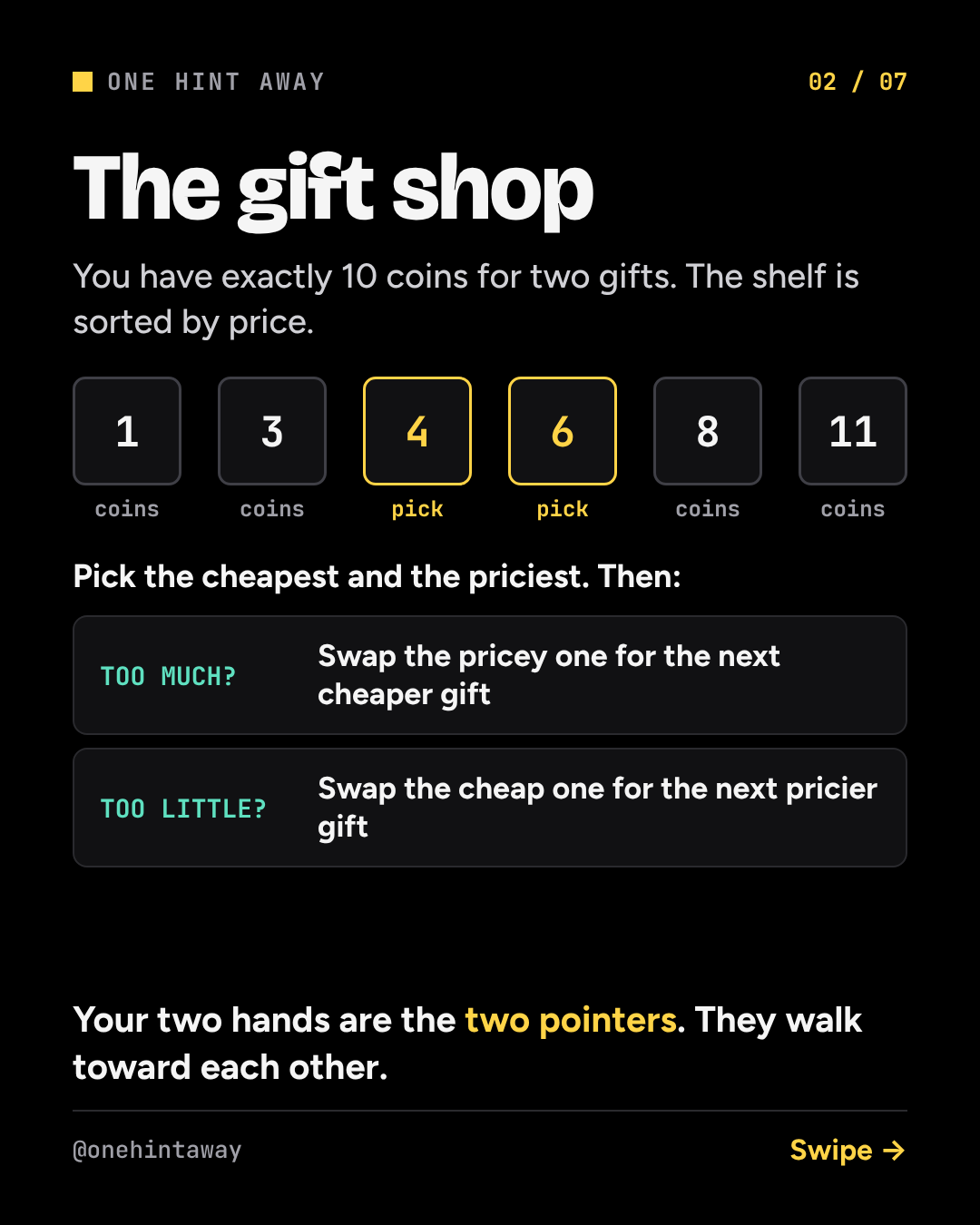
A sorted array and a pair to find: start at both ends and walk inward.
One Hint Away (@onehintaway). Clues: the array is sorted and you need a pair with some property, such as a target sum.
Worked example: LeetCode 167, Two Sum II - Input Array Is Sorted (Medium). The array is sorted in non-decreasing order, there is exactly one answer, and LeetCode wants the two positions counted from 1, using only constant extra space.
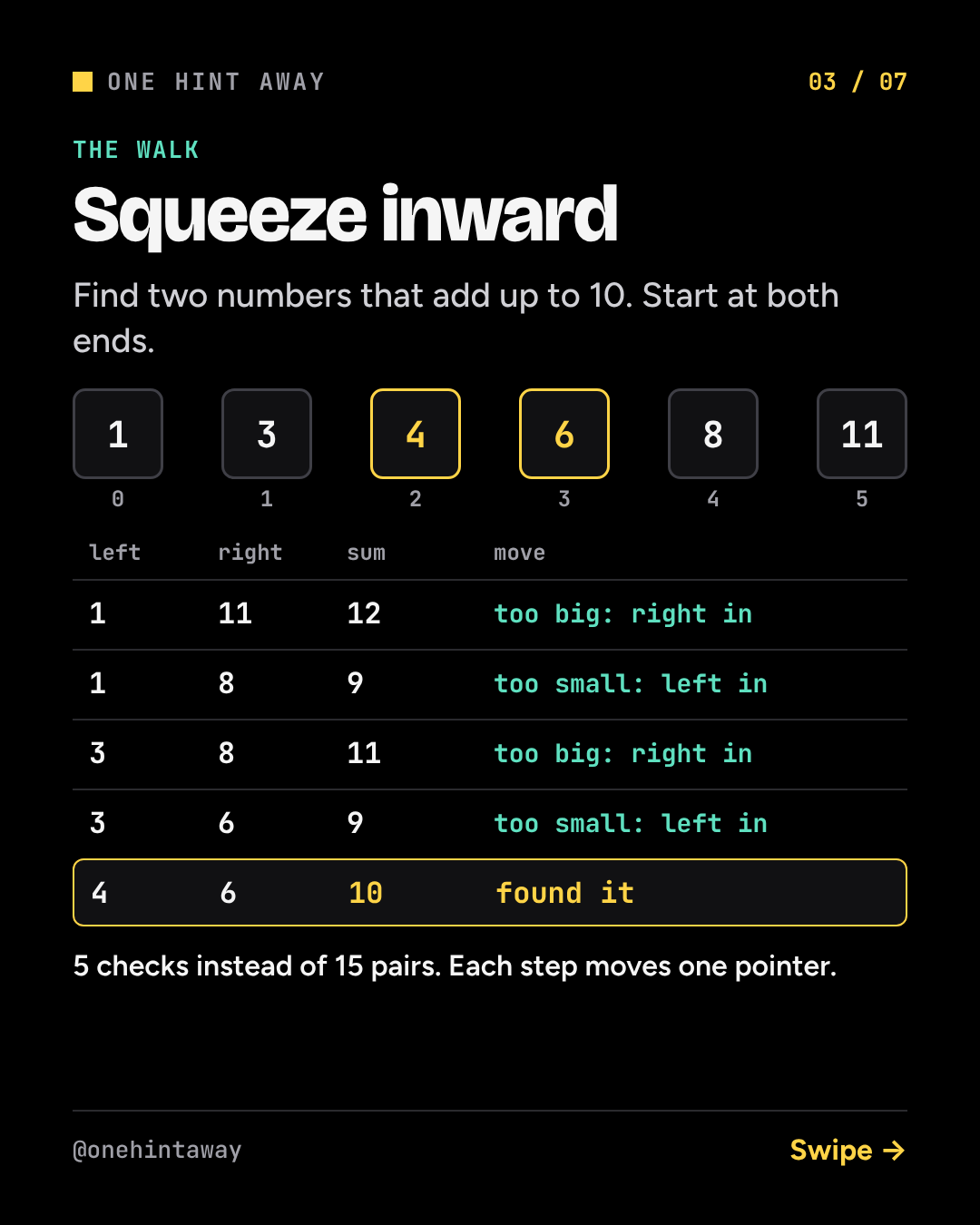
The walk
numbers = [1, 3, 4, 6, 8, 11], target = 10 returns [3, 4] (positions of 4 and 6, counted from 1).
| left | right | sum | move |
|---|---|---|---|
| 1 | 11 | 12 | too big: right in |
| 1 | 8 | 9 | too small: left in |
| 3 | 8 | 11 | too big: right in |
| 3 | 6 | 9 | too small: left in |
| 4 | 6 | 10 | found it |
5 checks instead of 15 pairs.
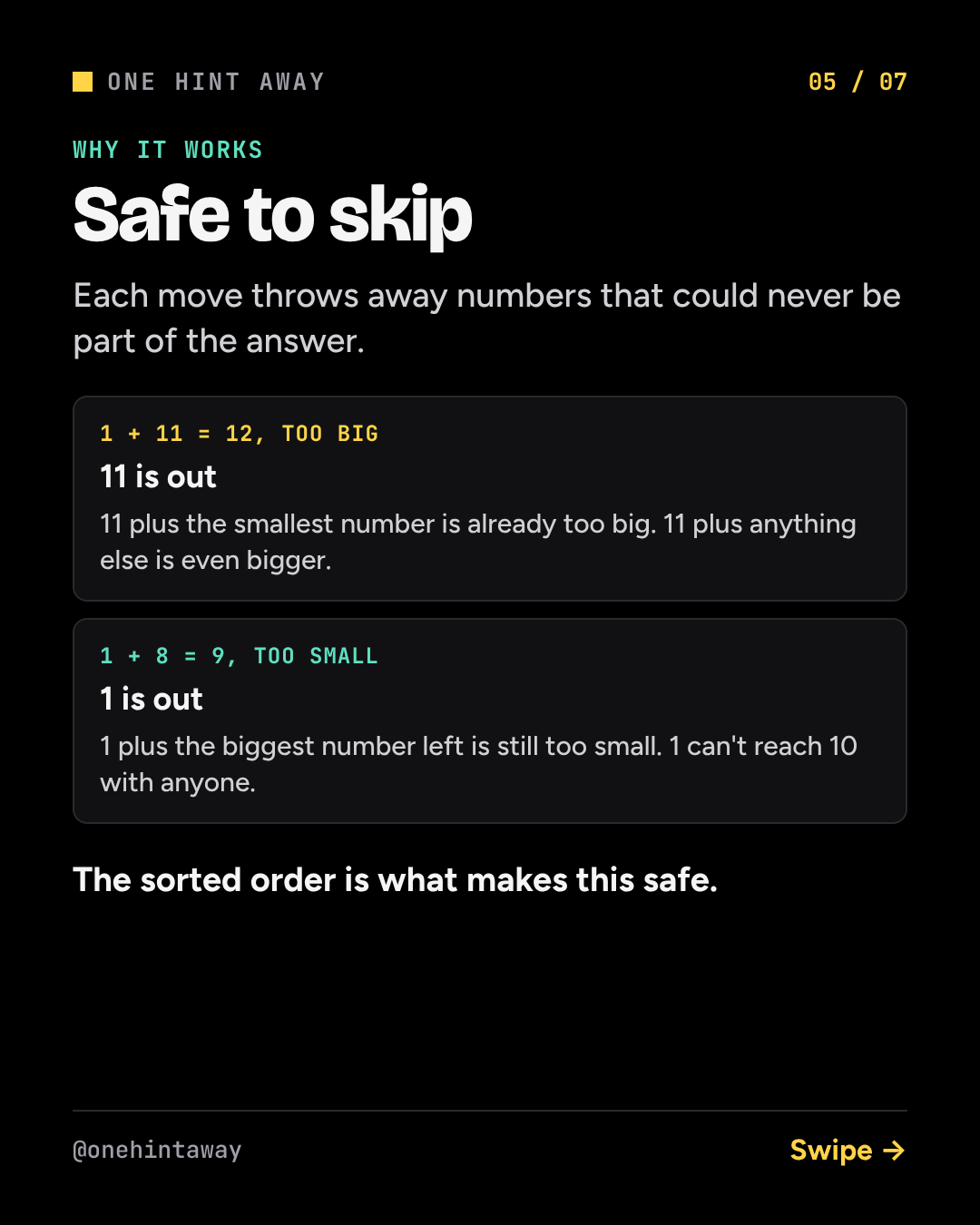
Why skipping is safe: if 1 + 11 is already too big, 11 plus any number to the right of 1 is bigger still, so 11 can't be in the answer. If 1 + 8 is too small, 1 plus anything left of 8 is smaller still, so 1 can't be in the answer.
Pseudocode
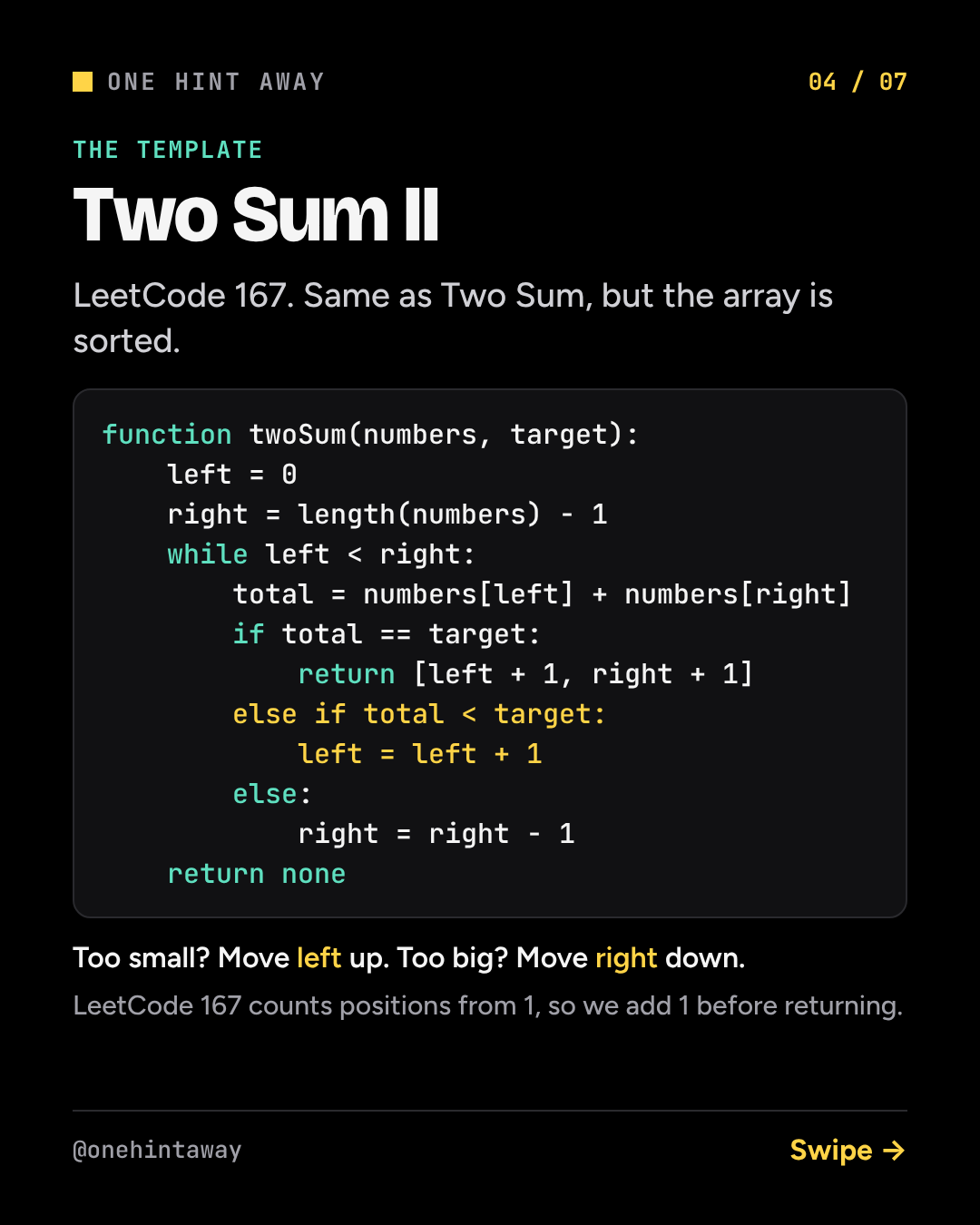
function twoSum(numbers, target):
    left = 0
    right = length(numbers) - 1
    while left < right:
        total = numbers[left] + numbers[right]
        if total == target:
            return [left + 1, right + 1]
        else if total < target:
            left = left + 1
        else:
            right = right - 1
    return none
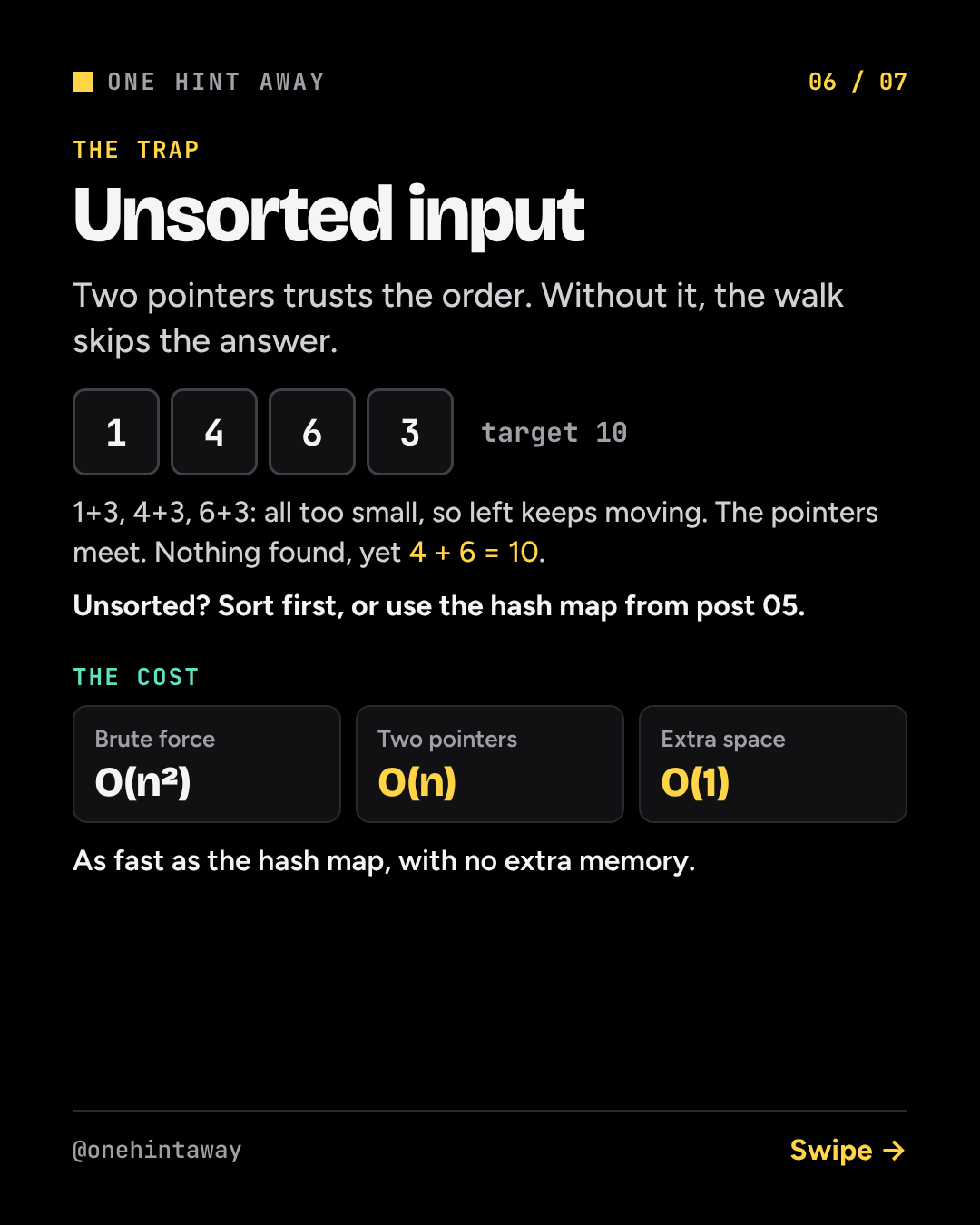
The trap: two pointers only works on sorted input. On [1, 4, 6, 3] with target 10, every sum (1+3, 4+3, 6+3) is too small, the pointers meet and nothing is found, even though 4 + 6 = 10. For unsorted input, sort first or use the hash map from post 05.
Code
class Solution {
    // Brute force: O(n^2) time, O(1) space
    public int[] twoSumBrute(int[] numbers, int target) {
        for (int i = 0; i < numbers.length; i++) {
            for (int j = i + 1; j < numbers.length; j++) {
                if (numbers[i] + numbers[j] == target) {
                    return new int[]{i + 1, j + 1};
                }
            }
        }
        return null;
    }

    // Two pointers: O(n) time, O(1) space
    public int[] twoSum(int[] numbers, int target) {
        int left = 0;
        int right = numbers.length - 1;
        while (left < right) {
            int total = numbers[left] + numbers[right];
            if (total == target) {
                return new int[]{left + 1, right + 1};
            } else if (total < target) {
                left = left + 1;
            } else {
                right = right - 1;
            }
        }
        return null;
    }
}
class Solution:
# Brute force: O(n^2) time, O(1) space
def twoSumBrute(self, numbers: list[int], target: int) -> list[int]:
n = len(numbers)
for i in range(n):
for j in range(i + 1, n):
if numbers[i] + numbers[j] == target:
return [i + 1, j + 1]
return None
# Two pointers: O(n) time, O(1) space
def twoSum(self, numbers: list[int], target: int) -> list[int]:
left = 0
right = len(numbers) - 1
while left < right:
total = numbers[left] + numbers[right]
if total == target:
return [left + 1, right + 1]
elif total < target:
left = left + 1
else:
right = right - 1
return Noneclass Solution {
public:
// Brute force: O(n^2) time, O(1) space
vector<int> twoSumBrute(vector<int>& numbers, int target) {
int n = numbers.size();
for (int i = 0; i < n; i++) {
for (int j = i + 1; j < n; j++) {
if (numbers[i] + numbers[j] == target) {
return {i + 1, j + 1};
}
}
}
return {};
}
// Two pointers: O(n) time, O(1) space
vector<int> twoSum(vector<int>& numbers, int target) {
int left = 0;
int right = numbers.size() - 1;
while (left < right) {
int total = numbers[left] + numbers[right];
if (total == target) {
return {left + 1, right + 1};
} else if (total < target) {
left = left + 1;
} else {
right = right - 1;
}
}
return {};
}
};// Brute force: O(n^2) time, O(1) space
function twoSumBrute(numbers, target) {
for (let i = 0; i < numbers.length; i++) {
for (let j = i + 1; j < numbers.length; j++) {
if (numbers[i] + numbers[j] === target) {
return [i + 1, j + 1];
}
}
}
return null;
}
// Two pointers: O(n) time, O(1) space
function twoSum(numbers, target) {
let left = 0;
let right = numbers.length - 1;
while (left < right) {
const total = numbers[left] + numbers[right];
if (total === target) {
return [left + 1, right + 1];
} else if (total < target) {
left = left + 1;
} else {
right = right - 1;
}
}
return null;
}If you sort in JavaScript yourself, pass a compare function: nums.sort((a, b) => a - b). Plain sort() compares numbers as text, so [10, 9, 1] becomes [1, 10, 9].
Complexity
| Version | Time | Extra space |
|---|---|---|
| Brute force | O(n²) | O(1) |
| Hash map (post 05) | O(n) | O(n) |
| Two pointers | O(n) | O(1) |
How it was tested
Verified: all four languages return [3, 4] on the example, find nothing on the unsorted trap input, and match the brute force on 3,000 random sorted inputs that each have exactly one answer. Re-run on 31 October 2026 on 3,001 inputs (3,000 random sorted arrays with exactly one answer, plus the example): both versions in all four languages matched an independent brute force on every one.
Practice
Try these in order. Open the worked example first if you got stuck on the slides.
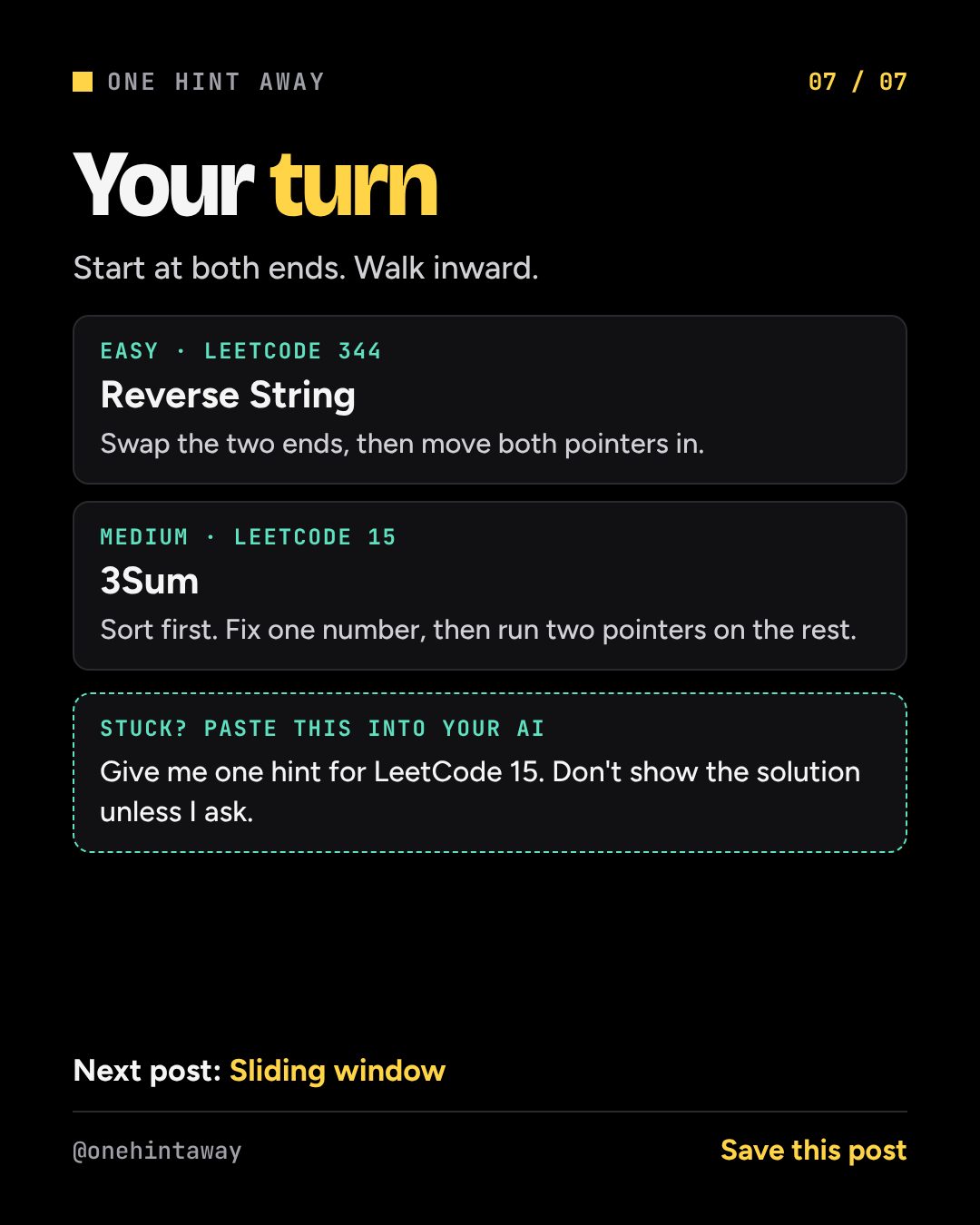
- LeetCode 167 Two Sum II - Input Array Is Sortedworked example
Swap the two ends, then move both pointers in.
- LeetCode 15 3Summedium
Sort first, fix one number, then run two pointers on the rest.