05HashingArrays and hashing
Hashing
"How many times?" or "have I seen this before?": reach for a hash map.
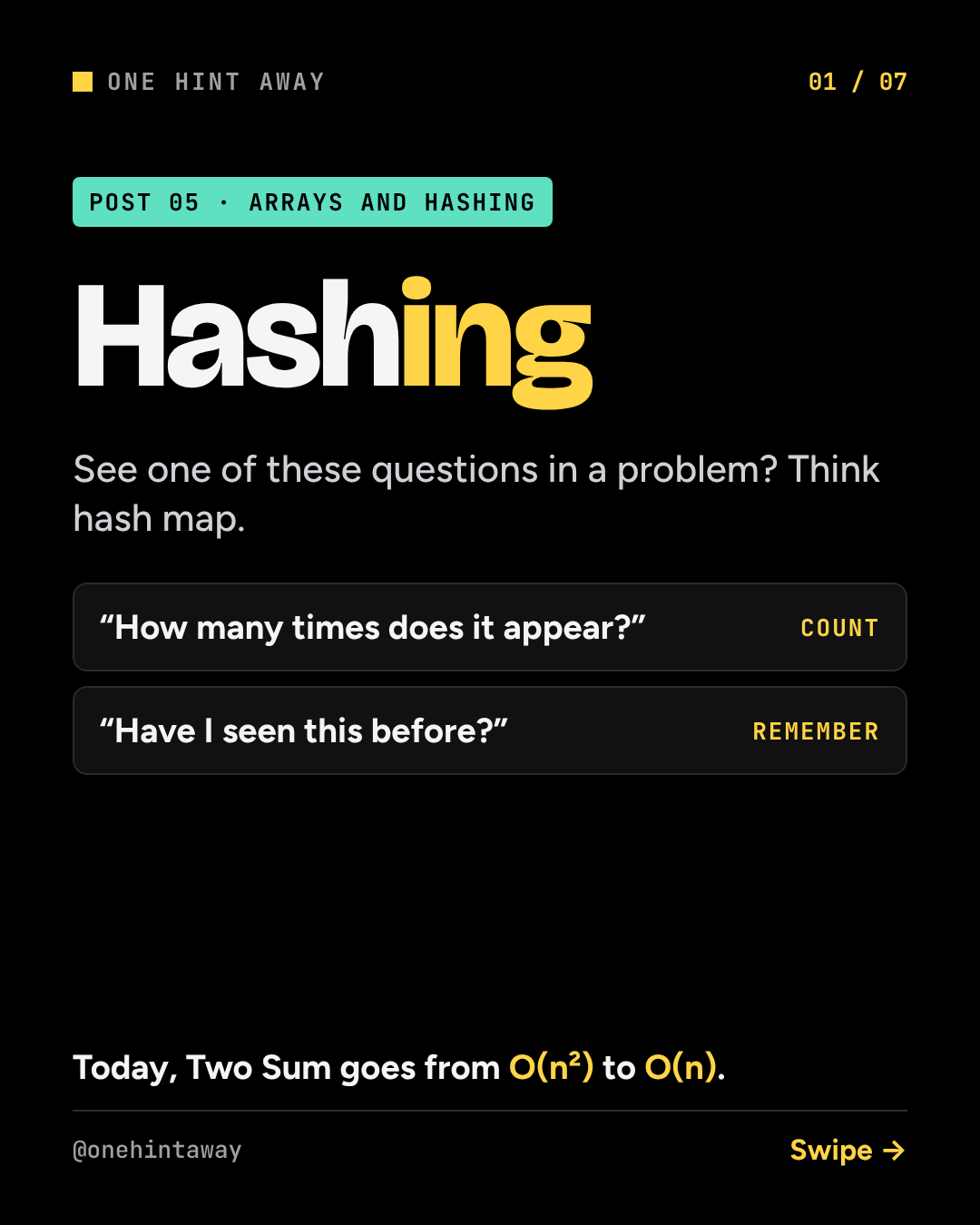
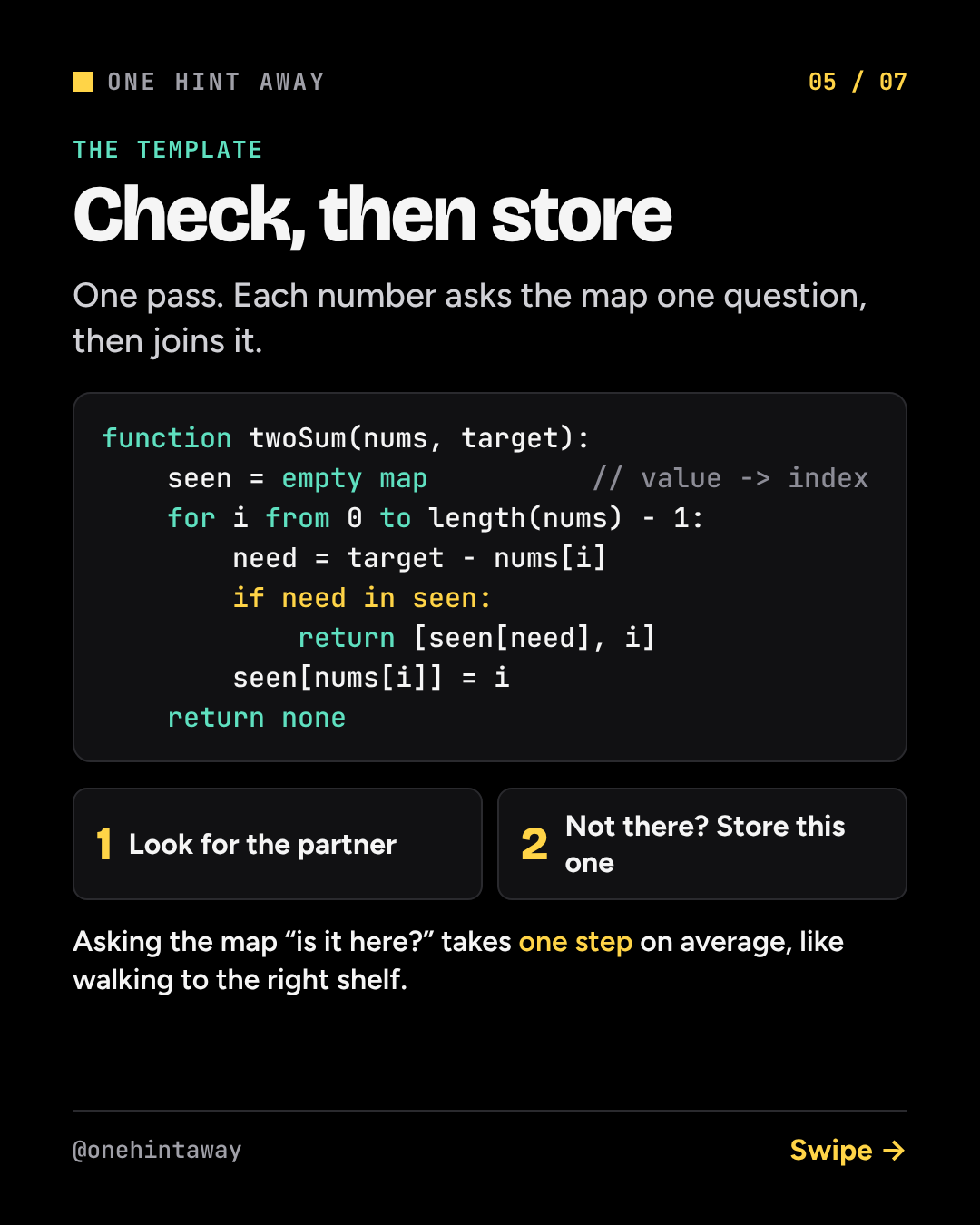
A hash map does two jobs. See "how many times does it appear?" in a problem: count. See "have I seen this before?": remember. Worked example: LeetCode 1, Two Sum (Easy). Each input has exactly one answer, and you can't use the same element twice.
The idea
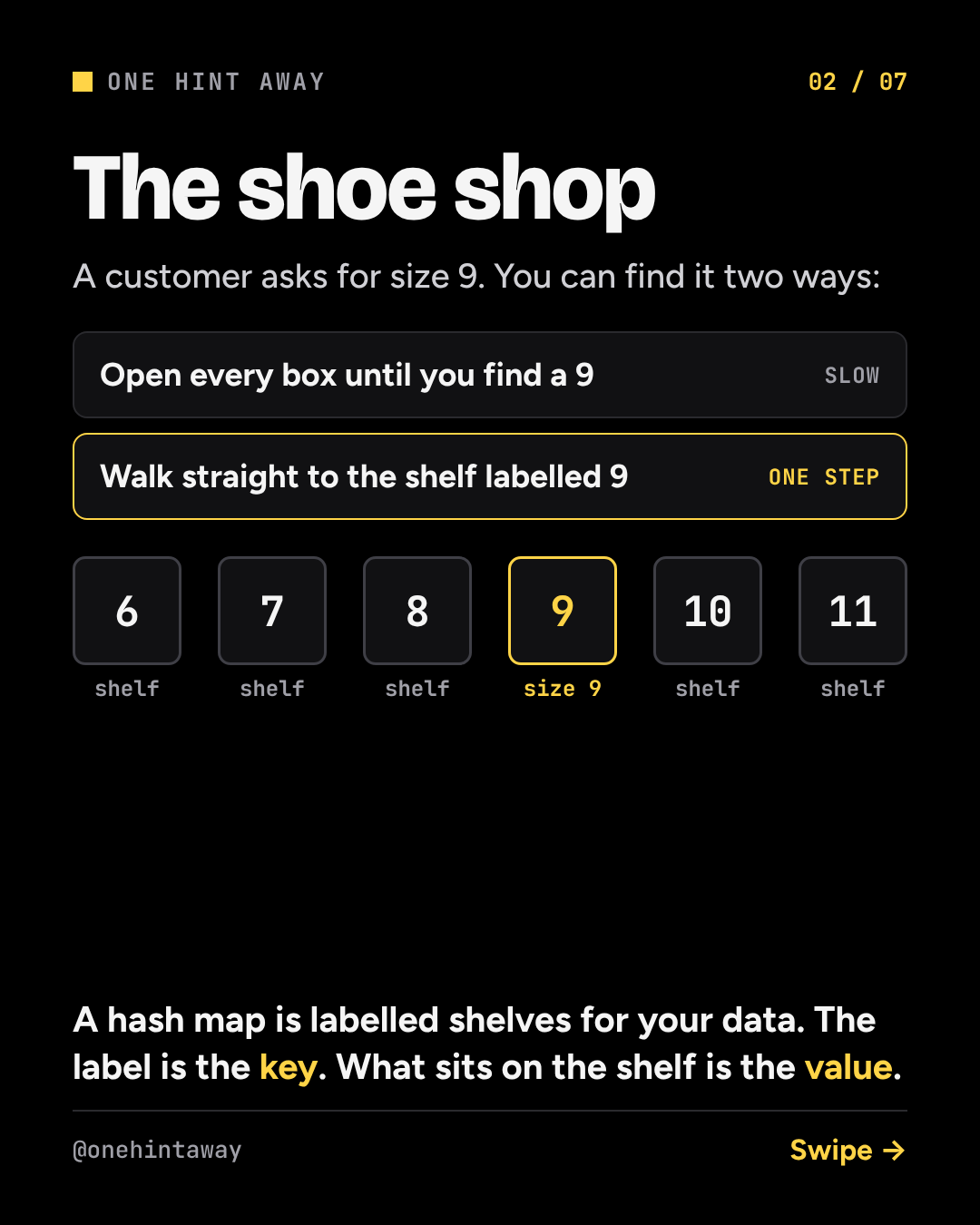
A shoe shop customer asks for size 9. You can open every box until you find a 9, or walk straight to the shelf labelled 9. A hash map is labelled shelves for your data: the label is the key, and what sits on the shelf is the value. Asking the map "is it here?" takes one step on average, like walking to the right shelf.
- Count:
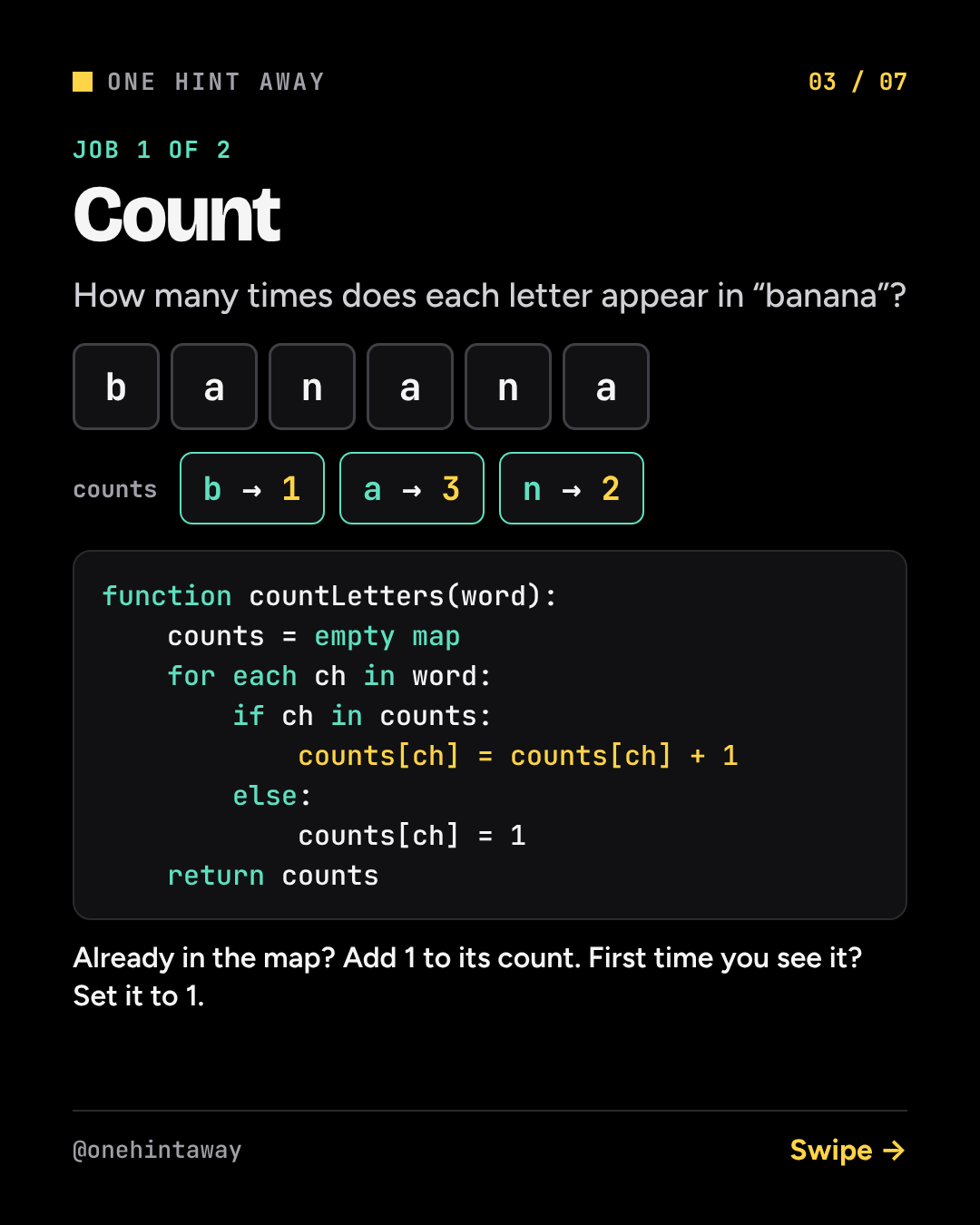
countLetters("banana")givesb → 1, a → 3, n → 2. Already in the map? Add 1 to its count. First time you see it? Set it to 1. - Remember (Two Sum): at each number, ask the map "have I seen the one I need?" (
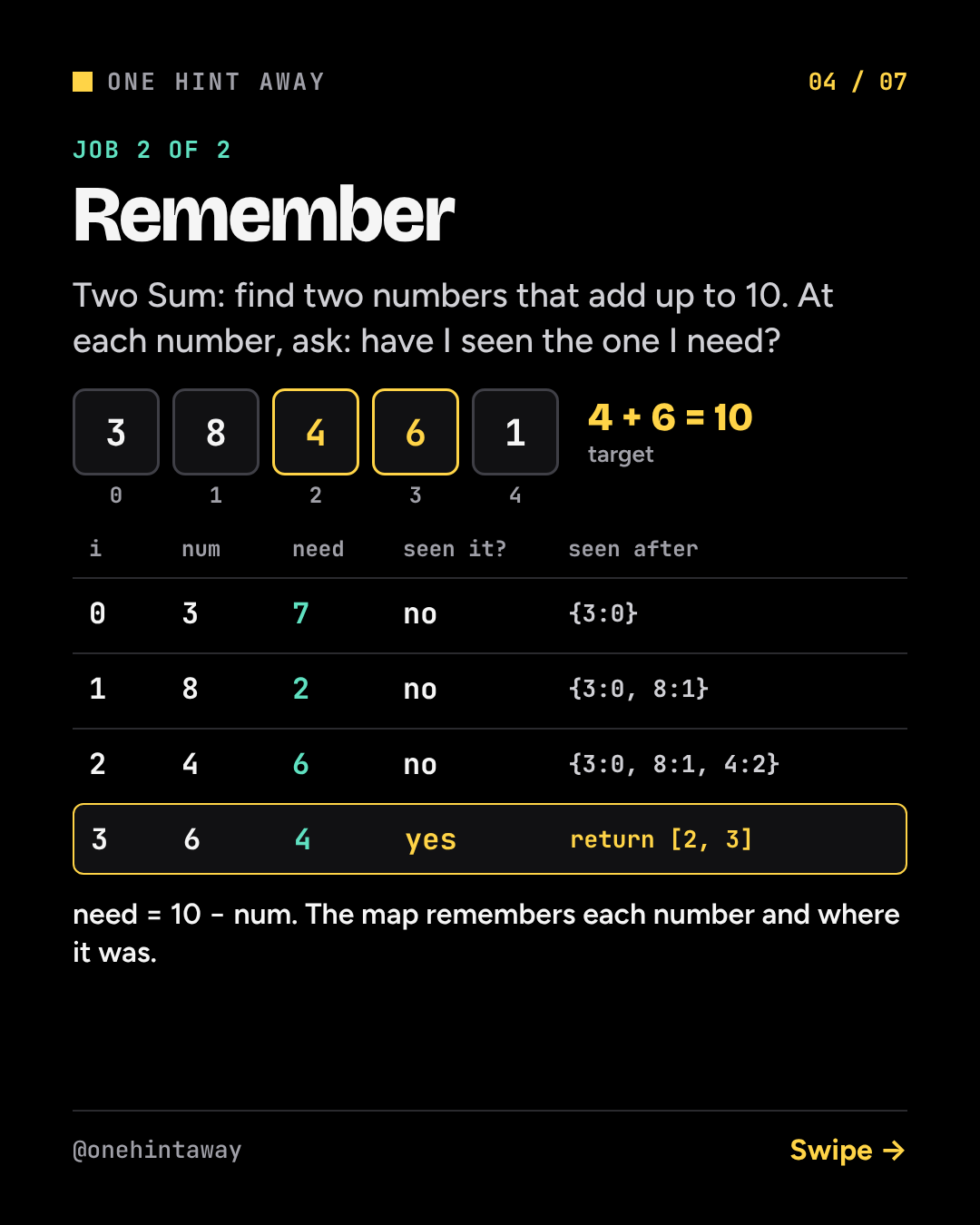
need = target - num). If not, store this number and where it was.
The walk
nums = [3, 8, 4, 6, 1], target = 10 returns [2, 3] (4 + 6).
| i | num | need | seen it? | seen after |
|---|---|---|---|---|
| 0 | 3 | 7 | no | {3:0} |
| 1 | 8 | 2 | no | {3:0, 8:1} |
| 2 | 4 | 6 | no | {3:0, 8:1, 4:2} |
| 3 | 6 | 4 | yes | return [2, 3] |
Pseudocode
function countLetters(word):
    counts = empty map
    for each ch in word:
        if ch in counts:
            counts[ch] = counts[ch] + 1
        else:
            counts[ch] = 1
    return counts

function twoSum(nums, target):
    seen = empty map          // value -> index
    for i from 0 to length(nums) - 1:
        need = target - nums[i]
        if need in seen:
            return [seen[need], i]
        seen[nums[i]] = i
    return none
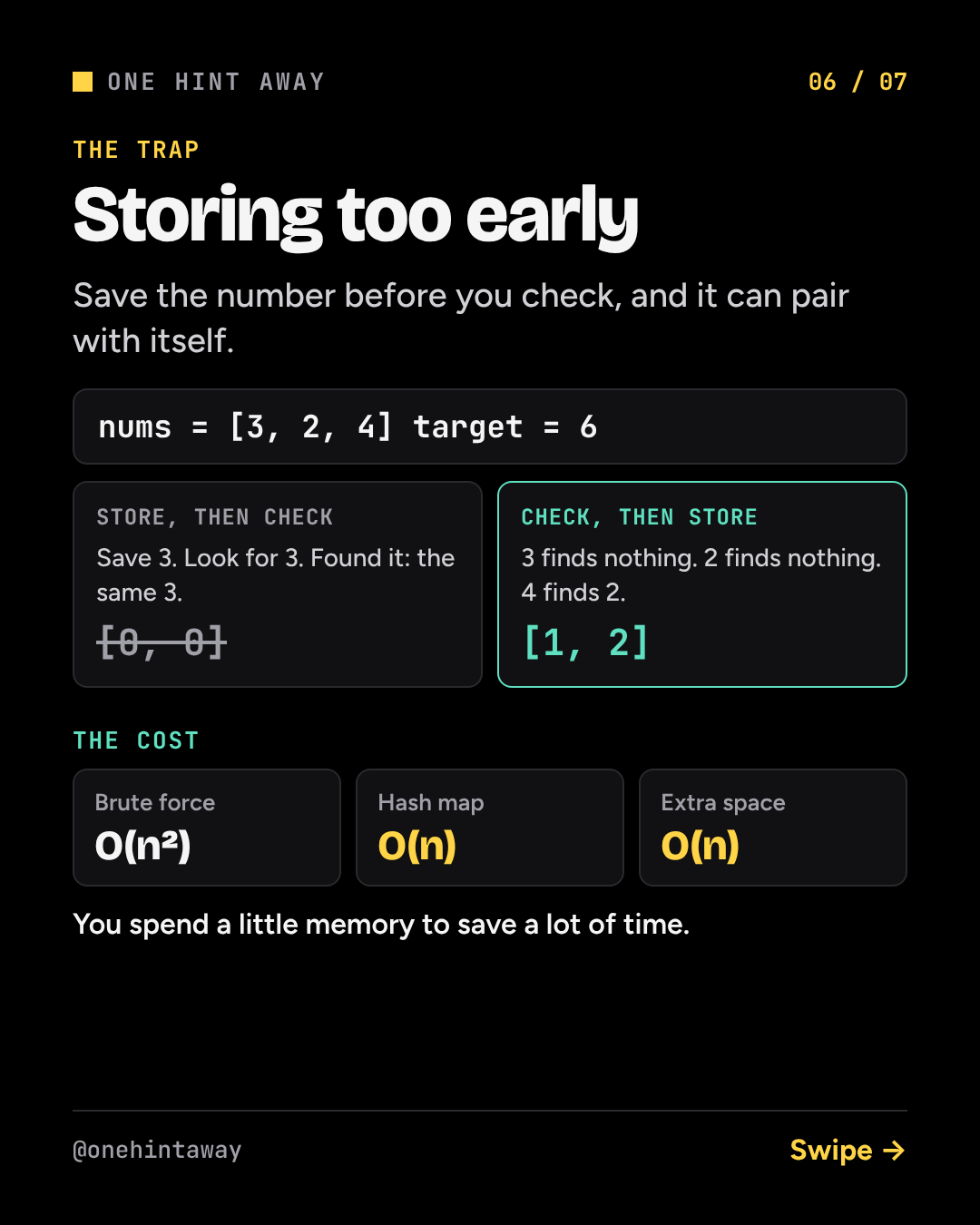
The trap: store the number before checking and it can pair with itself. For nums = [3, 2, 4], target = 6, "store, then check" saves 3, looks for 3, finds the same 3 and returns [0, 0]. "Check, then store" returns the correct [1, 2].
Code
import java.util.HashMap;
import java.util.Map;

class Solution {
    // O(n) time, O(k) space for k different letters
    public Map<Character, Integer> countLetters(String word) {
        Map<Character, Integer> counts = new HashMap<>();
        for (char ch : word.toCharArray()) {
            if (counts.containsKey(ch)) {
                counts.put(ch, counts.get(ch) + 1);
            } else {
                counts.put(ch, 1);
            }
        }
        return counts;
    }

    // Brute force: O(n^2) time, O(1) space
    public int[] twoSumBrute(int[] nums, int target) {
        int n = nums.length;
        for (int i = 0; i < n; i++) {
            for (int j = i + 1; j < n; j++) {
                if (nums[i] + nums[j] == target) {
                    return new int[]{i, j};
                }
            }
        }
        return null;
    }

    // Hash map: O(n) time, O(n) space
    public int[] twoSum(int[] nums, int target) {
        Map<Integer, Integer> seen = new HashMap<>();   // value -> index
        for (int i = 0; i < nums.length; i++) {
            int need = target - nums[i];
            if (seen.containsKey(need)) {
                return new int[]{seen.get(need), i};
            }
            seen.put(nums[i], i);
        }
        return null;
    }
}
class Solution:
# O(n) time, O(k) space for k different letters
def countLetters(self, word: str) -> dict:
counts = {}
for ch in word:
if ch in counts:
counts[ch] = counts[ch] + 1
else:
counts[ch] = 1
return counts
# Brute force: O(n^2) time, O(1) space
def twoSumBrute(self, nums: list[int], target: int) -> list[int]:
n = len(nums)
for i in range(n):
for j in range(i + 1, n):
if nums[i] + nums[j] == target:
return [i, j]
return None
# Hash map: O(n) time, O(n) space
def twoSum(self, nums: list[int], target: int) -> list[int]:
seen = {} # value -> index
for i in range(len(nums)):
need = target - nums[i]
if need in seen:
return [seen[need], i]
seen[nums[i]] = i
return Noneclass Solution {
public:
// O(n) time, O(k) space for k different letters
unordered_map<char, int> countLetters(const string& word) {
unordered_map<char, int> counts;
for (char ch : word) {
if (counts.count(ch)) {
counts[ch] = counts[ch] + 1;
} else {
counts[ch] = 1;
}
}
return counts;
}
// Brute force: O(n^2) time, O(1) space
vector<int> twoSumBrute(vector<int>& nums, int target) {
int n = nums.size();
for (int i = 0; i < n; i++) {
for (int j = i + 1; j < n; j++) {
if (nums[i] + nums[j] == target) {
return {i, j};
}
}
}
return {};
}
// Hash map: O(n) time, O(n) space
vector<int> twoSum(vector<int>& nums, int target) {
unordered_map<int, int> seen; // value -> index
for (int i = 0; i < (int)nums.size(); i++) {
int need = target - nums[i];
if (seen.count(need)) {
return {seen[need], i};
}
seen[nums[i]] = i;
}
return {};
}
};// O(n) time, O(k) space for k different letters
function countLetters(word) {
const counts = new Map();
for (const ch of word) {
if (counts.has(ch)) {
counts.set(ch, counts.get(ch) + 1);
} else {
counts.set(ch, 1);
}
}
return counts;
}
// Brute force: O(n^2) time, O(1) space
function twoSumBrute(nums, target) {
for (let i = 0; i < nums.length; i++) {
for (let j = i + 1; j < nums.length; j++) {
if (nums[i] + nums[j] === target) {
return [i, j];
}
}
}
return null;
}
// Hash map: O(n) time, O(n) space
function twoSum(nums, target) {
const seen = new Map(); // value -> index
for (let i = 0; i < nums.length; i++) {
const need = target - nums[i];
if (seen.has(need)) {
return [seen.get(need), i];
}
seen.set(nums[i], i);
}
return null;
}Complexity
| Function | Time | Extra space |
|---|---|---|
countLetters | O(n) | O(k), k = different letters |
twoSumBrute | O(n²) | O(1) |
twoSum | O(n) on average | O(n) |
You spend a little memory to save a lot of time.
How it was tested
All four languages return [2, 3] on the example and [1, 2] on the trap input, and count "banana" as b 1, a 3, n 2. All three functions in all four languages were then run on 3,002 inputs (3,000 random words and random arrays that each have exactly one answer, plus the two examples) and matched an independent brute force on every one.
Practice
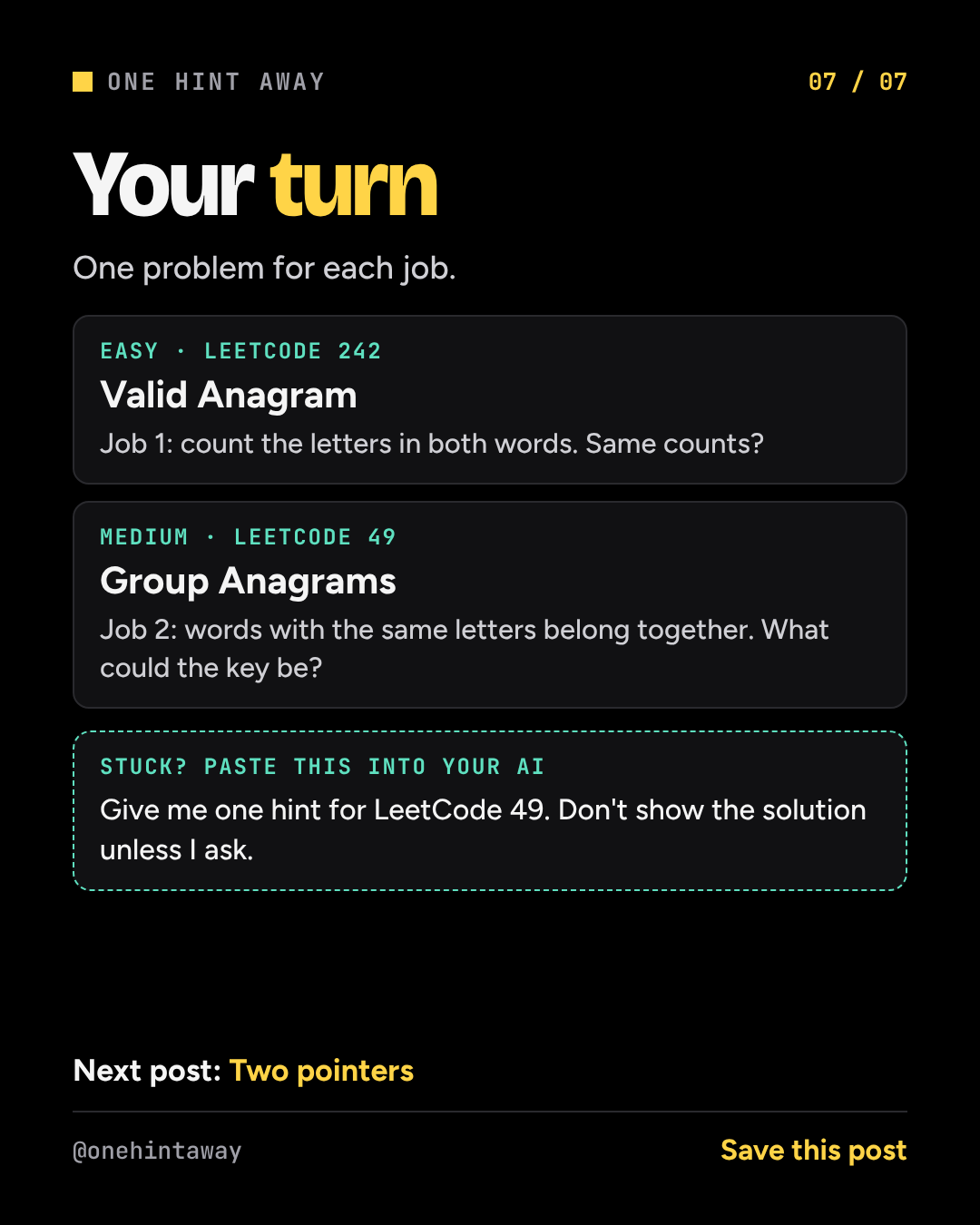
Try these in order. Open the worked example first if you got stuck on the slides.
- LeetCode 1 Two Sumworked example
Job 1: count the letters in both words. Same counts?
Job 2: words with the same letters belong together. What could the key be?