18Two pointersArrays and hashing
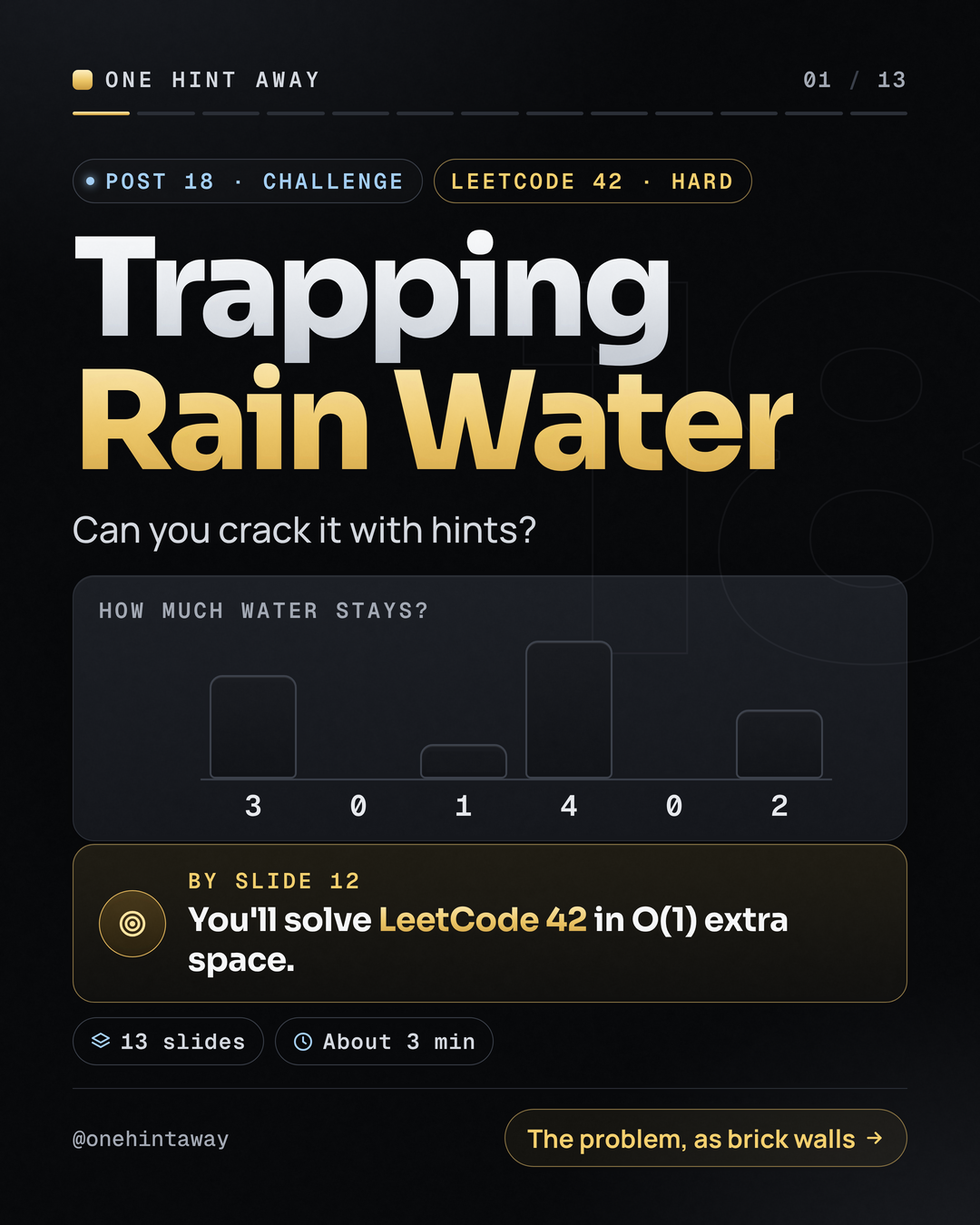
Trapping Rain Water
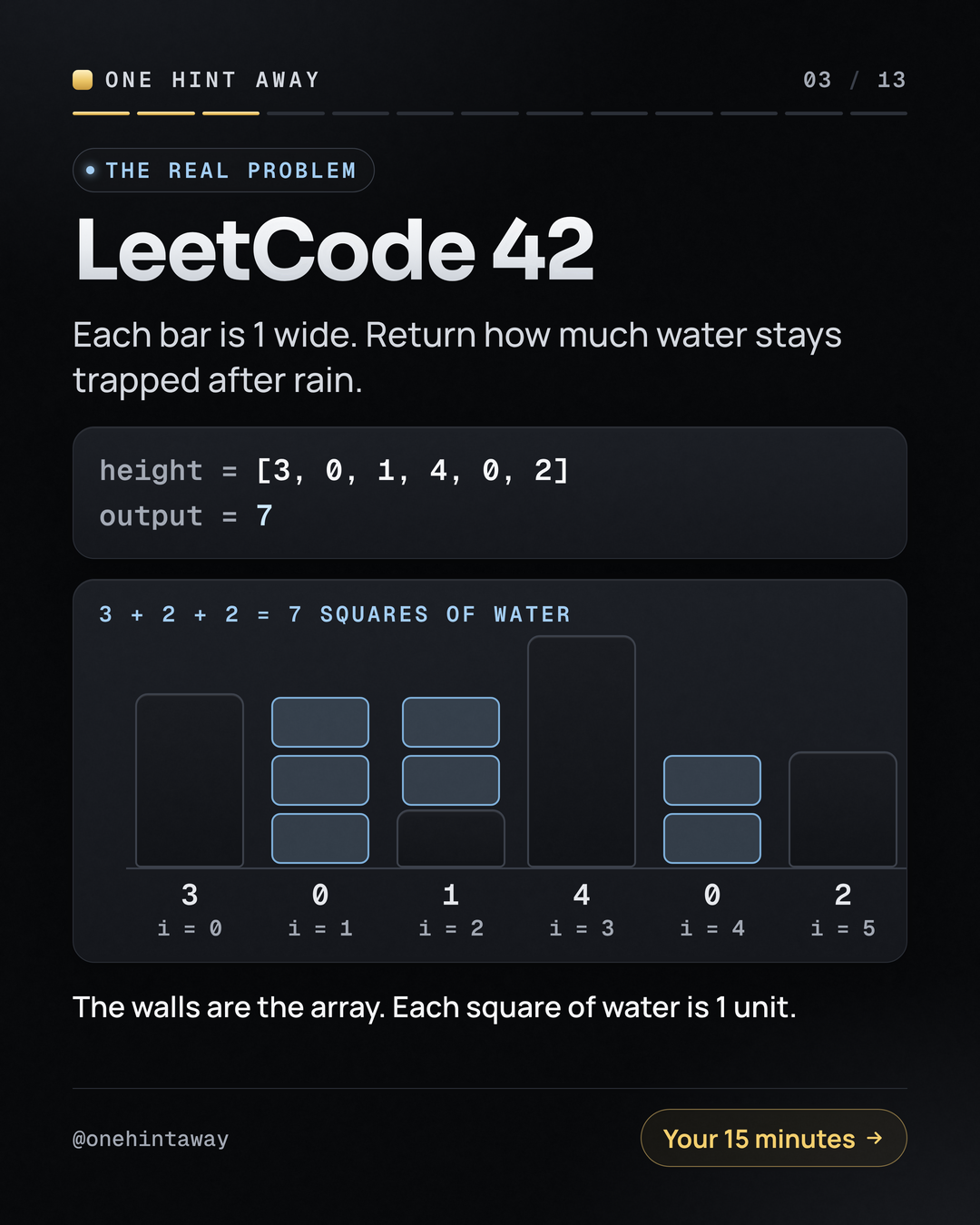
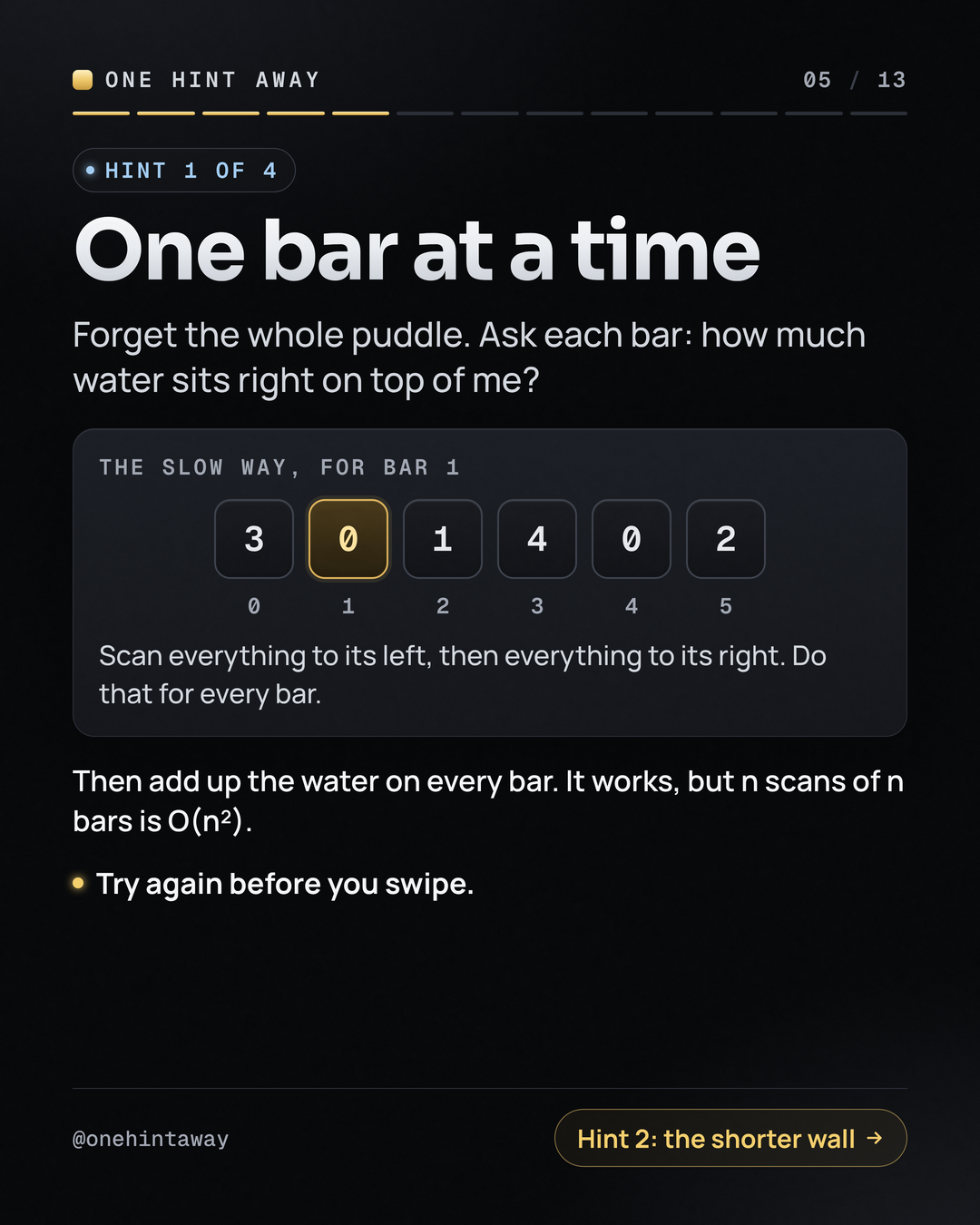
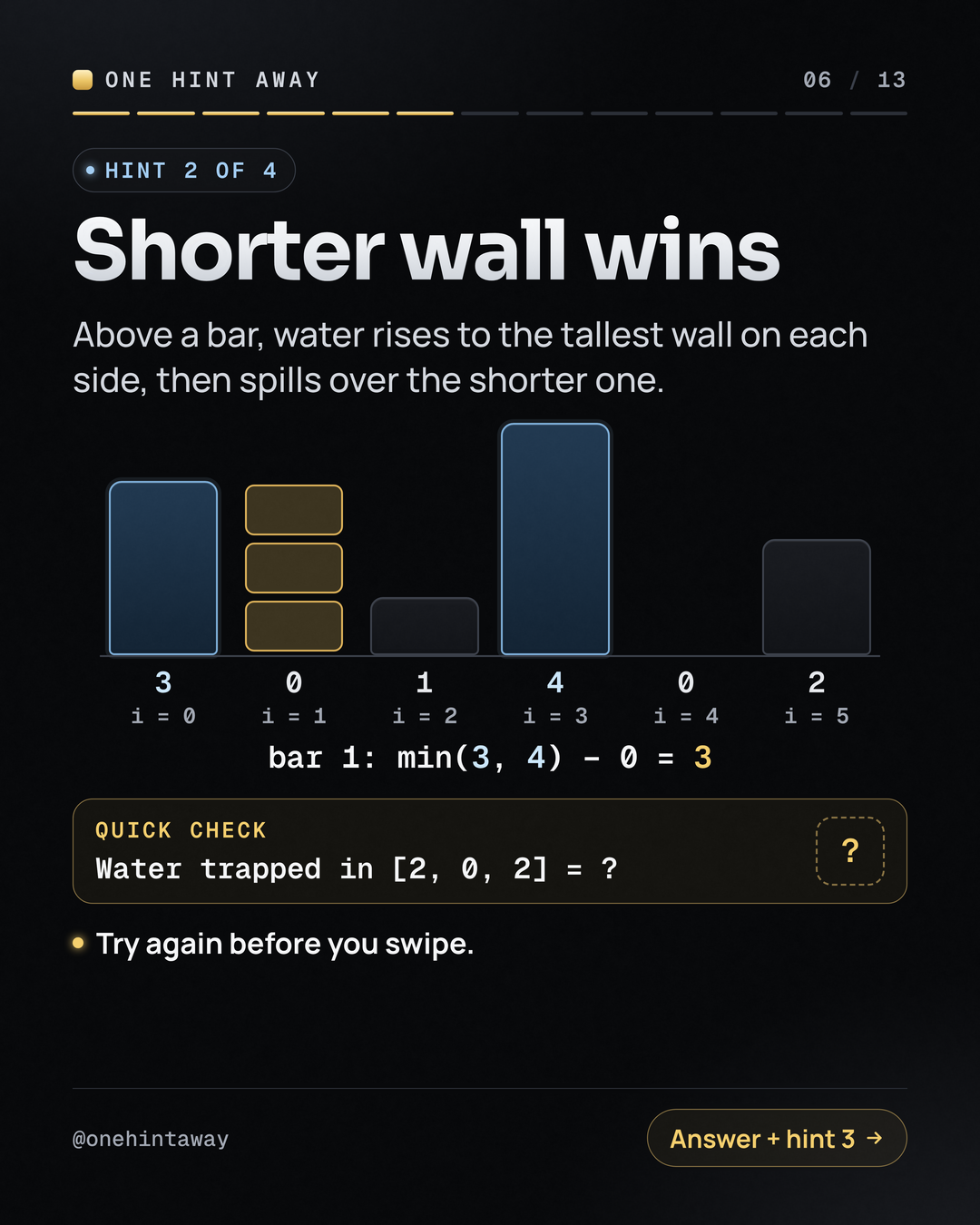
Water above each bar is the lower of the tallest walls on its two sides, minus the bar.

- Problem: LeetCode 42 · Trapping Rain Water (Hard, free)
- Worked example on the slides:
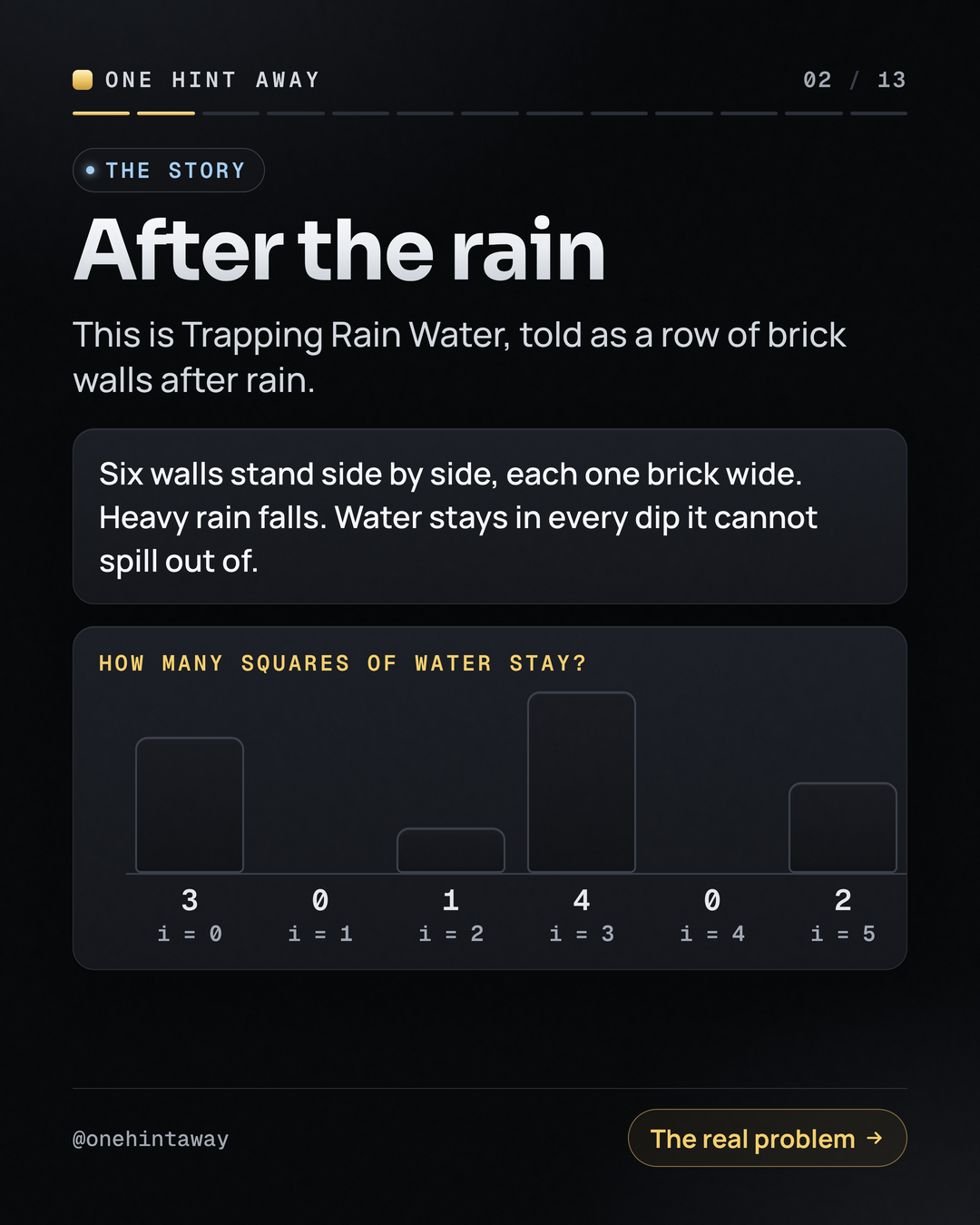
height = [3, 0, 1, 4, 0, 2]→7. Quick check:[2, 0, 2]→2.
The idea
Water above bar i = min(tallest wall on its left, tallest wall on its right) − height[i].
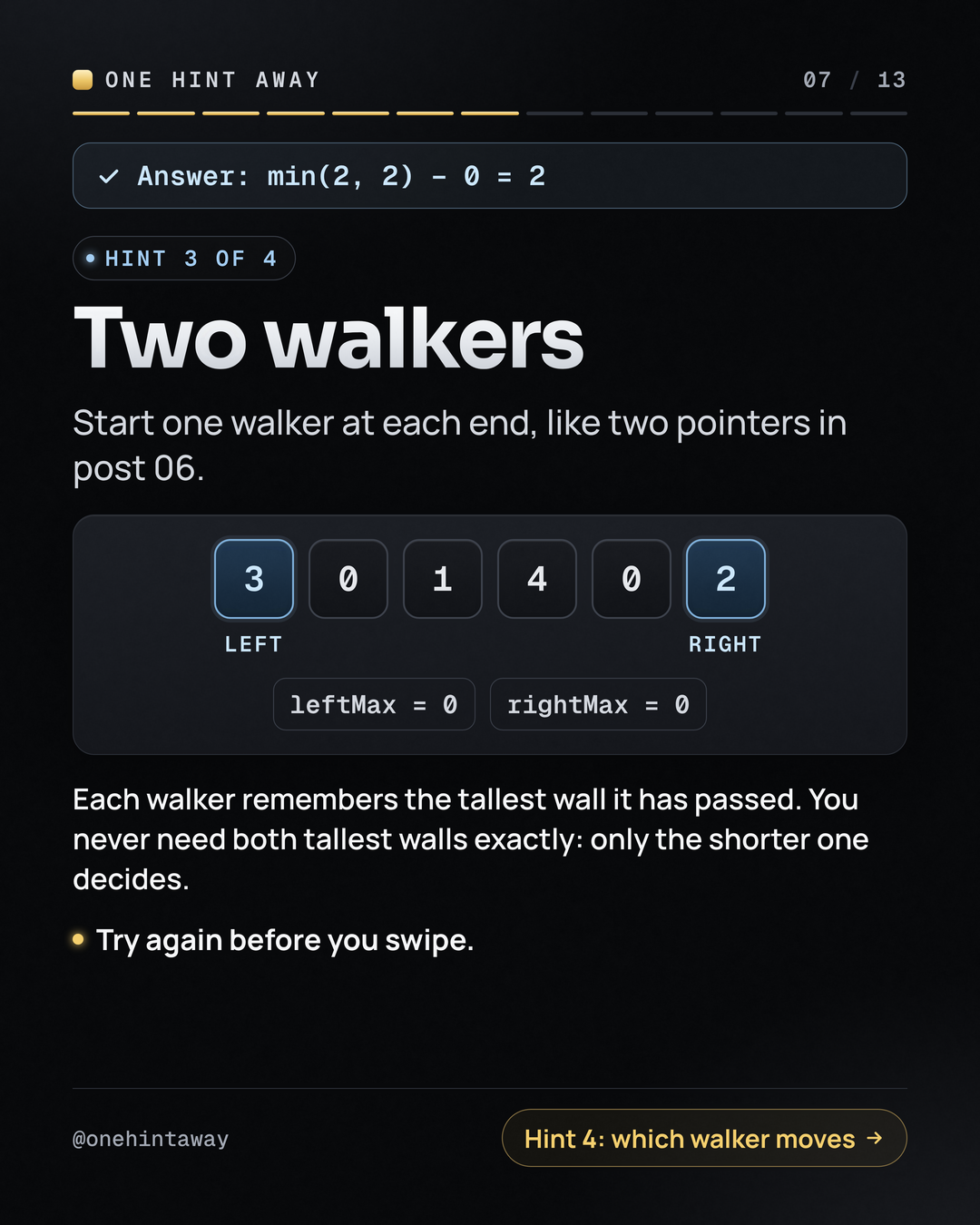
Two walkers start at the ends. Each remembers the tallest wall it has passed (leftMax, rightMax).
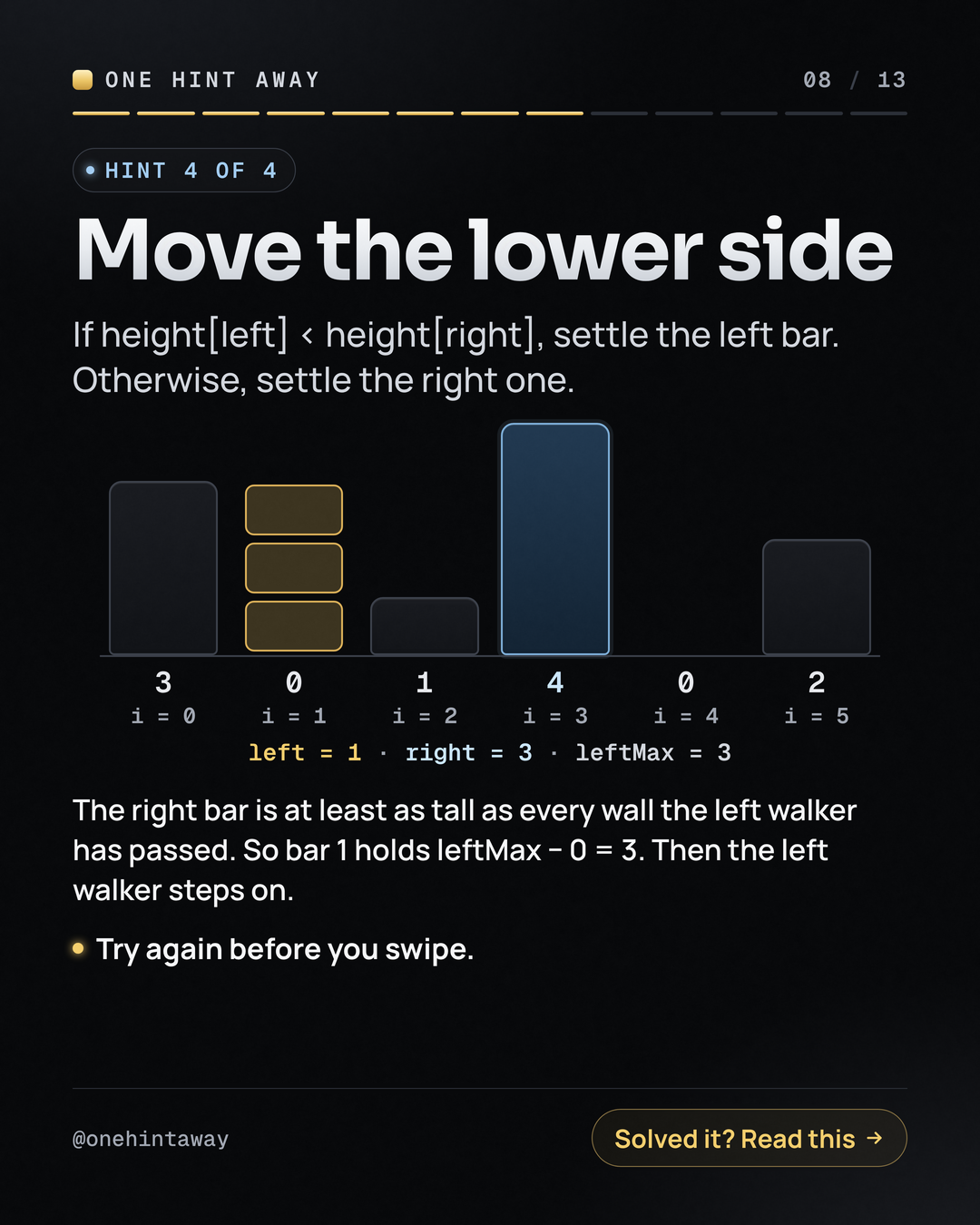
Always settle the lower side: if height[left] < height[right], the right bar is at least as tall as every wall the
left walker has passed, so the left bar holds leftMax − height[left]. Otherwise settle the right bar the same way.
Pseudocode
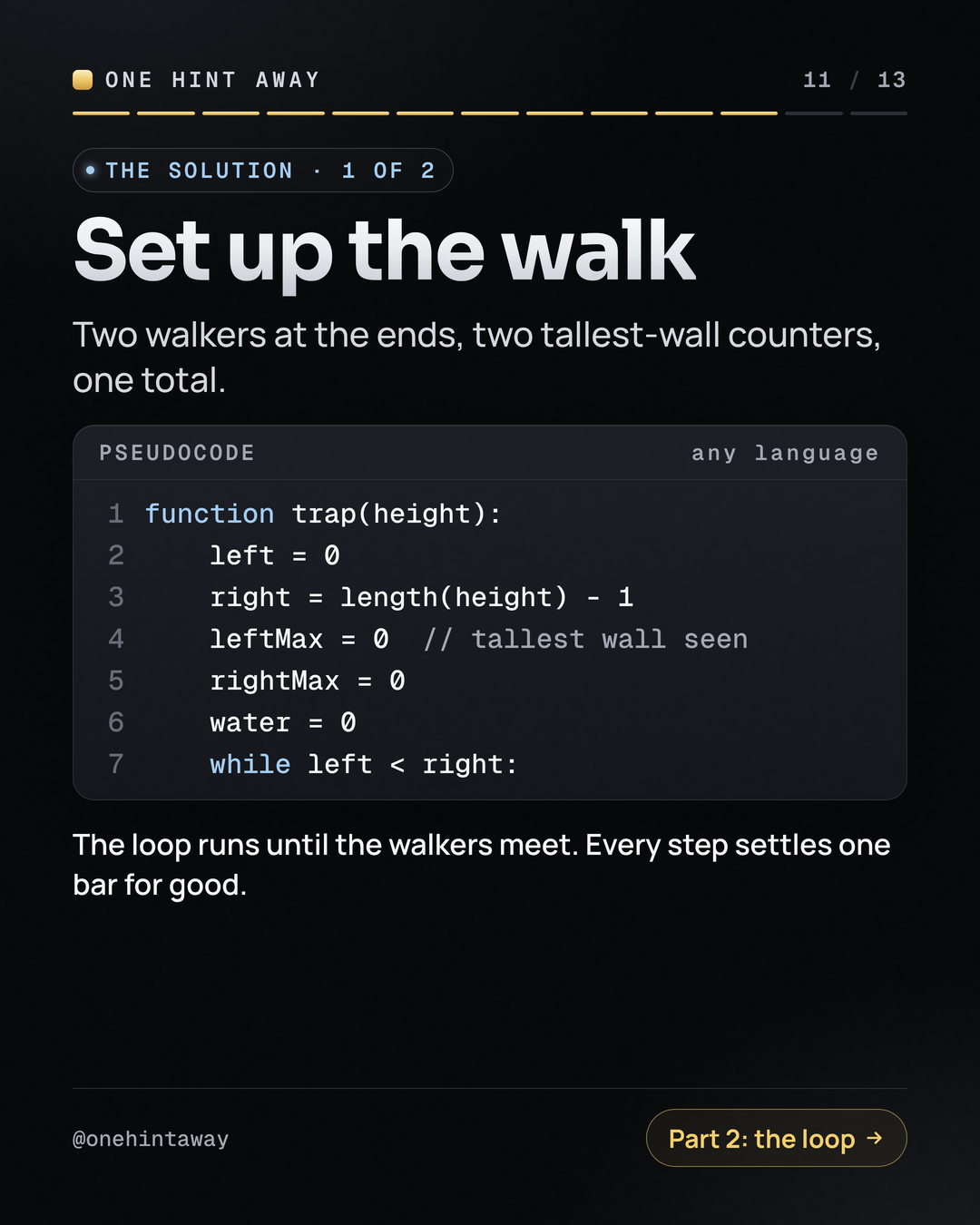
function trap(height):
    left = 0
    right = length(height) - 1
    leftMax = 0                // tallest wall seen
    rightMax = 0
    water = 0
    while left < right:
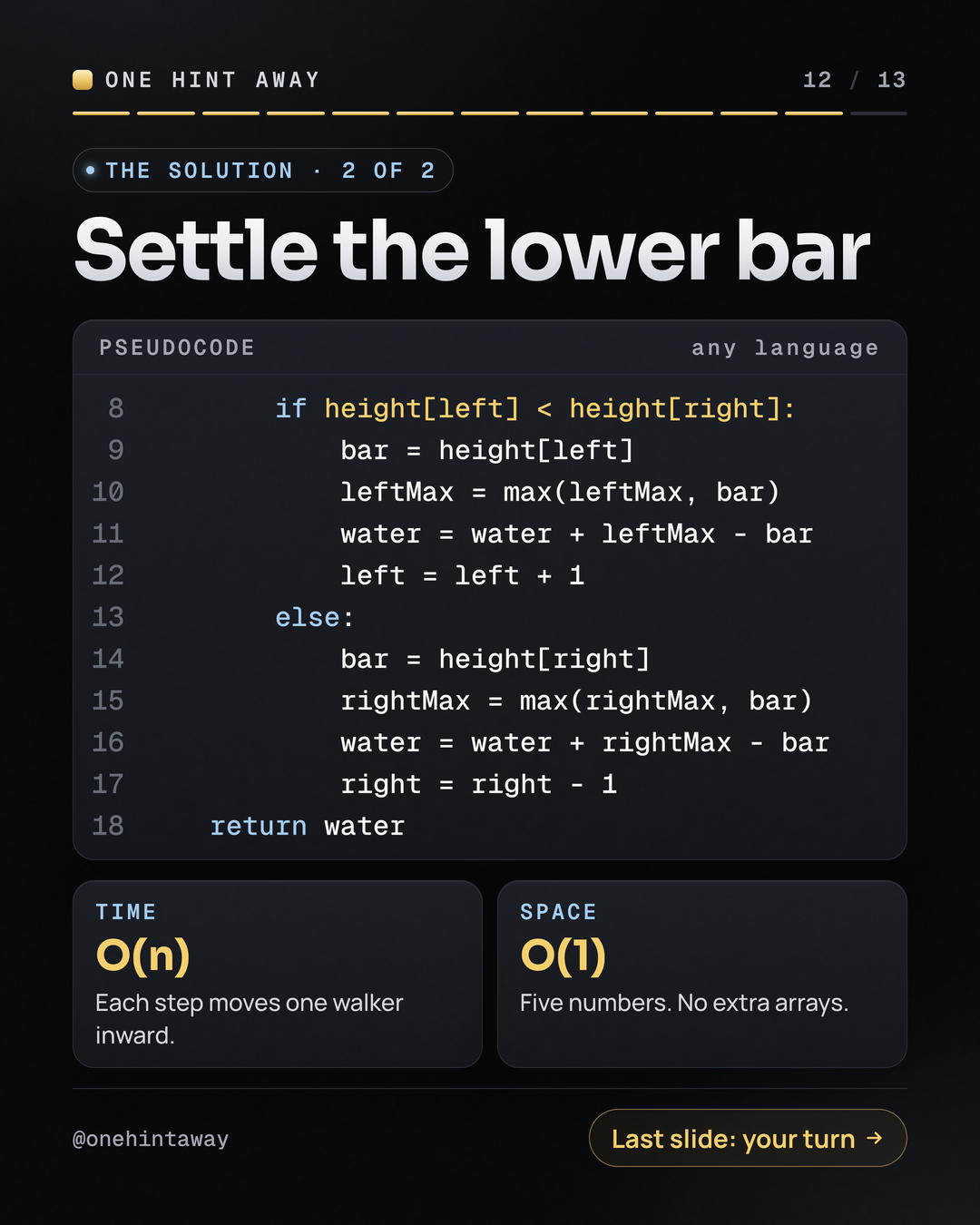
        if height[left] < height[right]:
            bar = height[left]
            leftMax = max(leftMax, bar)
            water = water + leftMax - bar
            left = left + 1
        else:
            bar = height[right]
            rightMax = max(rightMax, bar)
            water = water + rightMax - bar
            right = right - 1
    return water
The trap: moving the taller side. The rule only works when you settle the lower side: the bar on the other side is then at least as tall as every wall your walker has passed, so your own leftMax (or rightMax) decides the water. Swap the test and the example returns 5 instead of 7.
Code
public class Solution {
    public static int trap(int[] height) {
        int left = 0;
        int right = height.length - 1;
        int leftMax = 0;
        int rightMax = 0;
        int water = 0;
        while (left < right) {
            if (height[left] < height[right]) {
                int bar = height[left];
                leftMax = Math.max(leftMax, bar);
                water = water + leftMax - bar;
                left = left + 1;
            } else {
                int bar = height[right];
                rightMax = Math.max(rightMax, bar);
                water = water + rightMax - bar;
                right = right - 1;
            }
        }
        return water;
    }
}
def trap(height):
left = 0
right = len(height) - 1
leftMax = 0
rightMax = 0
water = 0
while left < right:
if height[left] < height[right]:
bar = height[left]
leftMax = max(leftMax, bar)
water = water + leftMax - bar
left = left + 1
else:
bar = height[right]
rightMax = max(rightMax, bar)
water = water + rightMax - bar
right = right - 1
return water#include <bits/stdc++.h>
using namespace std;
int trap(const vector<int>& height) {
int left = 0;
int right = (int)height.size() - 1;
int leftMax = 0;
int rightMax = 0;
int water = 0;
while (left < right) {
if (height[left] < height[right]) {
int bar = height[left];
leftMax = max(leftMax, bar);
water = water + leftMax - bar;
left = left + 1;
} else {
int bar = height[right];
rightMax = max(rightMax, bar);
water = water + rightMax - bar;
right = right - 1;
}
}
return water;
}function trap(height) {
let left = 0;
let right = height.length - 1;
let leftMax = 0;
let rightMax = 0;
let water = 0;
while (left < right) {
if (height[left] < height[right]) {
const bar = height[left];
leftMax = Math.max(leftMax, bar);
water = water + leftMax - bar;
left = left + 1;
} else {
const bar = height[right];
rightMax = Math.max(rightMax, bar);
water = water + rightMax - bar;
right = right - 1;
}
}
return water;
}Complexity
- Time: O(n). Each loop step moves one walker one place inward, so the loop runs n − 1 times.
- Space: O(1). Five numbers (
left,right,leftMax,rightMax,water) plusbar; no extra arrays. - Overflow: with LeetCode's limits (n ≤ 2 × 10⁴, height ≤ 10⁵) the total is below 2 × 10⁹, so a 32-bit int is enough.
How it was tested
All four versions were run from the code blocks in this file against a brute-force checker (for each bar, scan left and right for the tallest wall) on 2,016 inputs: 2,000 random arrays of length 0 to 12, plus 15 edge cases (empty, one bar, two bars, all equal, sorted, reversed, all zero, maximum heights) and one array of 20,000 bars with heights up to 100,000. All agreed. Re-run on 31 October 2026 on 3,005 more inputs (3,000 random arrays of length 0 to 12, plus the example, the quick check, the empty array, one bar and LeetCode's first example): all four matched the brute force on every one.
Practice
Try these in order. Open the worked example first if you got stuck on the slides.
- LeetCode 42 Trapping Rain Waterworked example
Same walls, same two walkers, a new question.