19Number theoryMaths
GCD, primes and the sieve
Count primes below n by crossing out multiples; get a GCD by taking remainders until one is zero.



Clues: count the primes below n, or find the GCD of two numbers. Worked example: LeetCode 204, Count Primes (Medium): count the primes strictly less than n. Free references: GeeksforGeeks, "Sieve of Eratosthenes" and "Euclidean algorithms (Basic and Extended)".
The idea
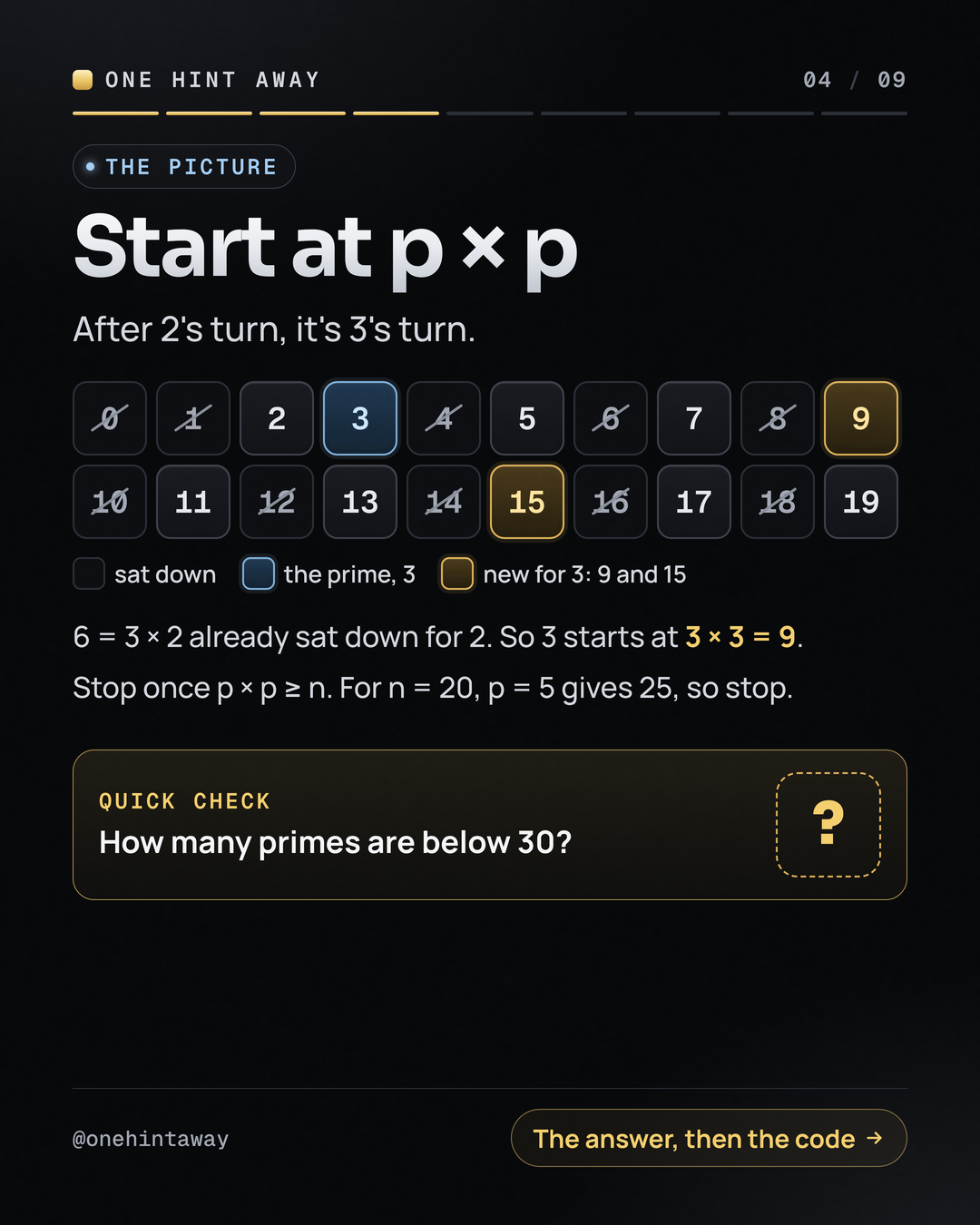
The sieve is a roll call. Students 2 to 19 stand up. The first one standing is prime: that's 2, because no smaller number sat it down. It sits down all its multiples: 4, 6, 8 and so on up to 18. Repeat with the next one standing. Whoever never sits down is prime, and you never divide.
Start crossing out at p × p. After 2's turn it's 3's turn, and 6 = 3 × 2 already sat down for 2, so 3 starts at 3 × 3 = 9. Stop once p × p ≥ n: for n = 20, p = 5 gives 25, so stop.
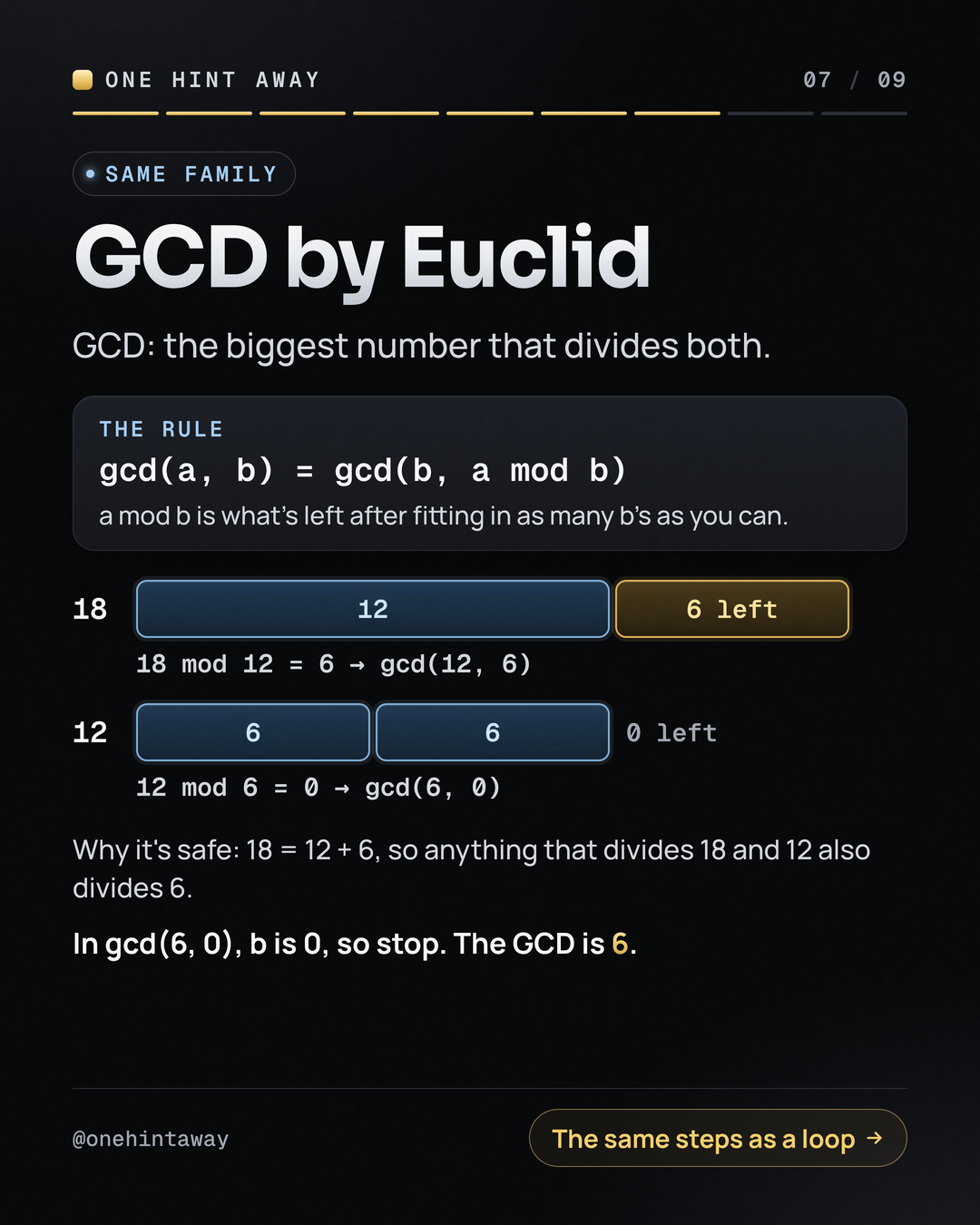
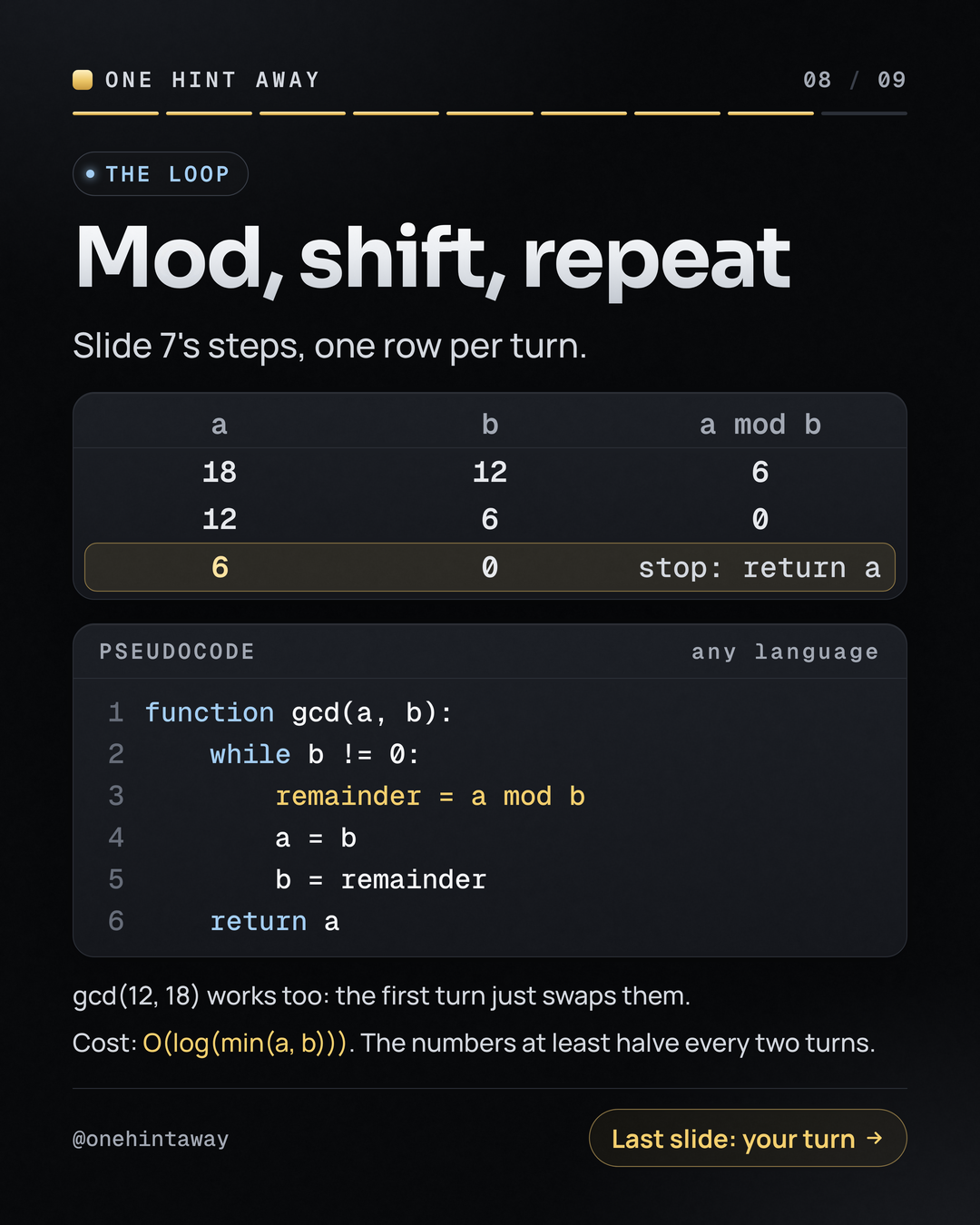
GCD by Euclid. The GCD is the biggest number that divides both. The rule: gcd(a, b) = gcd(b, a mod b), where a mod b is what's left after fitting in as many b's as you can. It's safe because 18 = 12 + 6, so anything that divides 18 and 12 also divides 6.
The walk
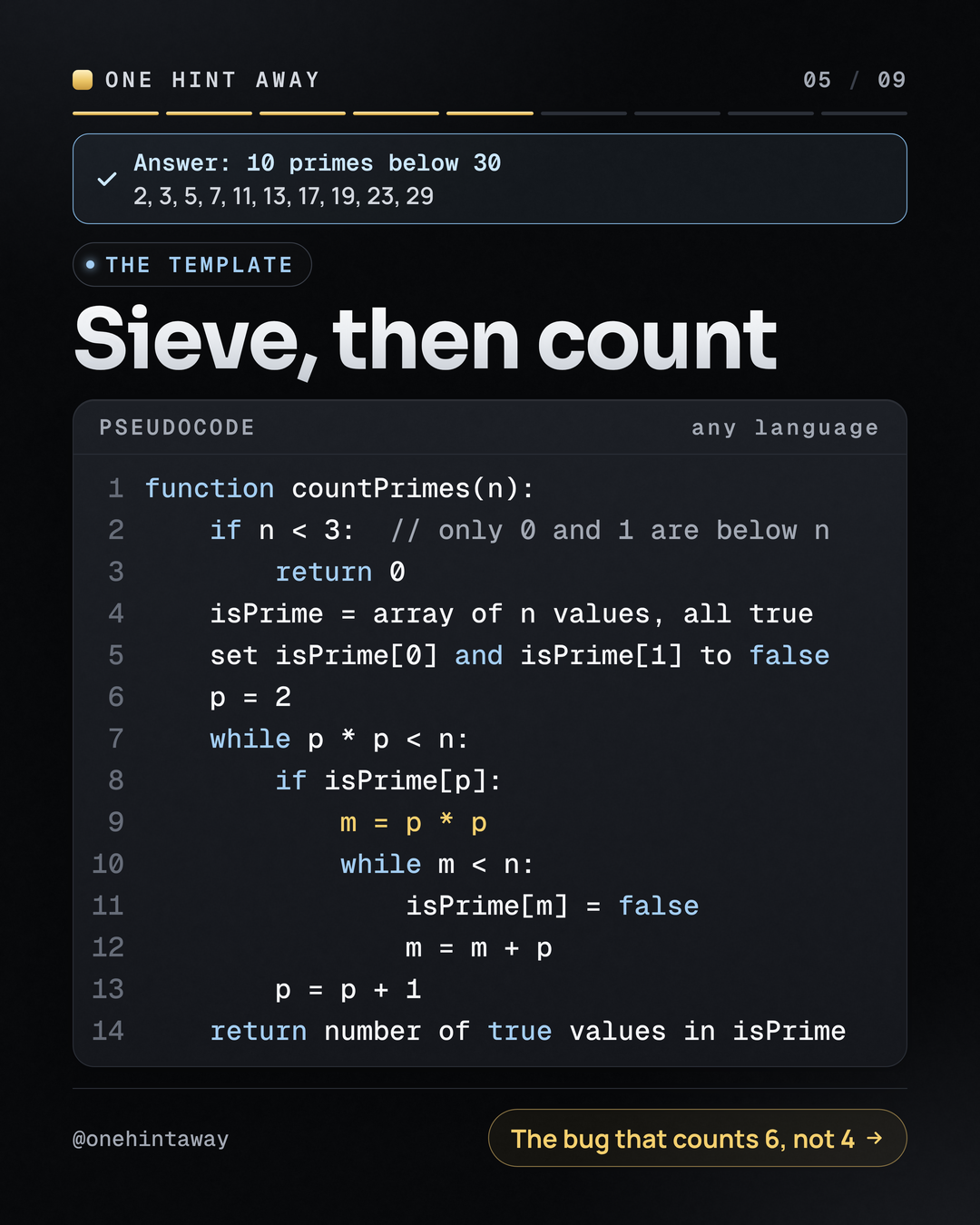
Primes below 20: 2, 3, 5, 7, 11, 13, 17, 19, so 8. Quick check from the post: there are 10 primes below 30 (2, 3, 5, 7, 11, 13, 17, 19, 23, 29).
gcd(18, 12), one row per turn of the loop:
| a | b | a mod b |
|---|---|---|
| 18 | 12 | 6 |
| 12 | 6 | 0 |
| 6 | 0 | stop: return a |
The GCD is 6. gcd(12, 18) works too: the first turn just swaps them.
Pseudocode
function countPrimes(n):
    if n < 3:  // only 0 and 1 are below n
        return 0
    isPrime = array of n values, all true
    set isPrime[0] and isPrime[1] to false
    p = 2
    while p * p < n:
        if isPrime[p]:
            m = p * p
            while m < n:
                isPrime[m] = false
                m = m + p
        p = p + 1
    return number of true values in isPrime

function gcd(a, b):
    while b != 0:
        remainder = a mod b
        a = b
        b = remainder
    return a
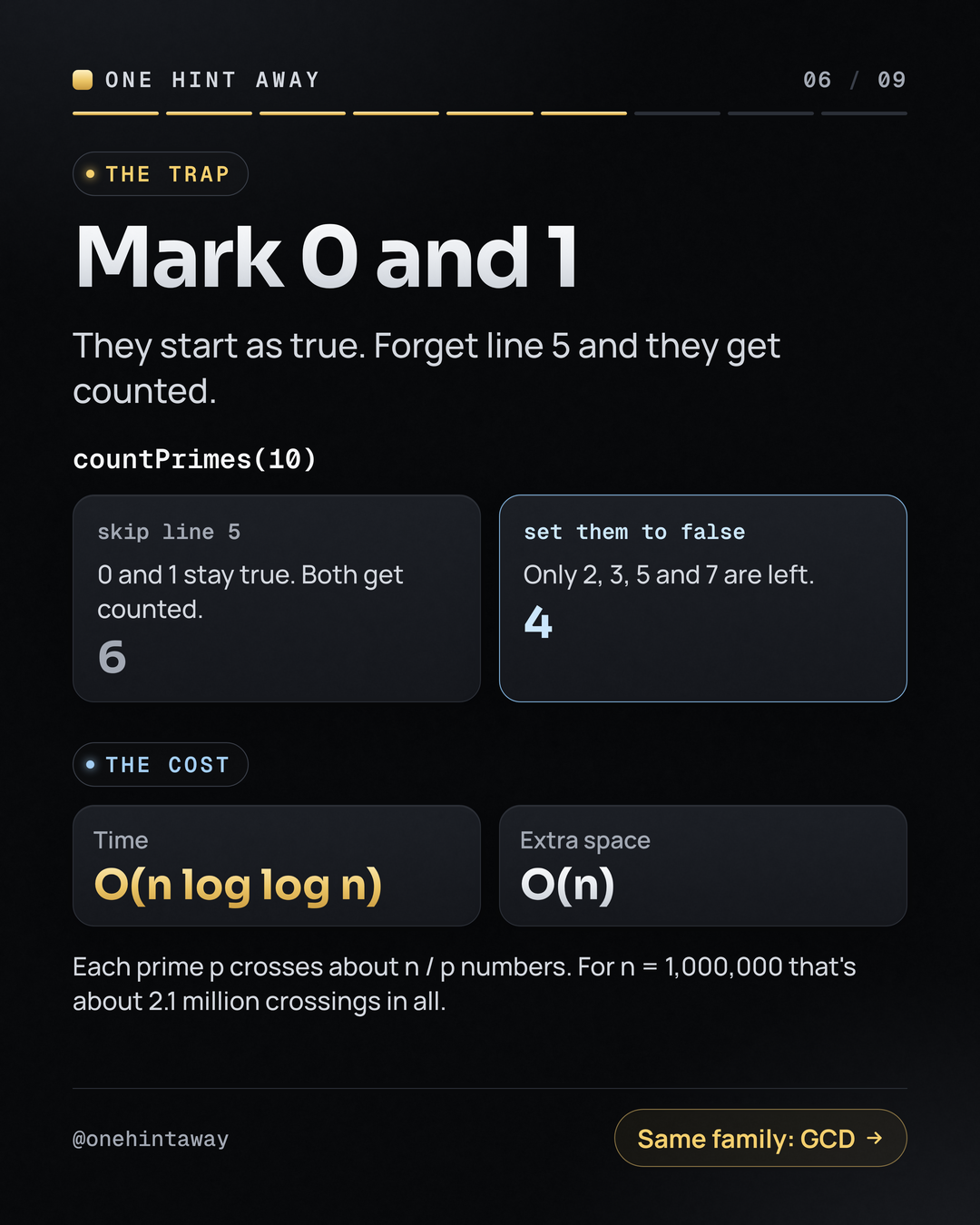
The trap: mark 0 and 1. They start as true; forget the line that sets them to false and they get counted. countPrimes(10) then returns 6 instead of 4 (only 2, 3, 5 and 7 are prime).
Code
class Solution {
    public int countPrimes(int n) {
        if (n < 3) return 0;  // only 0 and 1 are below n
        boolean[] isPrime = new boolean[n];
        java.util.Arrays.fill(isPrime, true);
        isPrime[0] = false;
        isPrime[1] = false;
        long p = 2;
        while (p * p < n) {
            if (isPrime[(int) p]) {
                long m = p * p;
                while (m < n) {
                    isPrime[(int) m] = false;
                    m = m + p;
                }
            }
            p = p + 1;
        }
        int count = 0;
        for (boolean b : isPrime) if (b) count++;
        return count;
    }

    public static int gcd(int a, int b) {
        while (b != 0) {
            int remainder = a % b;
            a = b;
            b = remainder;
        }
        return a;
    }
}
def count_primes(n: int) -> int:
if n < 3: # only 0 and 1 are below n
return 0
is_prime = [True] * n
is_prime[0] = False
is_prime[1] = False
p = 2
while p * p < n:
if is_prime[p]:
m = p * p
while m < n:
is_prime[m] = False
m = m + p
p += 1
return sum(is_prime)
def gcd(a: int, b: int) -> int:
while b != 0:
remainder = a % b
a = b
b = remainder
return a#include <vector>
int countPrimes(int n) {
if (n < 3) return 0; // only 0 and 1 are below n
std::vector<bool> isPrime(n, true);
isPrime[0] = false;
isPrime[1] = false;
long long p = 2;
while (p * p < n) {
if (isPrime[p]) {
long long m = p * p;
while (m < n) {
isPrime[m] = false;
m = m + p;
}
}
p = p + 1;
}
int count = 0;
for (bool b : isPrime) if (b) count++;
return count;
}
int gcd(int a, int b) {
while (b != 0) {
int remainder = a % b;
a = b;
b = remainder;
}
return a;
}function countPrimes(n) {
if (n < 3) return 0; // only 0 and 1 are below n
const isPrime = new Uint8Array(n).fill(1);
isPrime[0] = 0;
isPrime[1] = 0;
let p = 2;
while (p * p < n) {
if (isPrime[p]) {
let m = p * p;
while (m < n) {
isPrime[m] = 0;
m = m + p;
}
}
p = p + 1;
}
let count = 0;
for (let i = 0; i < n; i++) count += isPrime[i];
return count;
}
function gcd(a, b) {
while (b !== 0) {
const remainder = a % b;
a = b;
b = remainder;
}
return a;
}Complexity
| Function | Time | Extra space |
|---|---|---|
countPrimes | O(n log log n) | O(n) |
gcd | O(log(min(a, b))) | O(1) |
Each prime p crosses out about n / p numbers, and the sum of n / p over primes up to n grows like n log log n: for n = 1,000,000 that's about 2.1 million crossings in all. In gcd, the numbers at least halve every two turns.
How it was tested
The slide checks run on this code: primes below 20 = 8, primes below 30 = 10, countPrimes(10) = 4 (and 6 if 0 and 1 are left marked true), gcd(18, 12) = 6. On 31 October 2026 both functions in all four languages were run on 3,008 inputs (3,000 random n from 0 to 2,000 with random pairs up to 1,000, the slide examples, the edge cases n = 0, 1, 2 and 3 and gcd(6, 0), and n = 5,000,000 with a pair near 10⁹) and matched trial division and a reference GCD on every one.
Practice
Try these in order. Open the worked example first if you got stuck on the slides.
- LeetCode 204 Count Primesworked example
Take the smallest and largest. Run slide 8's loop.
Sieve up to right, then compare neighbouring primes.