03Foundations
Same structure, three languages
One pseudocode, mapped line by line to Java, Python, C++ and JavaScript.
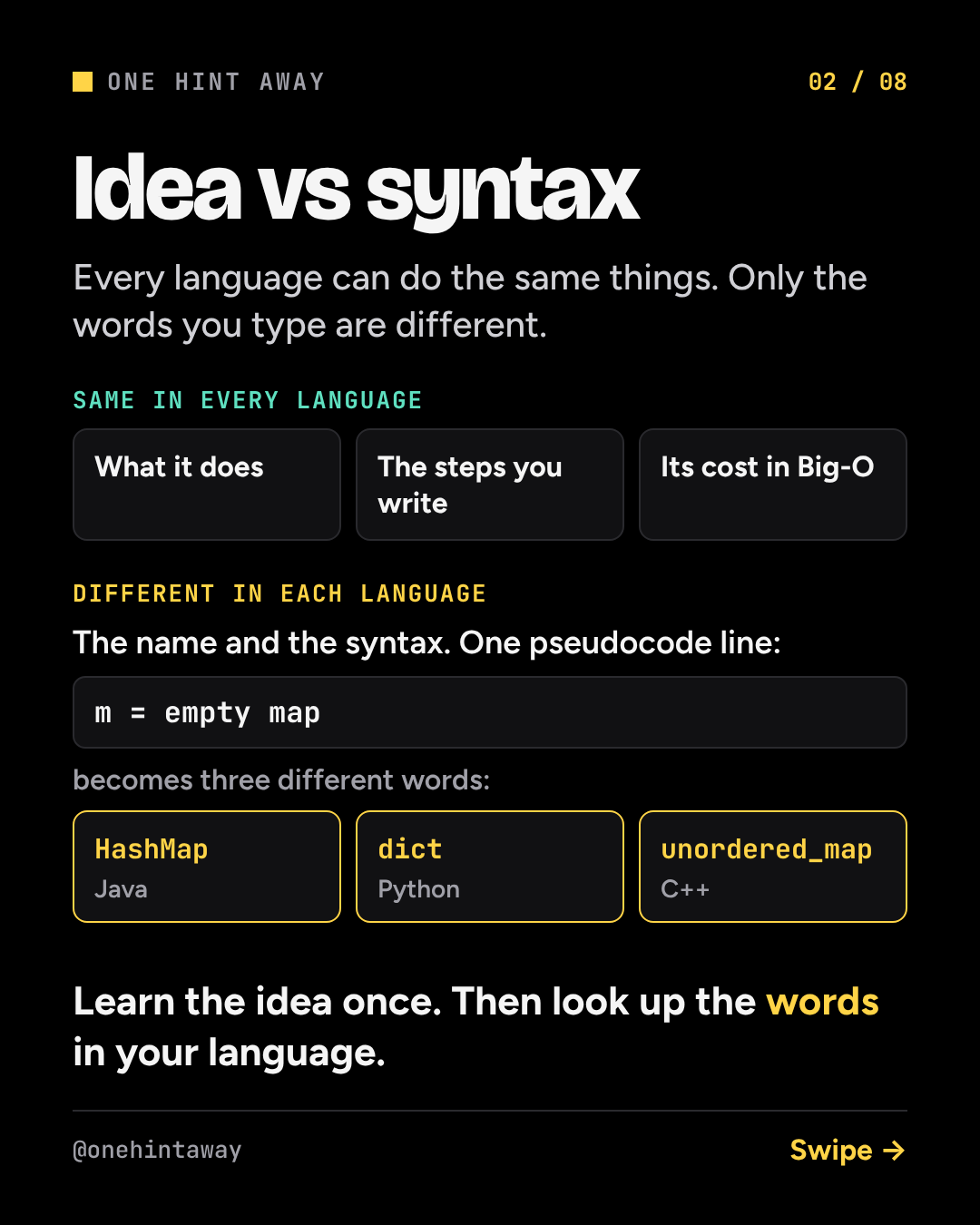
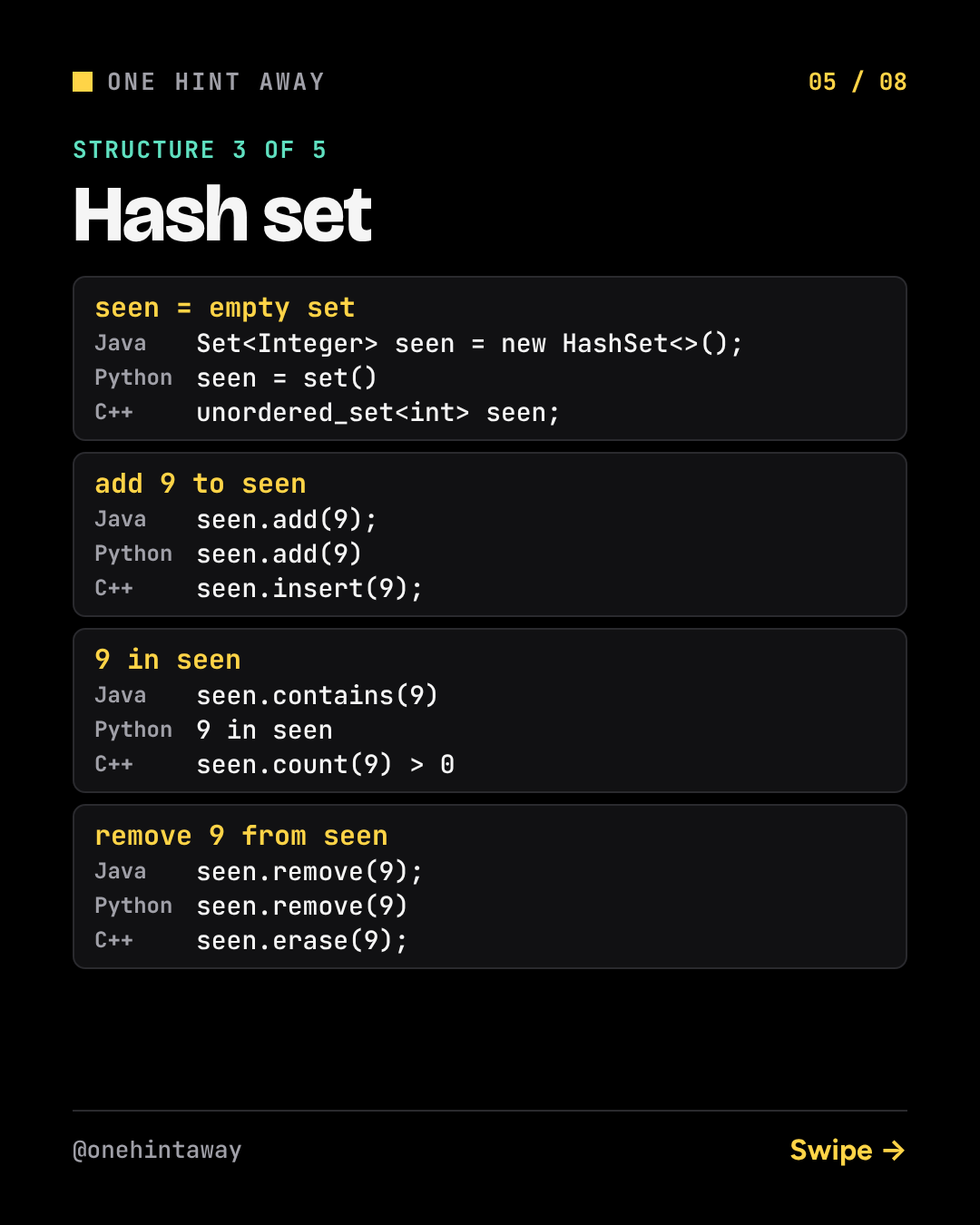
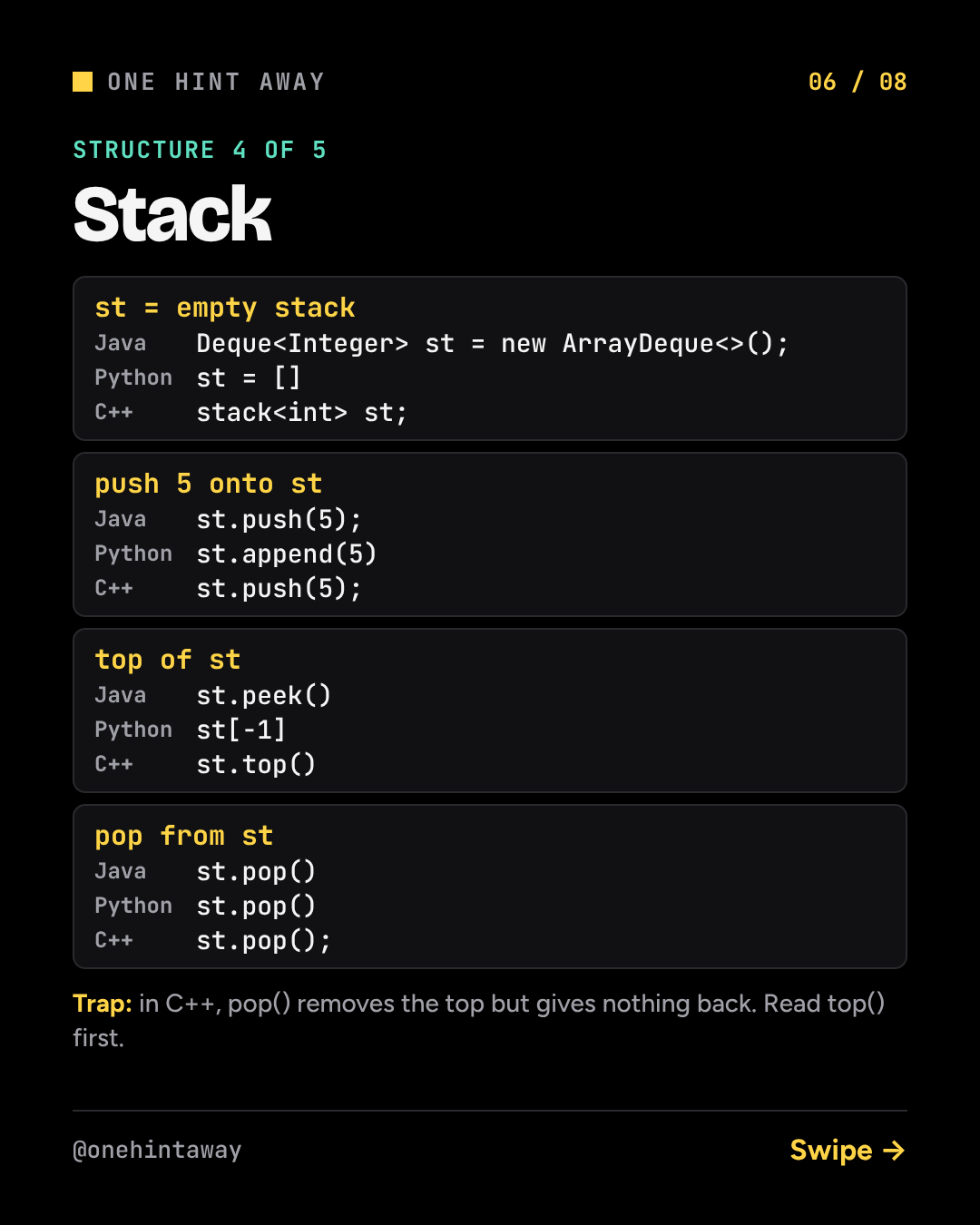
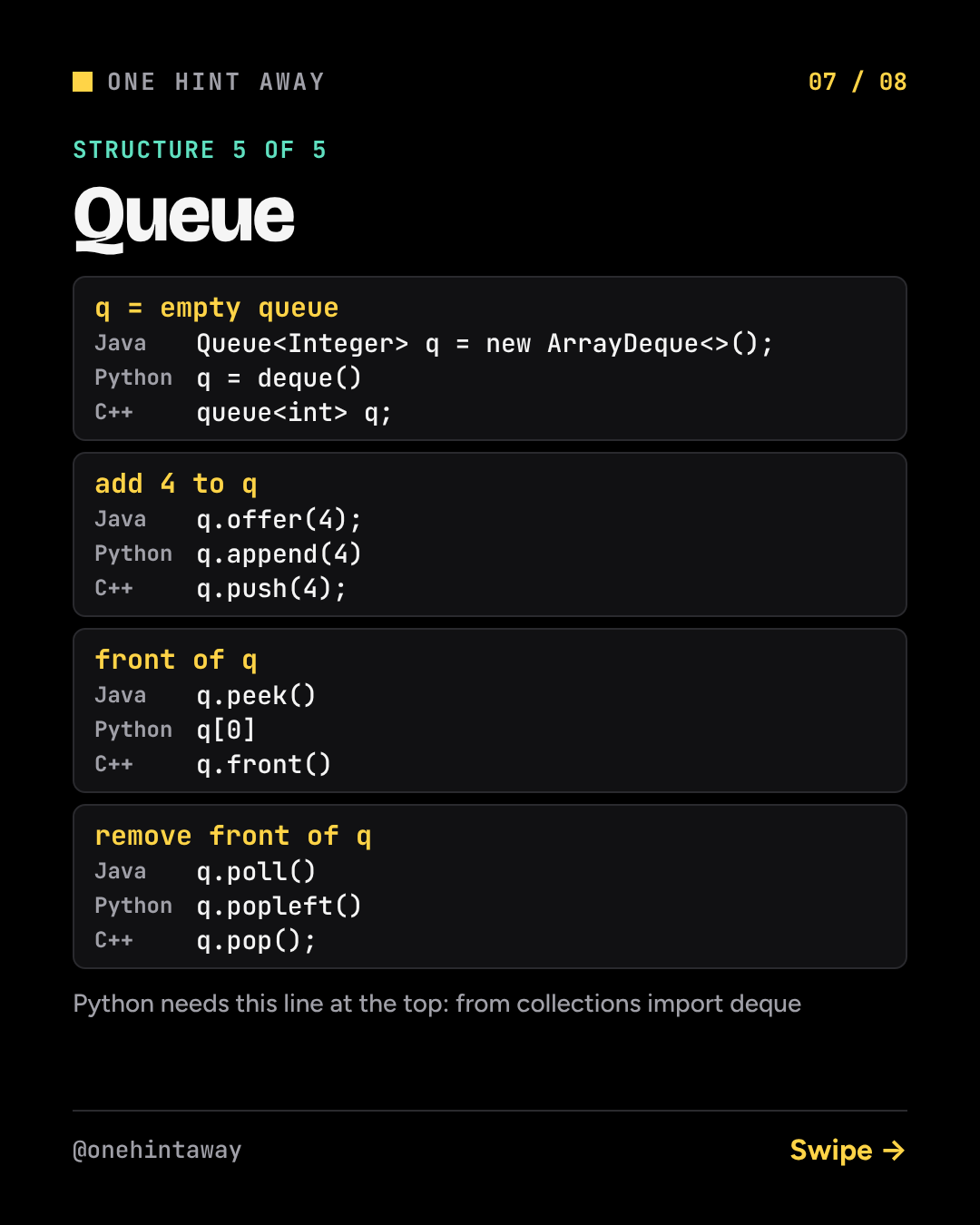
Every language can do the same things. Only the words you type are different. Learn the idea once in pseudocode, then look up the words in your language. The slides cover Java, Python and C++; JavaScript was added for the blog, so it appears here as a fourth column.
The idea
One pseudocode line, m = empty map, becomes HashMap in Java, dict in Python and unordered_map in C++ (and Map in JavaScript). What it does, the steps you write and its cost in Big-O stay the same in every language. Only the name and the syntax change. The dictionary below has every line you will type for the five structures.
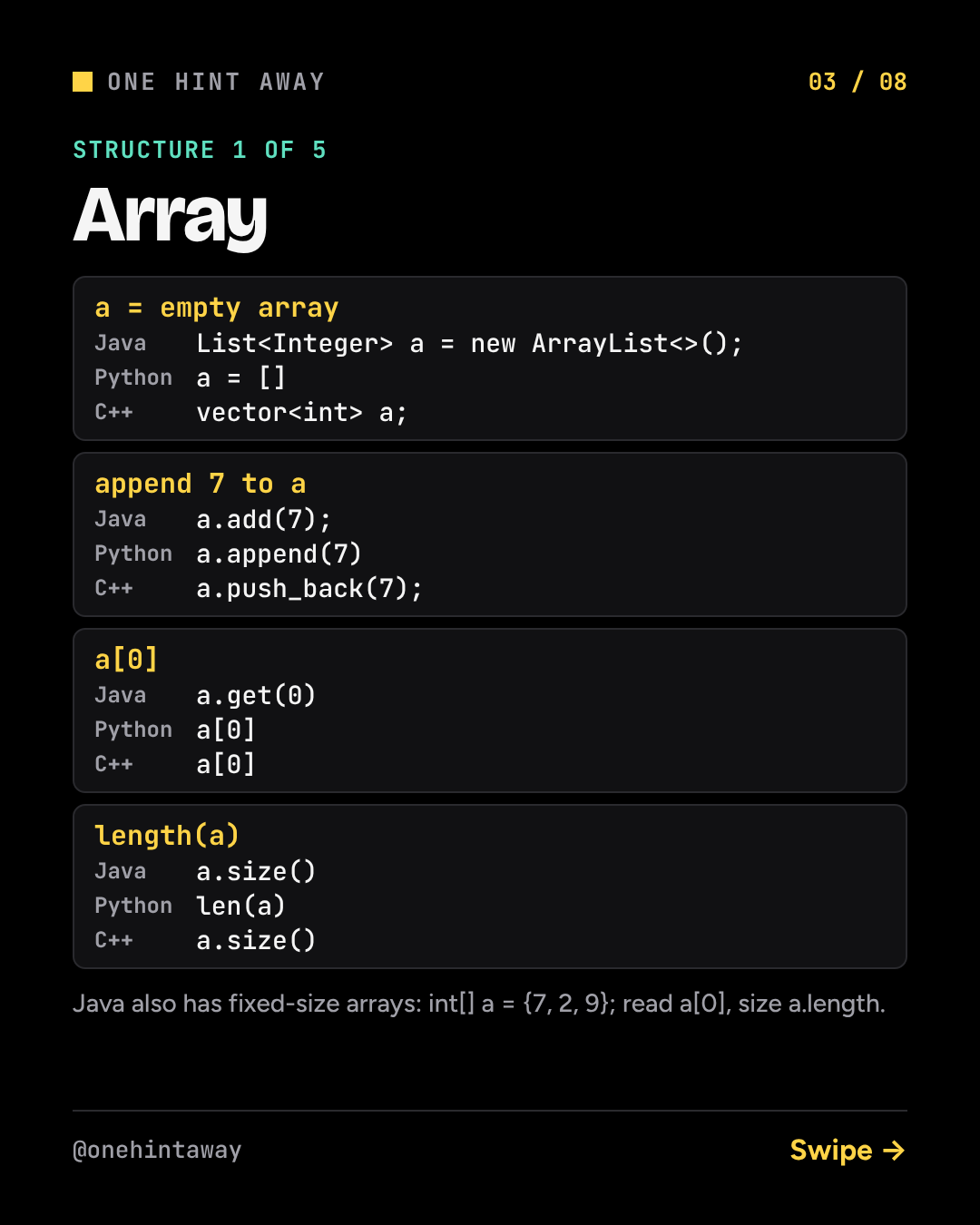
Array
| Pseudocode | Java | Python | C++ | JavaScript |
|---|---|---|---|---|
a = empty array | List<Integer> a = new ArrayList<>(); | a = [] | vector<int> a; | const a = []; |
append 7 to a | a.add(7); | a.append(7) | a.push_back(7); | a.push(7); |
a[0] | a.get(0) | a[0] | a[0] | a[0] |
length(a) | a.size() | len(a) | a.size() | a.length |
Java also has fixed-size arrays: int[] a = {7, 2, 9};, read with a[0], size with a.length. In JavaScript, every array grows as needed.
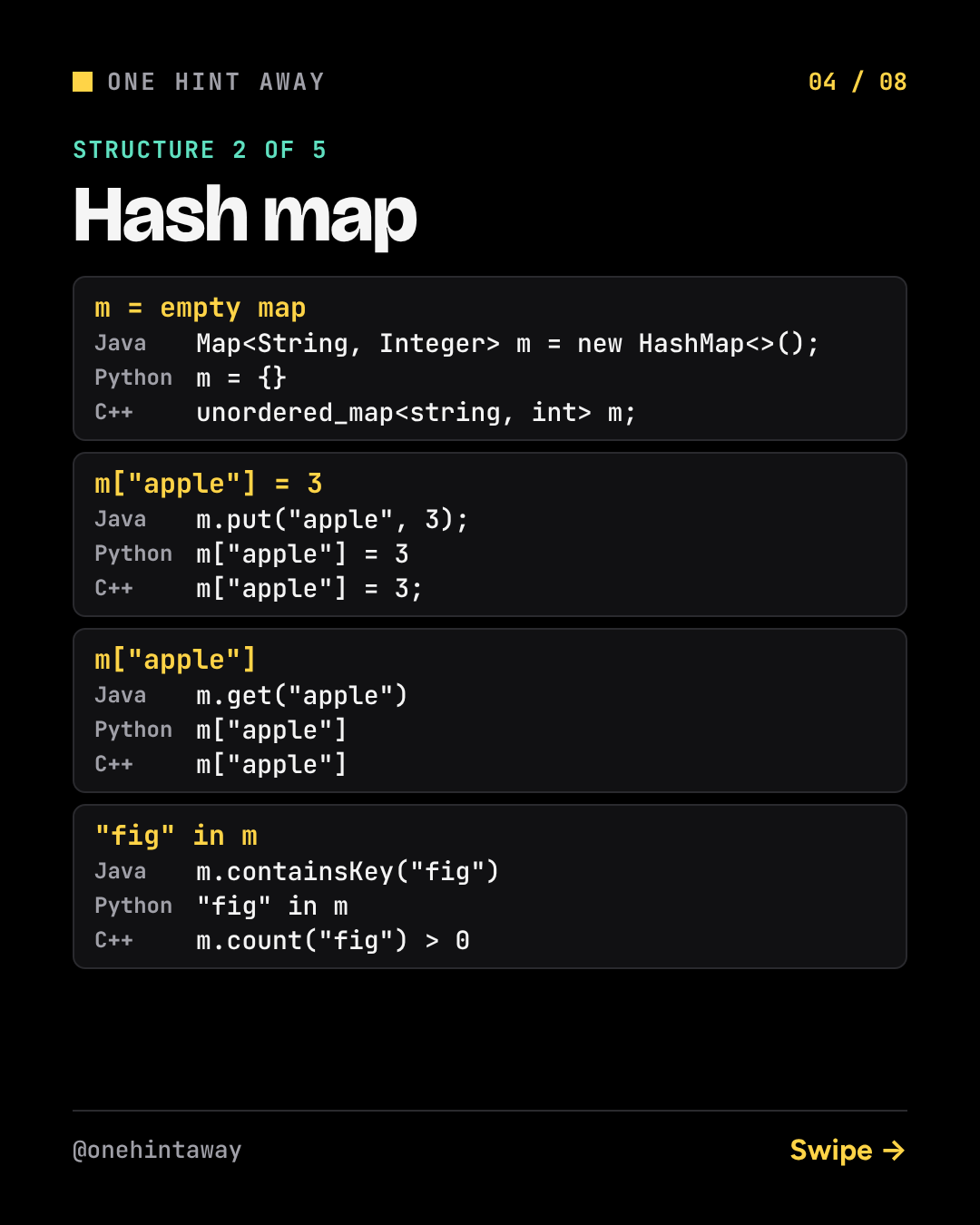
Hash map
| Pseudocode | Java | Python | C++ | JavaScript |
|---|---|---|---|---|
m = empty map | Map<String, Integer> m = new HashMap<>(); | m = {} | unordered_map<string, int> m; | const m = new Map(); |
m["apple"] = 3 | m.put("apple", 3); | m["apple"] = 3 | m["apple"] = 3; | m.set("apple", 3); |
m["apple"] | m.get("apple") | m["apple"] | m["apple"] | m.get("apple") |
"fig" in m | m.containsKey("fig") | "fig" in m | m.count("fig") > 0 | m.has("fig") |
In JavaScript, use Map rather than a plain object {}: a Map keeps keys of any type and has has() built in.
Hash set
| Pseudocode | Java | Python | C++ | JavaScript |
|---|---|---|---|---|
seen = empty set | Set<Integer> seen = new HashSet<>(); | seen = set() | unordered_set<int> seen; | const seen = new Set(); |
add 9 to seen | seen.add(9); | seen.add(9) | seen.insert(9); | seen.add(9); |
9 in seen | seen.contains(9) | 9 in seen | seen.count(9) > 0 | seen.has(9) |
remove 9 from seen | seen.remove(9); | seen.remove(9) | seen.erase(9); | seen.delete(9); |
Stack
| Pseudocode | Java | Python | C++ | JavaScript |
|---|---|---|---|---|
st = empty stack | Deque<Integer> st = new ArrayDeque<>(); | st = [] | stack<int> st; | const st = []; |
push 5 onto st | st.push(5); | st.append(5) | st.push(5); | st.push(5); |
top of st | st.peek() | st[-1] | st.top() | st[st.length - 1] |
pop from st | st.pop() | st.pop() | st.pop(); | st.pop() |
In C++, pop() removes the top but returns nothing, so read top() first.
Queue
| Pseudocode | Java | Python | C++ | JavaScript |
|---|---|---|---|---|
q = empty queue | Queue<Integer> q = new ArrayDeque<>(); | q = deque() | queue<int> q; | const q = []; let head = 0; |
add 4 to q | q.offer(4); | q.append(4) | q.push(4); | q.push(4); |
front of q | q.peek() | q[0] | q.front() | q[head] |
remove front of q | q.poll() | q.popleft() | q.pop(); | q[head++] |
Python needs from collections import deque at the top. In C++, pop() returns nothing here too, so read front() first.
JavaScript has no built-in queue. q.shift() removes the front but moves every other element, which is O(n). The array plus a head index keeps each step O(1): the front is q[head], and q[head++] reads it and moves past it.
Pseudocode
The program below runs every line of the dictionary once, so you can see each one work.
// array
a = empty array
append 7 to a
append 2 to a
a[0]                    // 7
length(a)               // 2

// hash map
m = empty map
m["apple"] = 3
m["apple"]              // 3
"fig" in m              // false

// hash set
seen = empty set
add 9 to seen
9 in seen               // true
remove 9 from seen
9 in seen               // false

// stack
st = empty stack
push 3 onto st
push 5 onto st
top of st               // 5
pop from st             // 5
top of st               // 3

// queue
q = empty queue
add 4 to q
add 7 to q
front of q              // 4
remove front of q       // 4
front of q              // 7
The trap: in C++, pop() removes the top of a stack (or the front of a queue) but gives nothing back. Read top() (or front()) first. In Java, Python and JavaScript, pop() returns the value it removes.
Code
import java.util.ArrayDeque;
import java.util.ArrayList;
import java.util.Deque;
import java.util.HashMap;
import java.util.HashSet;
import java.util.List;
import java.util.Map;
import java.util.Queue;
import java.util.Set;

public class ThreeLanguages {
    public static void main(String[] args) {
        // array
        List<Integer> a = new ArrayList<>();
        a.add(7);
        a.add(2);
        System.out.println(a.get(0));              // 7
        System.out.println(a.size());              // 2

        // hash map
        Map<String, Integer> m = new HashMap<>();
        m.put("apple", 3);
        System.out.println(m.get("apple"));        // 3
        System.out.println(m.containsKey("fig"));  // false

        // hash set
        Set<Integer> seen = new HashSet<>();
        seen.add(9);
        System.out.println(seen.contains(9));      // true
        seen.remove(9);
        System.out.println(seen.contains(9));      // false

        // stack
        Deque<Integer> st = new ArrayDeque<>();
        st.push(3);
        st.push(5);
        System.out.println(st.peek());             // 5
        System.out.println(st.pop());              // 5
        System.out.println(st.peek());             // 3

        // queue
        Queue<Integer> q = new ArrayDeque<>();
        q.offer(4);
        q.offer(7);
        System.out.println(q.peek());              // 4
        System.out.println(q.poll());              // 4
        System.out.println(q.peek());              // 7
    }
}
from collections import deque
# array
a = []
a.append(7)
a.append(2)
print(a[0]) # 7
print(len(a)) # 2
# hash map
m = {}
m["apple"] = 3
print(m["apple"]) # 3
print("fig" in m) # False
# hash set
seen = set()
seen.add(9)
print(9 in seen) # True
seen.remove(9)
print(9 in seen) # False
# stack
st = []
st.append(3)
st.append(5)
print(st[-1]) # 5
print(st.pop()) # 5
print(st[-1]) # 3
# queue
q = deque()
q.append(4)
q.append(7)
print(q[0]) # 4
print(q.popleft()) # 4
print(q[0]) # 7#include <iostream>
#include <queue>
#include <stack>
#include <string>
#include <unordered_map>
#include <unordered_set>
#include <vector>
using namespace std;
int main() {
cout << boolalpha;
// array
vector<int> a;
a.push_back(7);
a.push_back(2);
cout << a[0] << "\n"; // 7
cout << a.size() << "\n"; // 2
// hash map
unordered_map<string, int> m;
m["apple"] = 3;
cout << m["apple"] << "\n"; // 3
cout << (m.count("fig") > 0) << "\n"; // false
// hash set
unordered_set<int> seen;
seen.insert(9);
cout << (seen.count(9) > 0) << "\n"; // true
seen.erase(9);
cout << (seen.count(9) > 0) << "\n"; // false
// stack
stack<int> st;
st.push(3);
st.push(5);
cout << st.top() << "\n"; // 5
int popped = st.top(); // read first,
st.pop(); // then remove
cout << popped << "\n"; // 5
cout << st.top() << "\n"; // 3
// queue
queue<int> q;
q.push(4);
q.push(7);
cout << q.front() << "\n"; // 4
int removed = q.front(); // read first,
q.pop(); // then remove
cout << removed << "\n"; // 4
cout << q.front() << "\n"; // 7
}// array
const a = [];
a.push(7);
a.push(2);
console.log(a[0]); // 7
console.log(a.length); // 2
// hash map
const m = new Map();
m.set("apple", 3);
console.log(m.get("apple")); // 3
console.log(m.has("fig")); // false
// hash set
const seen = new Set();
seen.add(9);
console.log(seen.has(9)); // true
seen.delete(9);
console.log(seen.has(9)); // false
// stack
const st = [];
st.push(3);
st.push(5);
console.log(st[st.length - 1]); // 5
console.log(st.pop()); // 5
console.log(st[st.length - 1]); // 3
// queue (array + head index)
const q = [];
let head = 0;
q.push(4);
q.push(7);
console.log(q[head]); // 4
console.log(q[head++]); // 4
console.log(q[head]); // 7Complexity
Every operation in the tables above is O(1), on average for the hash map and hash set, and amortised for appending to an array. The JavaScript queue is O(1) per step only with the head index; shift() is O(n).
How it was tested
All four programs were compiled and run, and each printed the same twelve values: 7, 2, 3, false, true, false, 5, 5, 3, 4, 4, 7, matching the comments in the pseudocode (Python writes False and True with capitals).
Practice
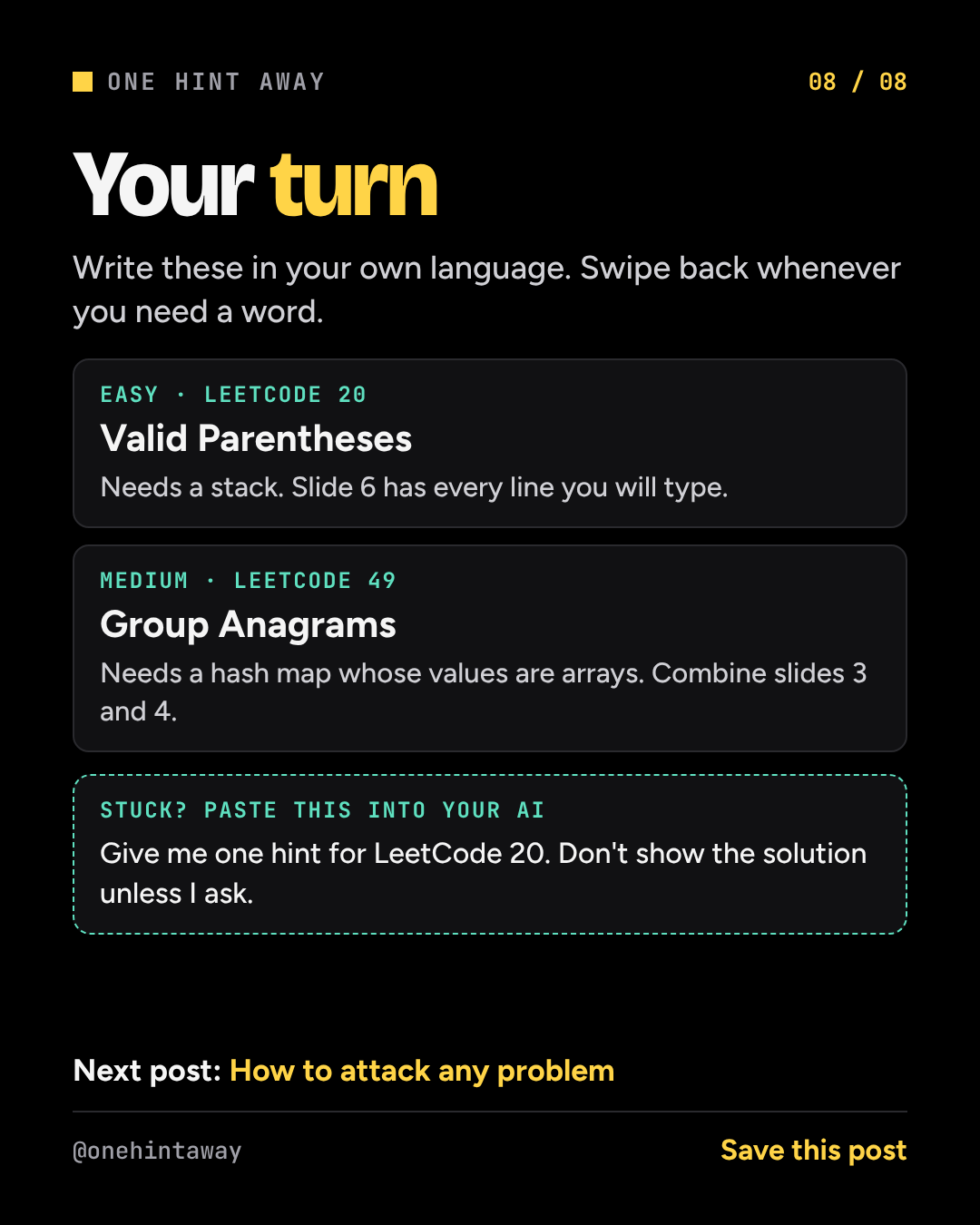
Try these in order. Open the worked example first if you got stuck on the slides.
Needs a stack. Slide 6 has every line you will type.
Needs a hash map whose values are arrays. Combine slides 3 and 4.