21RecursionRecursion and sorting
Recursion
A problem that holds a smaller copy of itself: answer the tiny case directly, call yourself on a smaller input, and let the call stack wait.
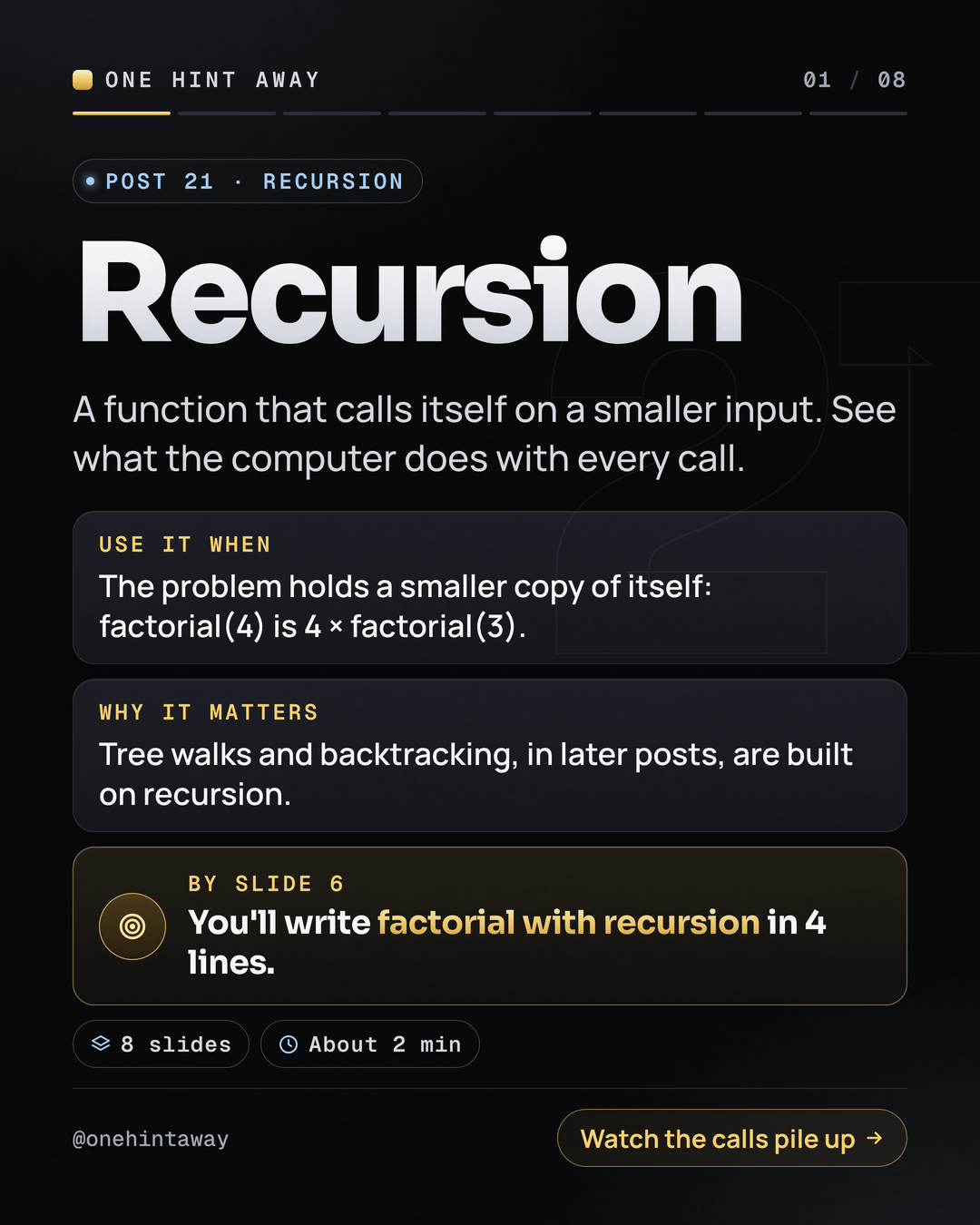
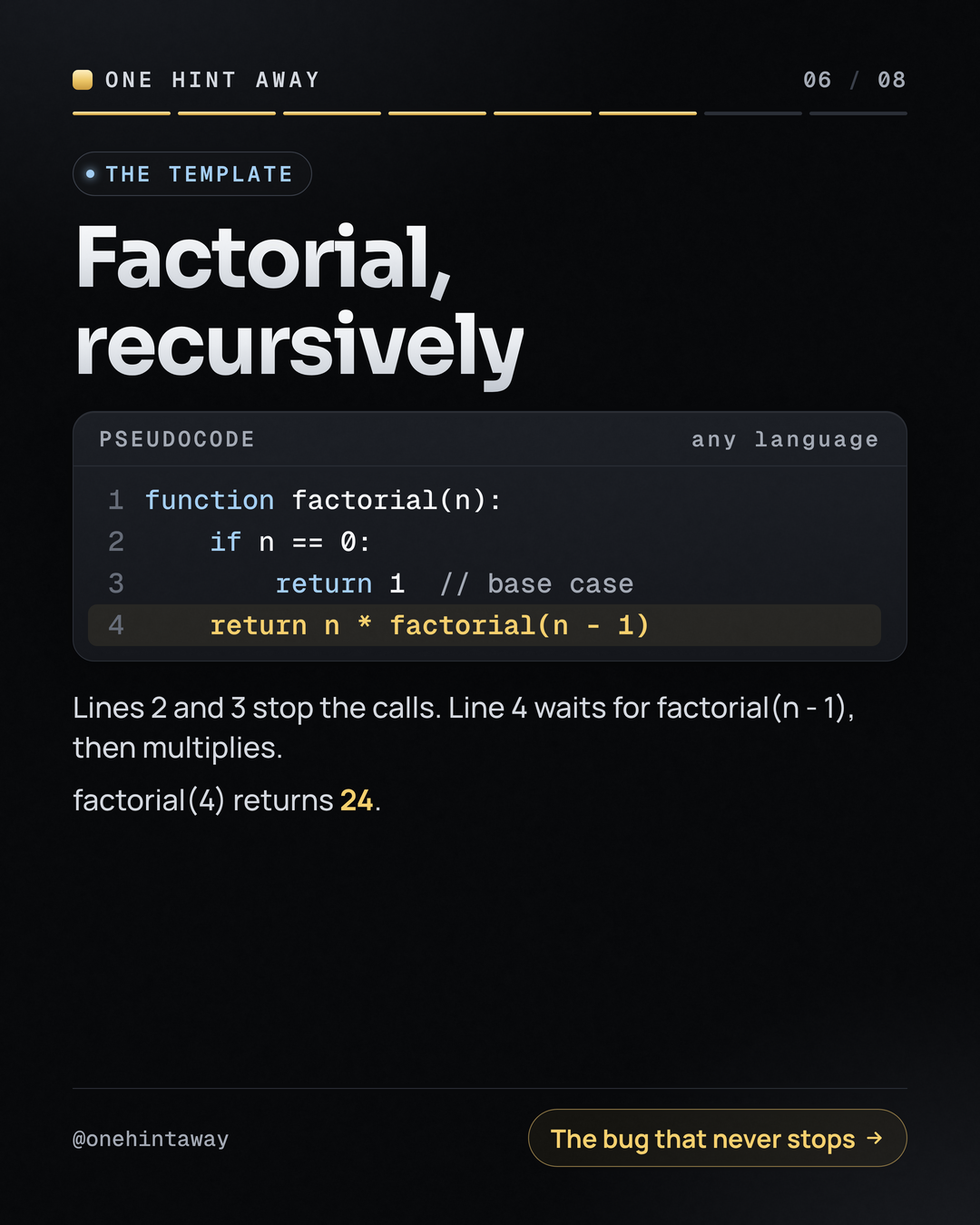
A problem that holds a smaller copy of itself, like factorial(4) = 4 × factorial(3), is a job for recursion. Worked example: factorial(4) = 24, followed call by call.
The idea
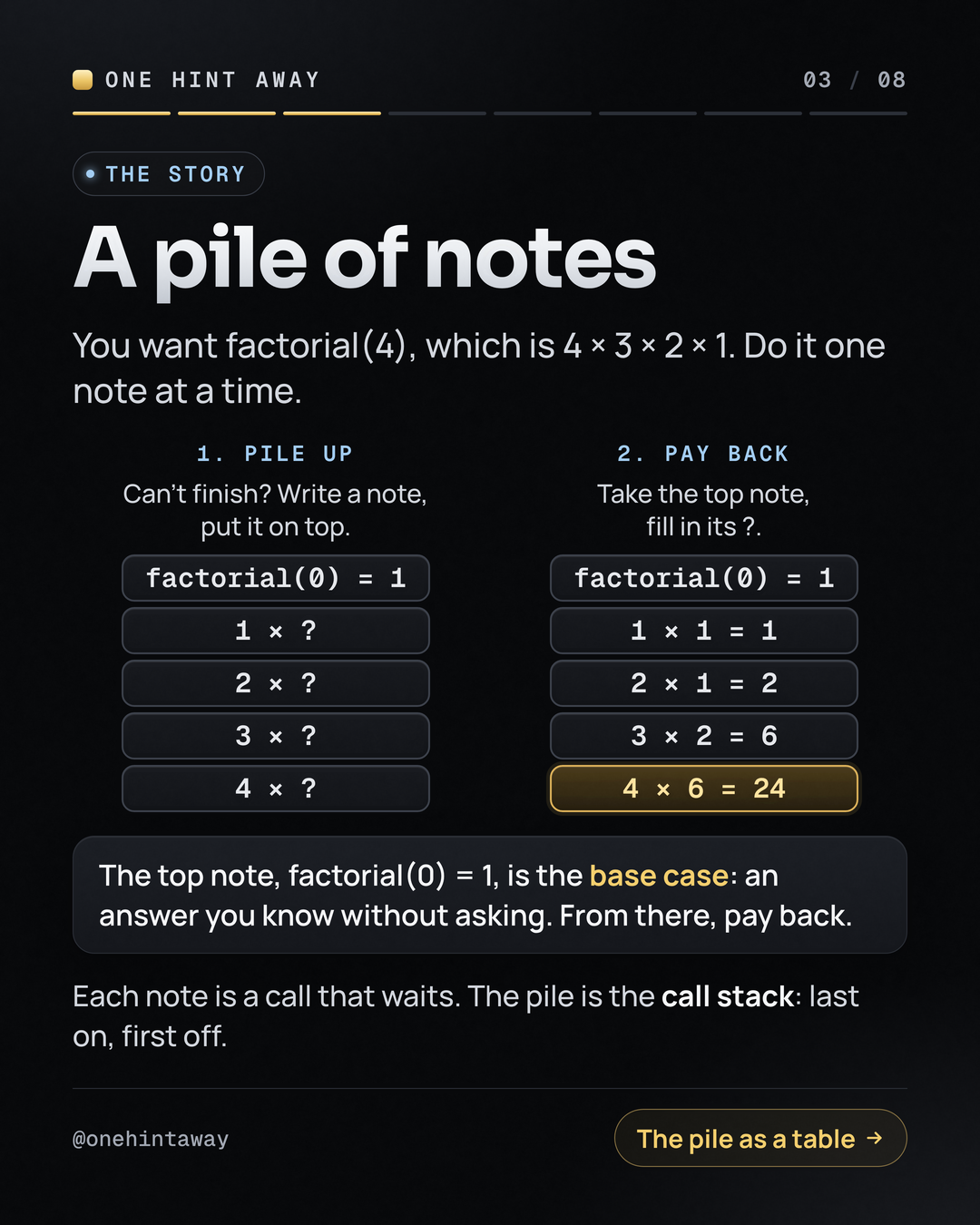
Picture working out factorial(4) with sticky notes. You can't finish 4 × ? yet, so you write it on a note and put it on a pile. Then 3 × ?, 2 × ? and 1 × ? go on top. The top note, factorial(0) = 1, is the base case: an answer you know without asking. From there you pay back: take the top note off, fill in its ? with the answer you just got, and pass the result to the note below.
That pile is the call stack. Each note is a call to factorial that is waiting for a smaller call to return. The last call in is the first one out, which is why the answers come back in reverse order: 1, 1, 2, 6, 24.
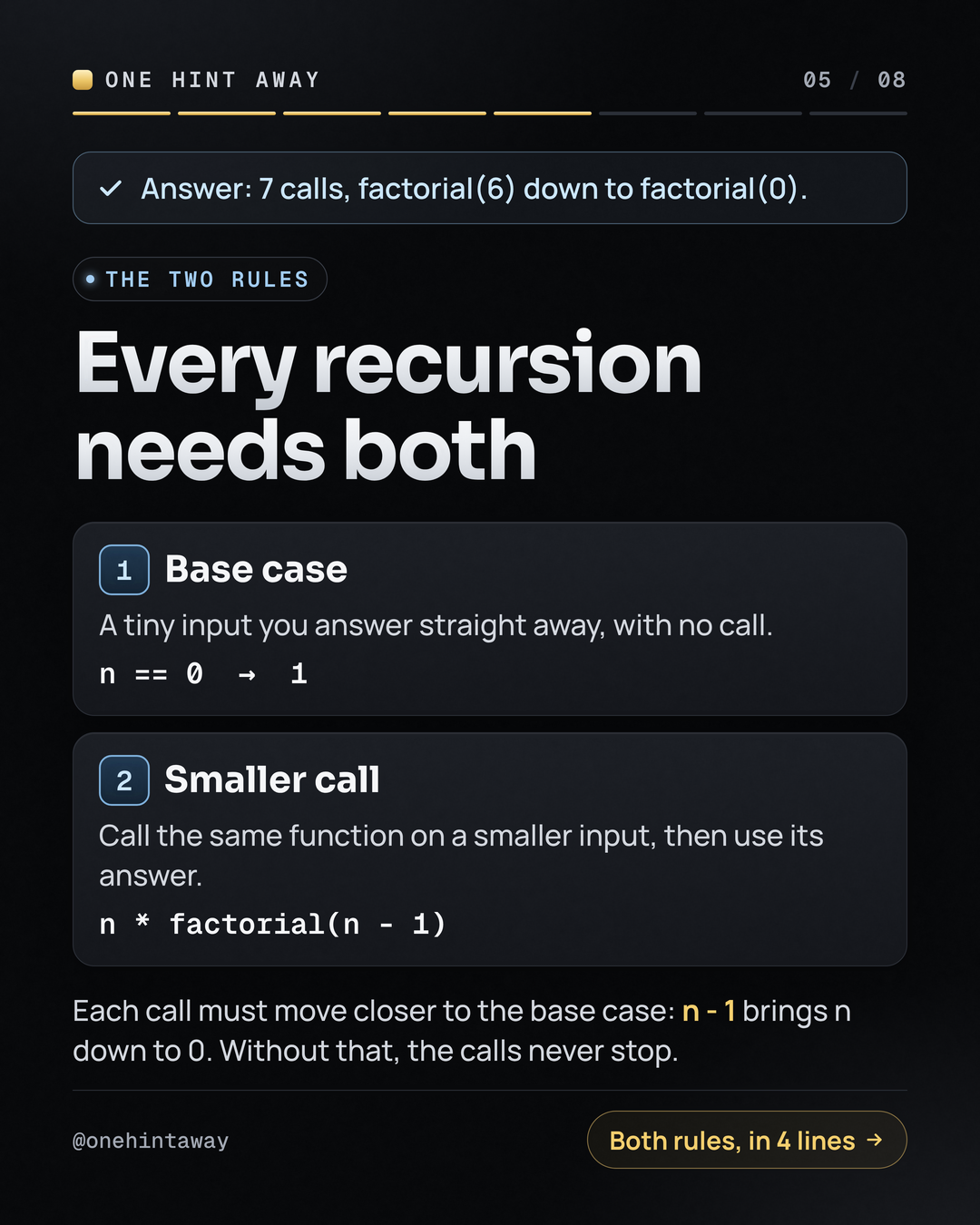
Every recursion needs two things: a base case it answers straight away, and a smaller call that moves closer to that base case each time. Here n - 1 brings n down to 0.
The walk
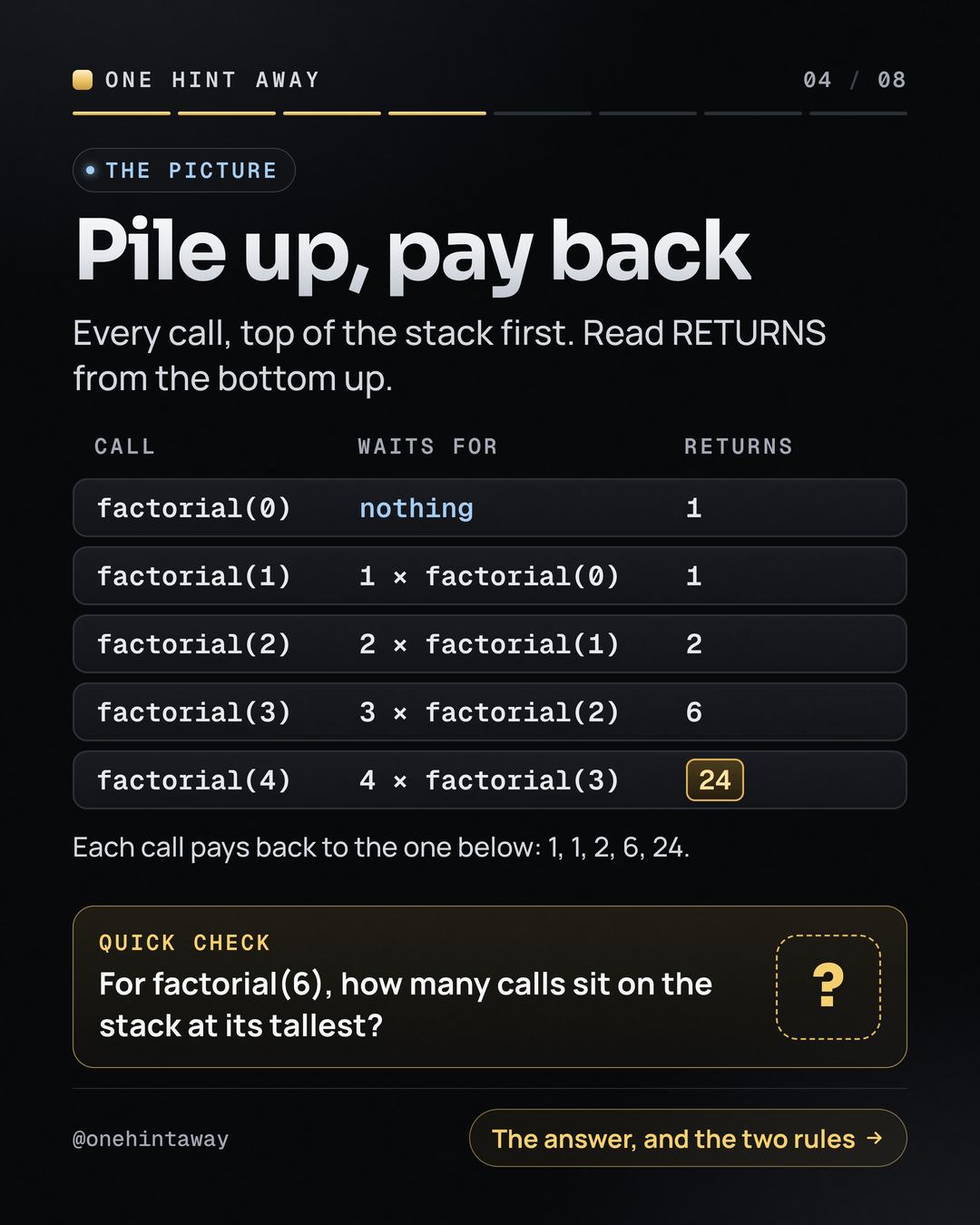
The stack at its tallest, top first. Read the RETURNS column from the bottom up to see the order the answers arrive.
| Call | Waits for | Returns |
|---|---|---|
| factorial(0) | nothing (base case) | 1 |
| factorial(1) | 1 × factorial(0) | 1 × 1 = 1 |
| factorial(2) | 2 × factorial(1) | 2 × 1 = 2 |
| factorial(3) | 3 × factorial(2) | 3 × 2 = 6 |
| factorial(4) | 4 × factorial(3) | 4 × 6 = 24 |
For factorial(4) the stack holds 5 calls at once. Quick check: for factorial(6), how many calls sit on the stack at its tallest? Answer: 7, factorial(6) down to factorial(0).
Pseudocode
function factorial(n):
    if n == 0:
        return 1  // base case
    return n * factorial(n - 1)
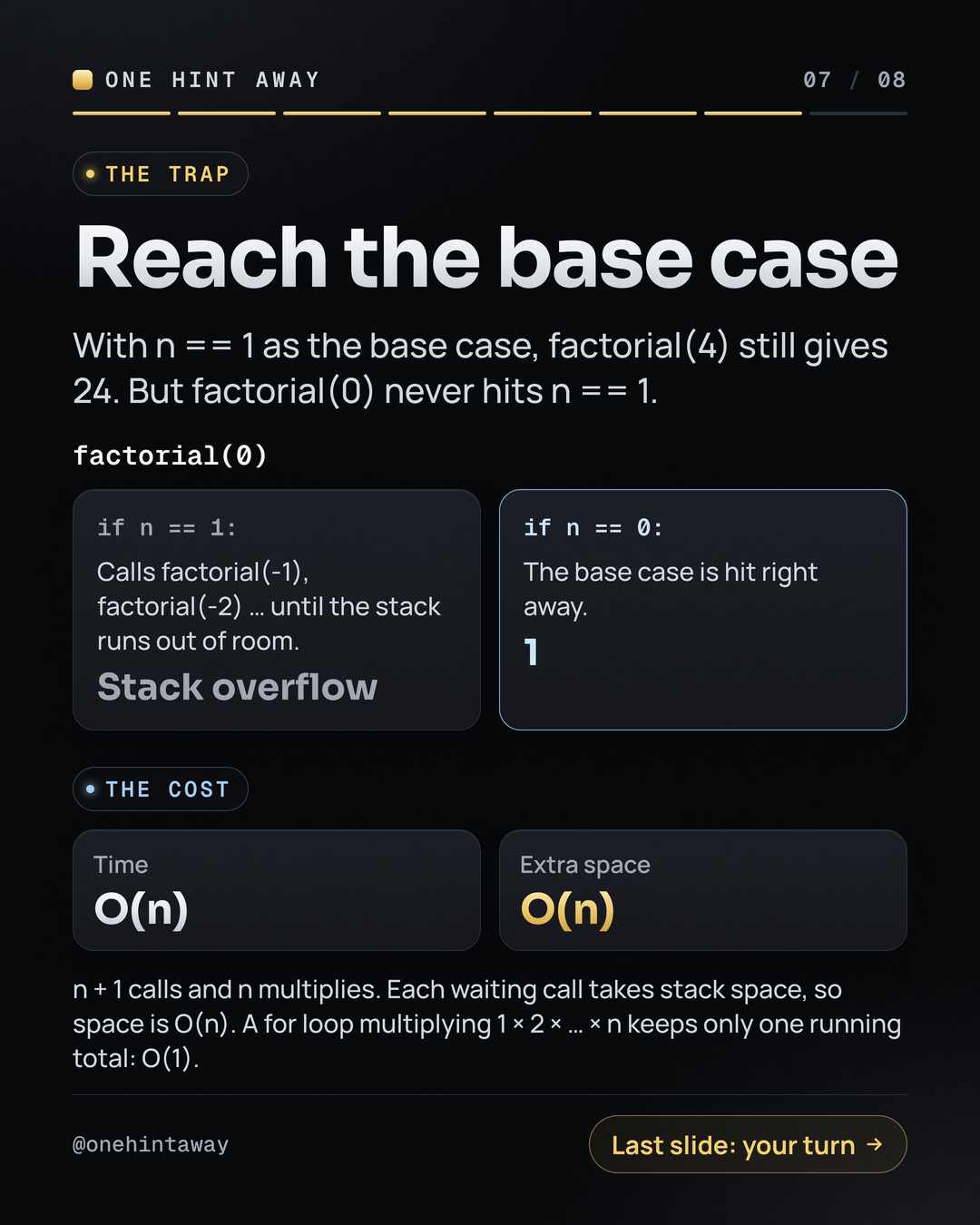
The trap: a base case the input can skip. With if n == 1 as the base case, factorial(4) still returns 24, but factorial(0) calls factorial(-1), factorial(-2) and so on until the stack runs out of room and it ends in a stack overflow. With if n == 0, factorial(0) returns 1 straight away.
Code
class Solution {
    public long factorial(int n) {
        if (n == 0) {
            return 1;            // base case
        }
        return n * factorial(n - 1);
    }
}
class Solution:
def factorial(self, n: int) -> int:
if n == 0:
return 1 # base case
return n * self.factorial(n - 1)class Solution {
public:
long long factorial(int n) {
if (n == 0) {
return 1; // base case
}
return n * factorial(n - 1);
}
};function factorial(n) {
if (n === 0n) {
return 1n; // base case (BigInt: exact past 2^53)
}
return n * factorial(n - 1n);
}Java long and C++ long long hold factorial(n) exactly up to n = 20; factorial(21) overflows 64 bits. Python integers have no limit. The JavaScript version uses BigInt, so call it as factorial(4n).
Complexity
- Time: O(n). There are n + 1 calls and n multiplies.
- Extra space: O(n). Up to n + 1 calls wait on the call stack at once. A for loop multiplying 1 × 2 × … × n keeps only one running total, so it needs O(1).
How it was tested
The Java, Python, C++ and JavaScript solutions were run on 1,021 inputs (every n from 0 to 20, plus 1,000 random n in that range) and every output matched a loop-based brute force. The call order and the returns 1, 1, 2, 6, 24 came from an instrumented run of factorial(4), and a second instrumented run of factorial(6) peaked at 7 calls on the stack. The trap was run in all four languages: factorial(4) gave 24 each time, and factorial(0) never stopped until it hit the stack limit (StackOverflowError in Java, RecursionError in Python, RangeError in JavaScript, a segmentation fault in C++).
Practice
Try these in order. Open the worked example first if you got stuck on the slides.
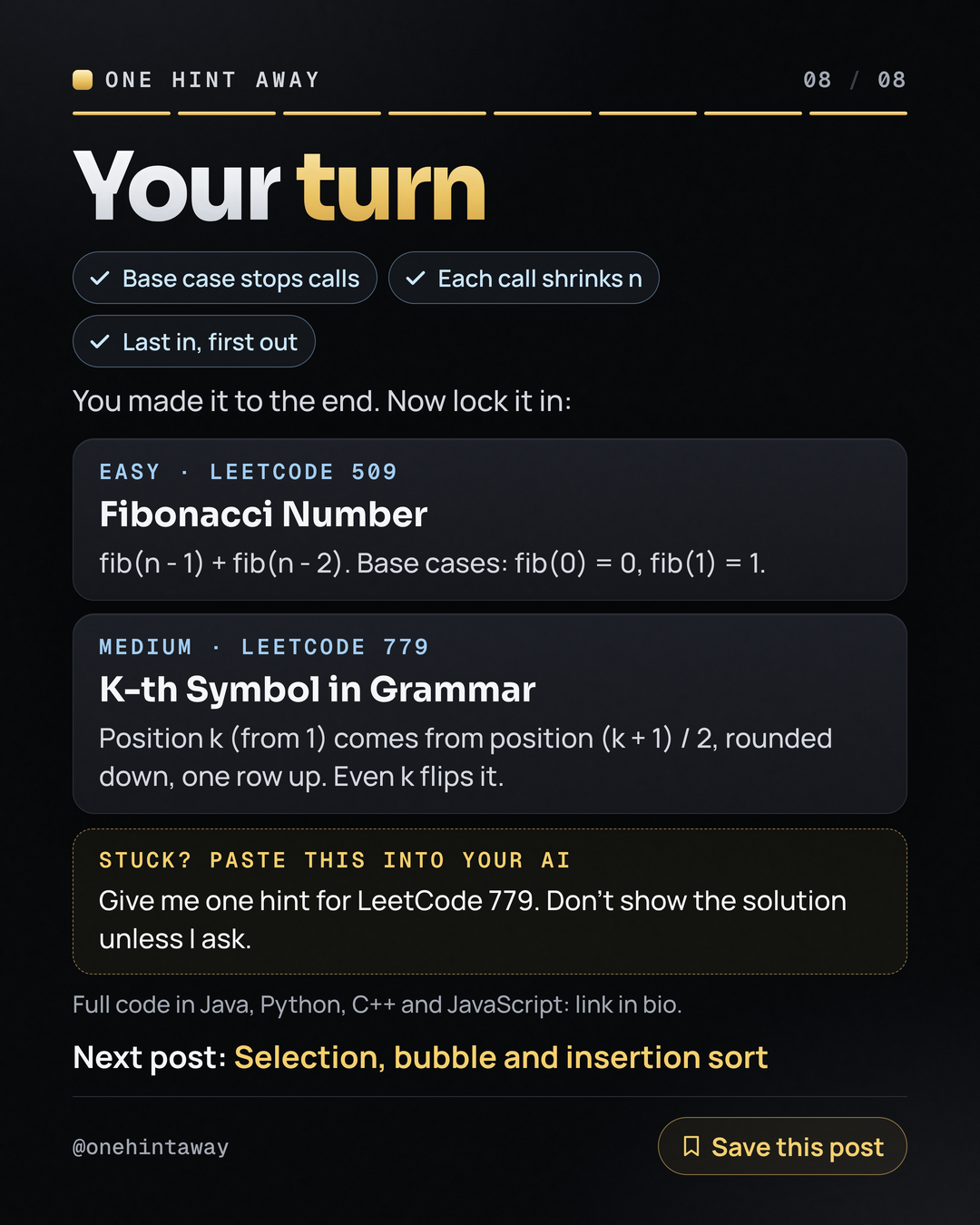
fib(n - 1) + fib(n - 2). Base cases: fib(0) = 0, fib(1) = 1.
Position k (from 1) comes from position (k + 1) / 2, rounded down, one row up. Even k flips it.